
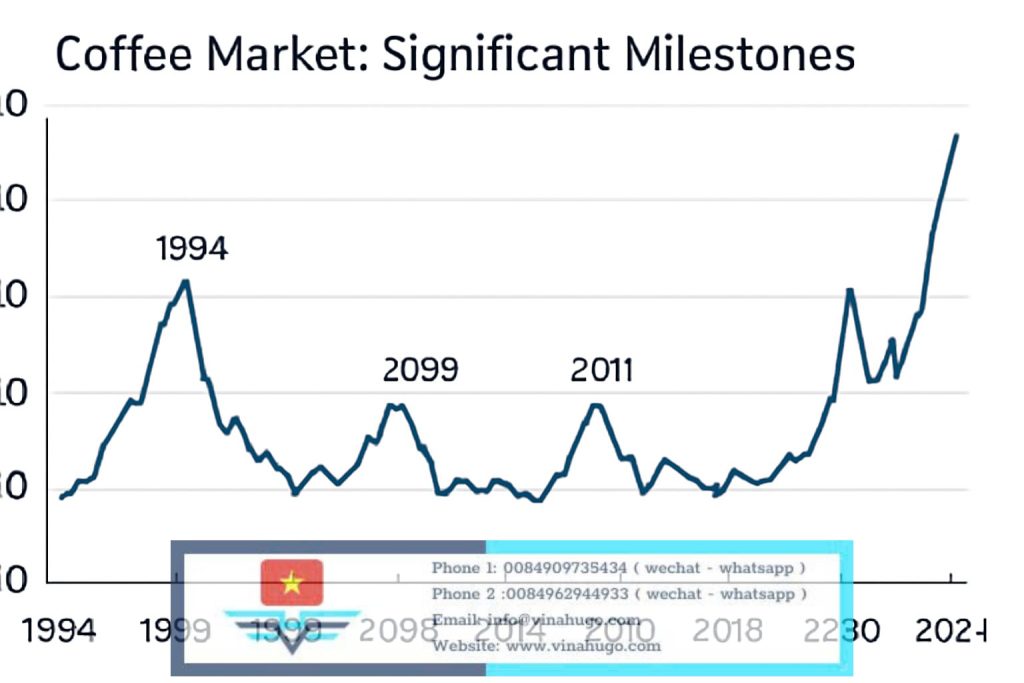
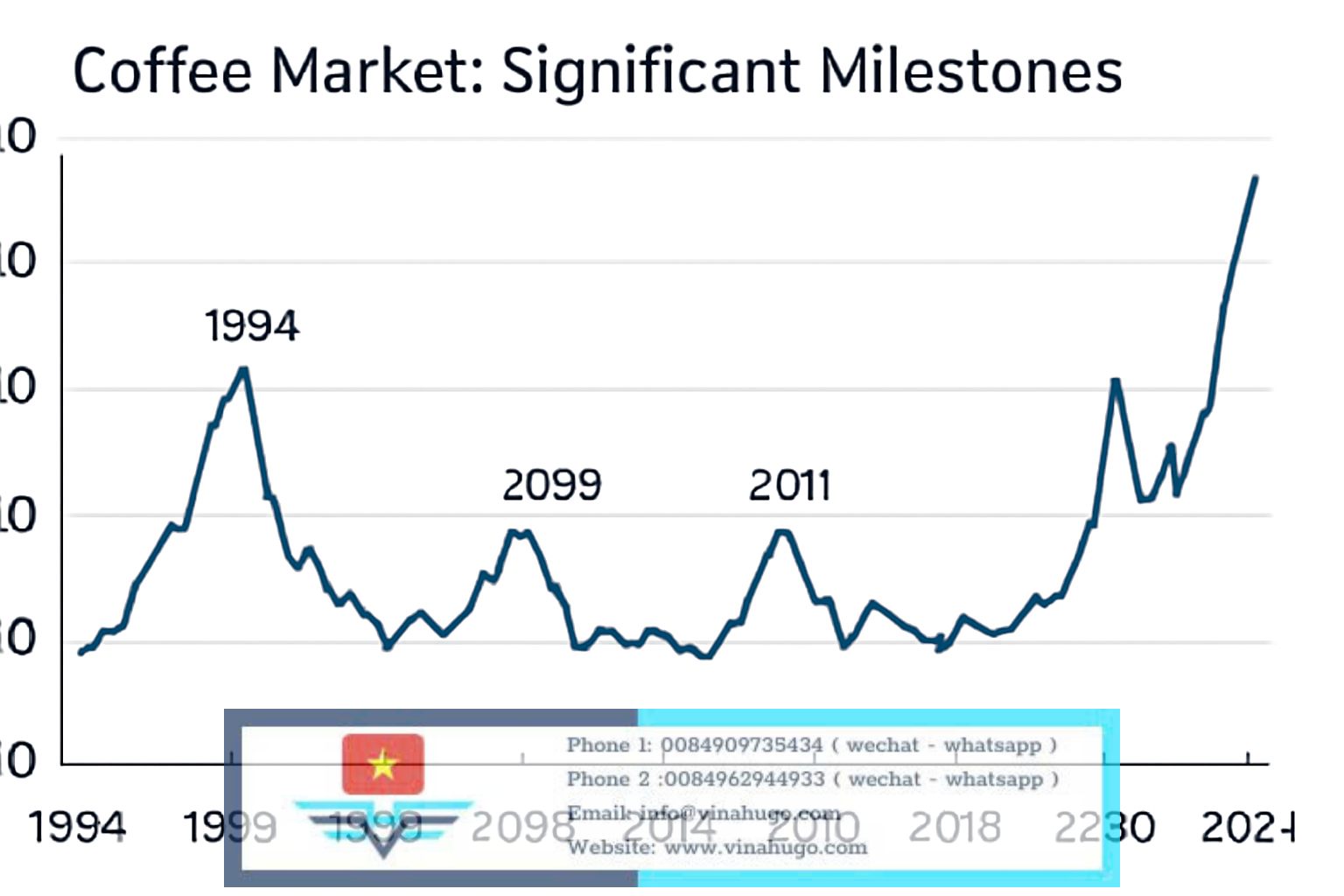
To give an overview of the significant moments when coffee prices surged to create historical milestones, Nguyễn Hằng provides the following article for readers.
It has been a long time since coffee growers, traders, and companies in Vietnam have had such a joyful harvest season. Since the harvest season ended, the market has surpassed the previous precedent of “good harvest, bad prices” to maintain a continuous upward trend, leaving behind historical price milestones.
However, in the past two days, the price has sharply decreased, reminding us of the market stories of 1994 and 2008.
1994
Table of Contents
In early June 1994, coffee prices in the global market rose sharply due to concerns over low yields. On June 8th, Robusta coffee price in London hit $3,150/ton — the highest at that time and even until today.
In the domestic market, the competition between companies and traders in various provinces led to continuous fluctuations in the price of coffee, changing 2-3 times a day, and pushed the price to a sky-high 43 million VND/ton. However, this record lasted only for a brief 150 minutes before dropping to 39 million VND/ton, with no one buying. The market froze for three days, and when prices were seen again, they had dropped to 36 million VND/ton, and then gradually fell.
However, this decline only lasted until the end of August. The price spiked again in September when news came of Brazil being hit by its first frost of the year, which severely affected the coffee crop, and the next year’s output might only be 50% of the projected amount.
Domestic coffee prices rose again, and once again reached 43 million VND/ton, with some regions even seeing prices of 45 million VND/ton. However, after September, both global and domestic coffee prices began to fall, partly due to the increased production after high prices encouraged more coffee cultivation.
2008
It wasn’t until early March 2008 that coffee prices rebounded strongly, surpassing $2,700/ton in the global market, and reaching 40.1 million VND/ton in the domestic market on March 3rd.
Recall that year, just like the end of 2010, the coffee harvest in Vietnam was expected to drop significantly, with some regions reporting losses of up to 40%, others at 20%-30%, and overall production in Vietnam expected to decrease by 30%.
The news of the poor harvests in Vietnam, along with those in Colombia and Brazil, drove global coffee prices up to their highest levels since 1994, even during Vietnam’s Lunar New Year holiday.
The market also recorded March 14th as an unforgettable lesson, with many calling it “Black Friday” for coffee traders on the London market. Specifically, in the previous two trading sessions, coffee prices had risen by over $150/ton. The market was widely praised for its strong performance. However, with such a sudden rise, traders and speculators quickly sold off their positions, causing coffee prices to drop by $127/ton on March 14th, with a price gap of $179/ton between the high and low prices. In the domestic market, coffee prices on March 15th fell to 37.5 million VND/ton, dropping 1.5 million VND from the previous day.
Just like 14 years ago, the coffee market fell for a few months, but it rebounded strongly in July 2008, again surpassing $2,400/ton, and remained above $2,000/ton until the end of September.
2011
Both the global and domestic coffee markets experienced significant volatility in this year, with prices breaking several records. The global coffee price surpassed $2,500/ton for the first time since March 2008, while domestic prices went over 49 million VND/ton. Compared to the previous year, coffee prices had more than doubled. Compared to the beginning of 2011, excluding the sharp declines on March 10th and 11th, Robusta coffee prices had risen by more than 20%.
However, the heat in the coffee market has cooled down since it reached a record high on March 9th globally and March 10th domestically. Global coffee prices fell sharply in the last two trading sessions, losing $136/ton after a rise of $154/ton in the previous two sessions.
Domestic coffee prices, after hitting a record high of 49 million VND/ton on March 10th, quickly dropped as traders refused to buy at the May futures price, calculating the March futures price with a much smaller increase — only under $20. As of now, the price of coffee in Vietnam has fallen to 45.4 million VND/ton.
What happened in the past two sessions this year mirrors scenarios from 2008 and 1994, due to profit-taking and liquidation by investors, along with price manipulation and the reluctance of domestic companies and traders to buy at high prices.
2024
2024 is perhaps the most volatile year in the history of the Vietnamese coffee market and the world.
Robusta coffee prices traded on the London market have surpassed the historical levels set in September 1994. On April 25th, 2024, the price of Robusta coffee reached $4,574/ton, with domestic coffee prices also reaching a historic level of 132,000 VND/kg. The price of coffee in Vietnam continued to surge, exceeding 134,000 VND/kg in the following days.
However, this historic price did not last long. After the long holiday celebrating Vietnam’s Reunification Day and International Labor Day, both domestic and global coffee prices plummeted sharply. Robusta coffee prices on the London market dropped more than $800/ton in just five trading sessions. Prices in the Vietnamese domestic market also dropped drastically, with coffee prices suddenly falling from 134,000 VND/kg to around 100,000 VND/kg within just five days.