
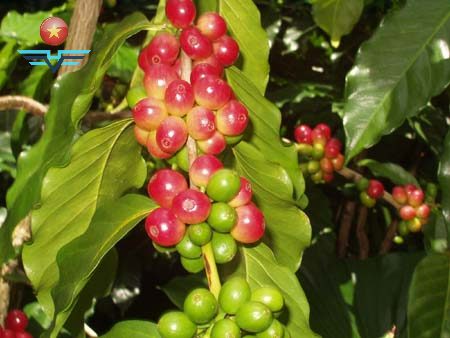
Every year, Vietnam produces about 850,000 tons of coffee, with nearly half of that—around 340,000–350,000 tons—consisting of byproducts, mainly the coffee pulp.
Most of this discarded coffee pulp from export processing plants is dumped directly into rivers, streams, ponds, and lakes, causing serious environmental pollution and threatening the health of both workers and surrounding communities.
To address this problem while making use of a nutrient-rich material for livestock feed, after many years of research in coffee-growing and processing areas, a team from the Institute of Agricultural Electromechanics and Post-Harvest Technology, led by Associate Professor Dr. Nguyễn Thùy Châu, has recently completed a pilot project titled “Industrial-Scale Production of Fermented Coffee Pulp as Livestock Feed.”
Dr. Châu explained that the project, with a capacity of 5 tons per day, was implemented at Ea Pok Coffee Company in Đắk Lắk province, based on results from a previous national-level scientific research project: “Technology for Producing Fermented Coffee Pulp for Animal Feed,” which had already been reviewed and highly evaluated.
To produce fermented coffee pulp as livestock feed, the project used both naturally occurring and selectively cultured microorganisms to remove tannins and caffeine while creating the enzymes cellulase and pectinase in the coffee pulp medium enriched with additional nutrients.
The enzyme pectinase hydrolyzes the pectin in the coffee pulp into oligogalacturonides, which serve as a nutrient source for beneficial gut microorganisms in livestock. The fermented coffee pulp product contains tannin and caffeine levels below permissible limits and has a high protein content suitable for use as feed for livestock and fish.
The production process for fermented coffee pulp animal feed includes these steps:
-
Tannin removal: Using naturally occurring Bacillus subtilis bacteria present in the coffee pulp. The pulp is turned once daily for 7–8 days.
-
Caffeine removal: Using a selected strain of Aspergillus niger with caffeine-degrading activity, which also produces the enzymes cellulase and pectinase.
-
Fermentation: The coffee pulp is then fermented anaerobically with the selected Aspergillus niger strain in plastic bags for 9–10 days.
The resulting product is bright yellow, pleasantly aromatic, and free from bitter or astringent taste. Its nutrient composition (based on dry matter) includes: total protein 19–21%, total sugars 3.8–4.5%, caffeine 0.07%, and tannin 0.85%.
Trials conducted at the Ea Pok beef cattle farm in Đắk Lắk showed that fermented coffee pulp could replace 30% of the concentrate feed in daily rations without affecting growth and development. In addition, trials using the fermented pulp as feed for fish—such as silver carp, common carp, grass carp, and tilapia—in a 500 m² mixed pond at the Ea Tam freshwater fish hatchery in Buôn Ma Thuột city also yielded promising results.
Based on these findings, scientists from the Institute of Agricultural Electromechanics and Post-Harvest Technology recommend that animal feed producers and farmers in coffee-growing regions use fermented coffee pulp as a supplementary feed ingredient. This approach helps reduce feed costs, increases income, and effectively minimizes local environmental pollution.