
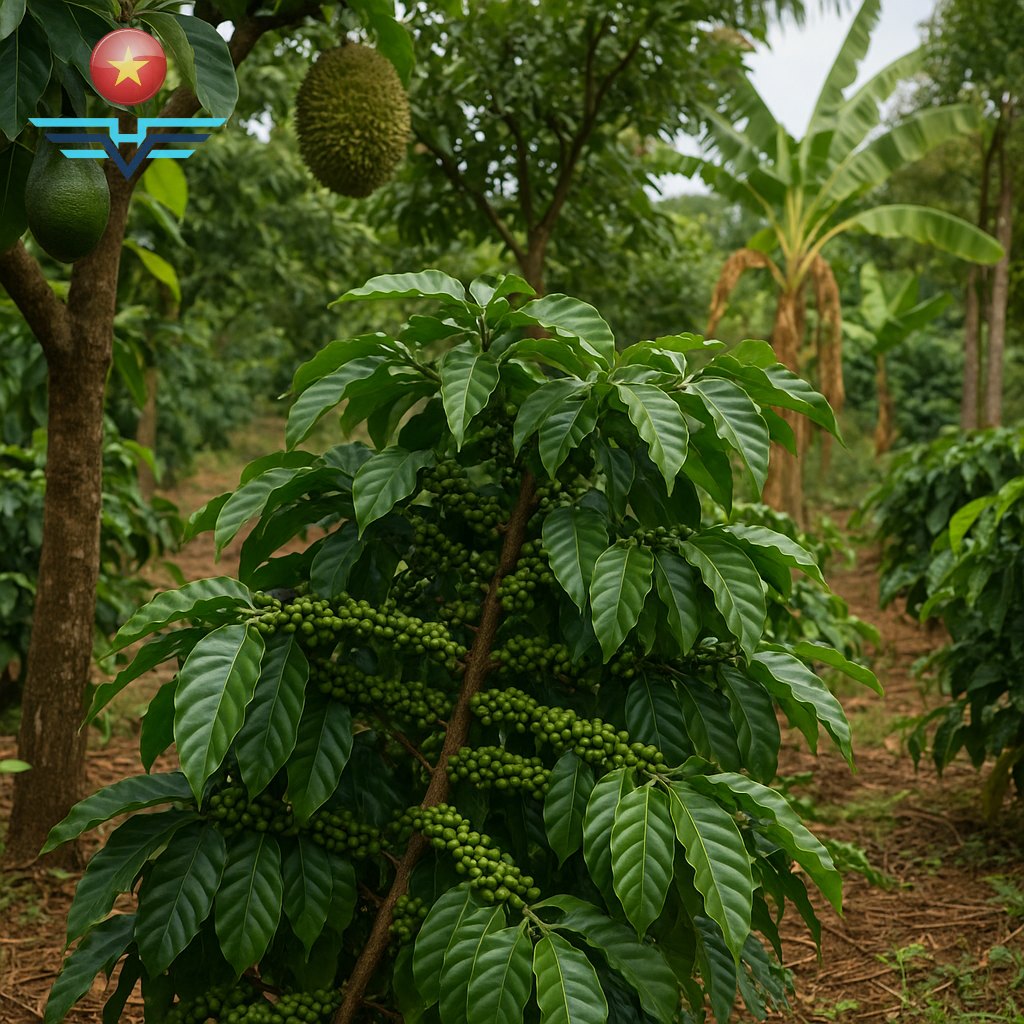
Growing coffee alongside other crops not only raises profits and protects the production environment, but also reduces risks caused by volatile market prices.
Strong Economic Benefits
Table of Contents
Agricultural specialists note that intercropping coffee delivers several advantages. First, it lowers production costs and increases income per hectare—typically 3 to 5 times higher than monocropping.
In 2022, average profit for 1 hectare of pure coffee was 42.4 million VND, while intercropped coffee earned over 65 million VND per hectare.
Specific profit levels:
-
Coffee intercropped with cashew: 85 million VND/ha
-
With black pepper: 75 million VND/ha
-
With durian: 145 million VND/ha
-
With avocado: about 90 million VND/ha
-
With other fruit trees: 70–100 million VND/ha
Profits from intercropped coffee gardens rise by at least 30% compared to single-crop coffee. The increase comes partly from lower input costs and additional income streams.
Intercropping Across Đắk Nông Province
According to the Provincial Agricultural Development Division, Đắk Nông has 139,932 hectares of coffee, of which 53,174 hectares are intercropped. This includes:
-
5,879 ha with cashew
-
29,000 ha with black pepper
-
485 ha with rubber
-
7,311 ha with durian
-
5,062 ha with avocado
Where farmers follow proper technical guidelines and align with local development plans for industrial and fruit crops, intercropping delivers even higher returns.
Farmers’ Experiences
Đỗ Đăng Bình, in Phú Tiến village (Đắk Nang, Krông Nô), cultivates 5 hectares of coffee. In recent years, he has intercropped 600 durian trees, 600 avocado trees (variety 034) and several mango, sapodilla, and guava trees.
This season alone, in addition to harvesting over 50 tons of fresh coffee, he expects 15 tons of durian and over 20 tons of avocado, generating nearly 1.5 billion VND in total income.
Bình explains: “This multi-crop model helps stabilize my income. More importantly, I can better cope with unpredictable market price fluctuations.”
Similarly, Nguyễn Trung Nam, in Lương Sơn village (Nam Xuân, Krông Nô), intercrops grafted dổi (Michelia tonkinensis) on 1 hectare of coffee. His dried dổi seeds are under contract to a company at over 800,000 VND/kg.
Lữ Văn Kéo, Director of Nam Xuân Agricultural Service Cooperative for Spices and Culinary Products, notes that the cooperative guides farmers to interplant dổi trees with coffee and black pepper to raise incomes. However, he cautions growers not to rush into large-scale dổi planting purely for short-term gains.
Environmental and Yield Advantages
Agricultural experts also highlight that intercropping helps reduce soil erosion and nutrient leaching. Plant residues from companion crops supply 24–26% of the soil’s organic matter content.
Field results show that intercropping can even increase coffee yields, while improving soil health, providing shade and windbreaks, and creating a more sustainable farming environment.
Through careful planning and proper technical practices, intercropping coffee with fruit or industrial crops proves to be a profitable and environmentally friendly strategy, boosting profits by more than 30% and making coffee farming more resilient to market and climate challenges.