
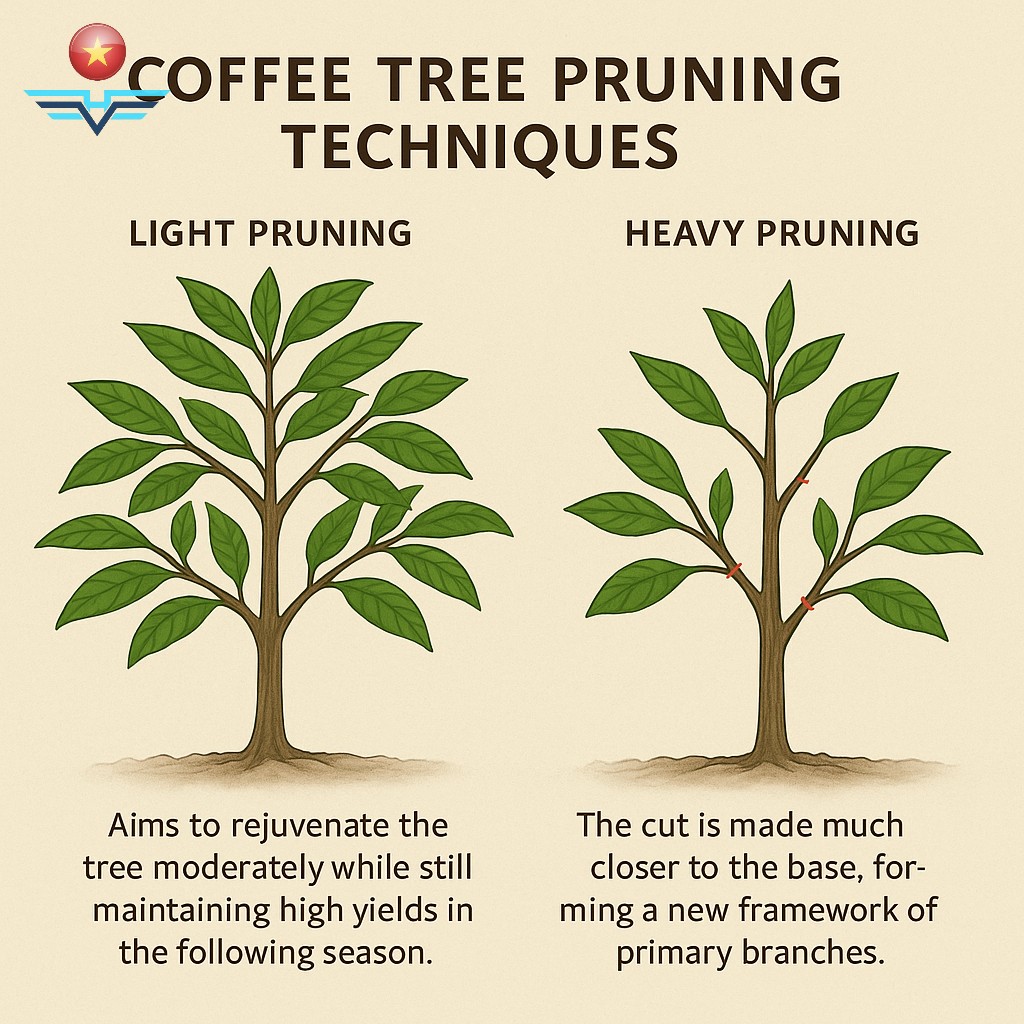
On perennial crops such as tea and coffee, aging plants often experience declining productivity. To restore vigor and ensure high yields, farmers apply pruning techniques—commonly known in coffee cultivation as light pruning and heavy pruning. Recently, growers have also explored the rejuvenation of root systems, offering an additional pathway to boost yield and tree health.
Light Pruning: Gradual Rejuvenation
Table of Contents
Purpose
-
Moderately rejuvenates the tree while maintaining high yields in the following season.
-
Encourages good branching and allows the canopy to expand.
How It Works
Each year, after harvest:
-
Cuts are made slightly higher and farther from the trunk and main stem.
-
This stimulates new branch formation, supporting a balanced, productive canopy.
Heavy Pruning: Fundamental Rejuvenation
When to Apply
After several years of light pruning, the canopy becomes too tall and wide, making light pruning less effective.
Method
-
Cut closer to the base, but not too close to the stump, to allow faster regrowth of branches and foliage.
-
Select a point where there are several main (framework) branches, so the tree can quickly develop fruit-bearing branches.
Outcome
-
After heavy pruning, a new framework of primary branches is formed.
-
Farmers can then restart the cycle of light pruning.
Root Rejuvenation: An Overlooked Opportunity
Concept
While canopy pruning is common, root rejuvenation is less discussed but equally important. Controlled root pruning can help old coffee trees regain vigor and improve yields.
Key Difference
-
Branch pruning focuses on the canopy.
-
Root pruning targets lateral (horizontal) roots, not the vertical taproots.
How to Perform Root Pruning
Step 1: Cutting the Roots
-
Slice the soil vertically at a set distance from the trunk.
-
The inner root zone (closer to the trunk) remains as the permanent root system, while the outer zone is the pruned section.
Step 2: Soil and Fertilizer Management
-
Plow or loosen the soil outside the cut.
-
Apply organic manure, fused calcium phosphate, superphosphate, or finely ground apatite to improve fertility.
-
Continue applying balanced NPK fertilizers, ideally at a depth of 15–20 cm to reach the feeder roots.
Step 3: Tracking and Scheduling
-
Measure and record the distance from the trunk to the cut.
-
Follow a sequence similar to light and heavy pruning for future root pruning cycles.
Timing and Best Practices
-
The ideal time for both canopy and root pruning is shortly after harvest.
-
Perform pruning and fertilization two to three days before the first irrigation.
-
When rains or irrigation water arrive, the tree will rapidly produce new roots and shoots under favorable conditions.
Wider Applications
This root and canopy pruning technique can also be applied to other long-lived fruit or perennial crops grown for flowers, shoots, leaves, or fruit. Experienced growers can adapt the method creatively for their specific crops and growing conditions.
Combining light and heavy canopy pruning with root pruning provides a comprehensive approach to rejuvenating old coffee trees. By carefully timing and executing these techniques, farmers can restore tree vigor, improve nutrient absorption, and boost yields, ensuring long-term sustainability and profitability for perennial coffee plantations.