
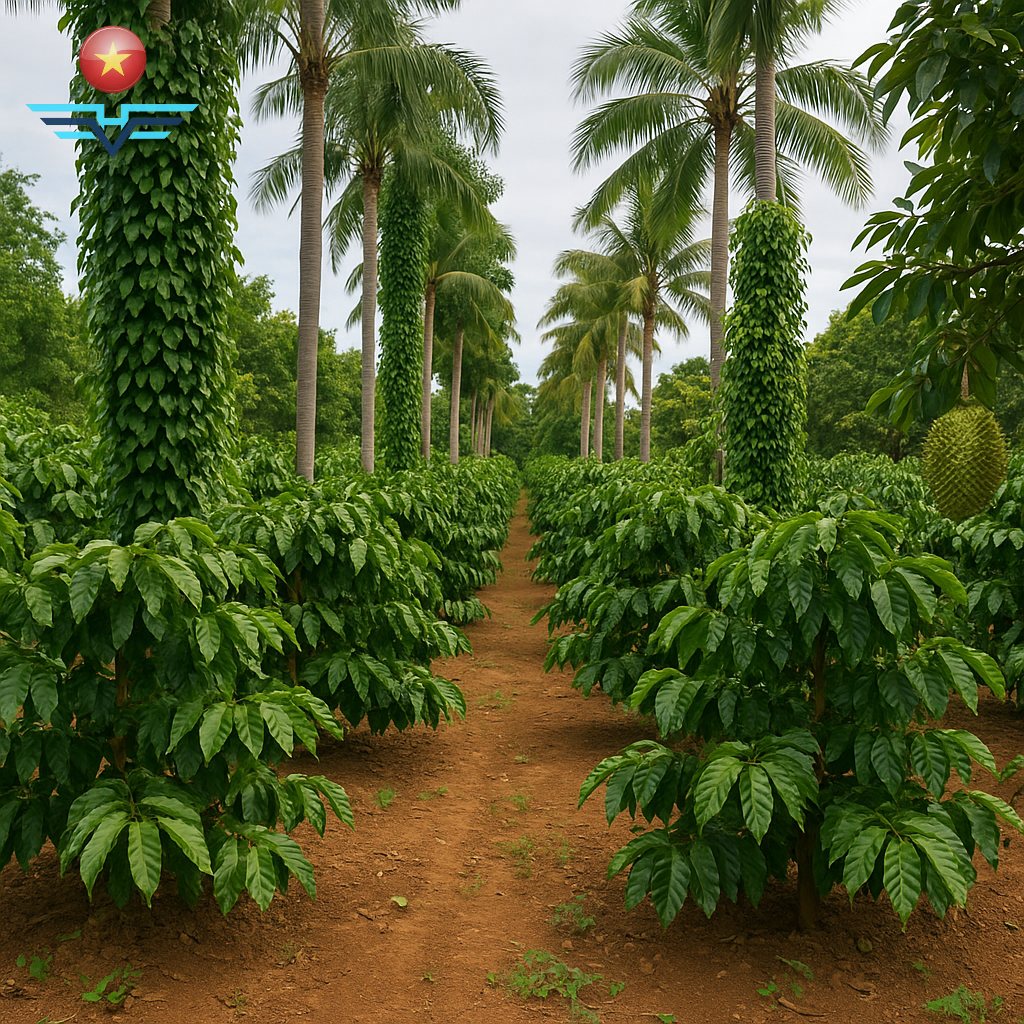
Mr. Dương Văn Hùng, a farmer from Hòa Thuận commune, Buôn Ma Thuột City, has long been recognized as one of Đắk Lắk Province’s outstanding farmers. His success lies in a diversified, multi-crop farming model that delivers high, stable profits and serves as a model for sustainable agriculture in Vietnam’s Central Highlands.
From Modest Beginnings to Bold Expansion
Table of Contents
-
1988: The government allocated 0.5 hectare of land to Mr. Hùng for coffee cultivation.
-
With limited capital and experience, initial coffee yields were low.
-
He sought advice from local farmers, agricultural extension workers, and the regional crop research center.
By 1994, determined to prosper, he mortgaged his house to buy three more hectares and established a diversified, multi-crop garden—a bold move that soon proved highly effective.
Innovative Intercropping System
Mr. Hùng’s integrated farm design combines coffee with multiple high-value crops and shade trees:
-
Two living fences: Acacia and soapberry trees.
-
Intercropping:
-
620 pepper vines trained on acacia trunks.
-
350 areca palms.
-
Durian trees: One row every two rows of pepper.
-
Benefits of the System
-
Coffee thrives in partial shade; acacia shields from wind and sun while supporting pepper vines.
-
Reduced heat stress during the dry season, requiring less irrigation and improving drought resistance.
-
Pepper grows better on living supports like acacia and areca than on concrete posts.
-
Weed suppression and better soil moisture retention thanks to four intercropped species.
“This is a sustainable production model,” Mr. Hùng explains.
Advanced Farming Techniques
According to farmers’ association chairman Trương Văn Đông, Mr. Hùng pairs modern farming practices with cost-saving innovations:
-
Sprays foliar fertilizer between soil fertilizer applications.
-
After harvest, prunes and irrigates heavily to trigger uniform flowering.
-
First in his commune to send soil samples for lab analysis to design a precise fertilizer program.
He also supports poorer households, providing fertilizer, know-how, and food to help them join his cooperative and expand large-scale production.
Year-Round Harvests and Profits
Mr. Hùng’s farm generates steady income across the seasons:
-
February–March: Over 3 tons of pepper from 620 vines.
-
June–September: Around 7 tons of durian from 350 trees.
-
October–December: About 15 tons of coffee from 3 hectares.
-
Areca palms: Yield tens of millions of đồng annually.
Financial Success
-
2007: Profits exceeded 600 million đồng after expenses.
-
2008: Despite falling pepper, coffee, and durian prices, profits still topped 400 million đồng.
A Model for Farmers Across Đắk Lắk
Mr. Trương Văn Đông calls Mr. Hùng’s farm “a model example for Đắk Lắk farmers,” attracting central and provincial delegations and thousands of growers eager to learn.
Beyond training farmers in orchard techniques, Mr. Hùng maintains a nursery of 10,000 Monthong durian seedlings and thousands of areca palms, supplying planting material to help others diversify their farms.
He even donates seedlings and provides interest-free loans to households in need, reinforcing his role as a community leader and advocate for sustainable agriculture.
By combining coffee with pepper, durian, and areca palms, and by applying modern agronomic practices, Mr. Dương Văn Hùng demonstrates how diversified farming can ensure high, stable profits while strengthening community development. His success story serves as an inspiring blueprint for farmers throughout Vietnam’s Central Highlands.