
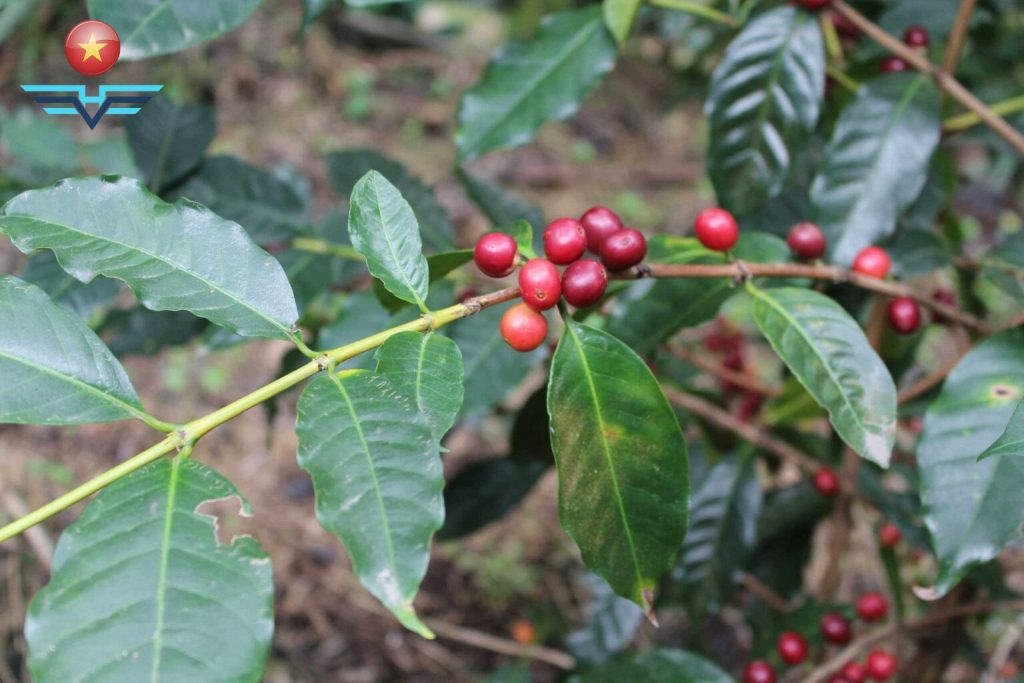
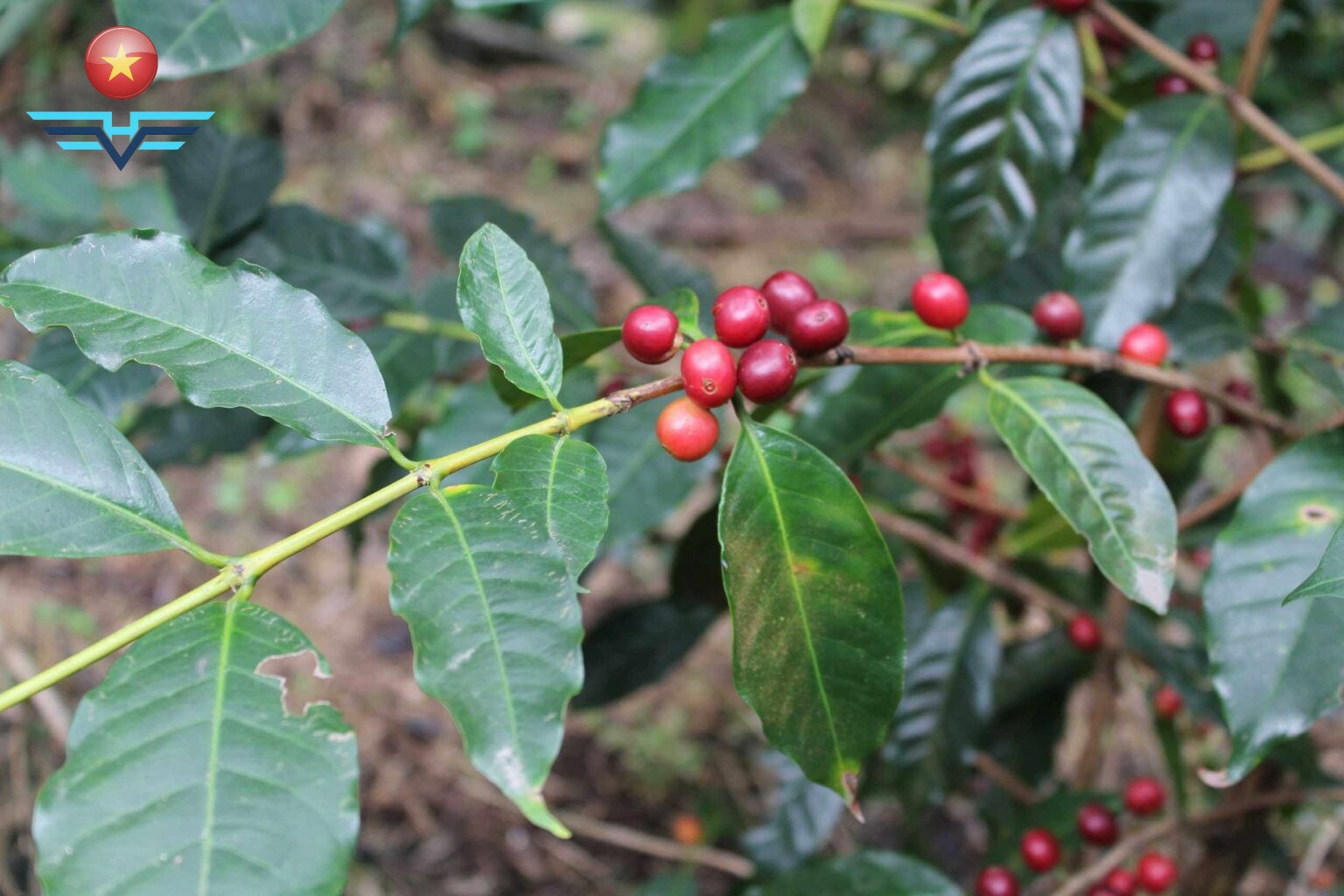
For a long time, Vietnamese farmers have mainly grown two coffee varieties: Robusta (of the Coffea canephora species) and Arabica (typically Catimor or Moka, of the Coffea arabica species).
The choice of which variety to plant generally depends on two key factors: yield potential and resistance to pests and diseases. The cup quality and flavor profile are also important considerations. Below are several other coffee varieties that are less familiar in Vietnam, and why they are rarely cultivated here:
Typica
Table of Contents
Typica is the original Arabica variety from which many other cultivars have been developed. Like other Arabica types, Typica has a conical shape with one main vertical stem and many slanting lateral branches forming angles of 50–70 degrees with the trunk. The plant can grow 3.5–4 meters tall. Typica is known for its excellent cup quality but produces a very low yield.
Bourbon
Bourbon yields about 20–30% more than Typica but still produces relatively low quantities. The tree is less conical than Typica and branches more densely, with narrower angles and closely spaced branch nodes. Its leaves are broad with slightly wavy edges. The cherries are small and heavy, ripen quickly, and drop easily in strong wind or heavy rain. Bourbon performs best at 3,500–6,500 feet and produces a cup quality as fine as Typica.
Caturra
A natural mutation of Bourbon discovered in Brazil, Caturra offers higher yields and good cup quality but requires careful management and fertilization. It is a compact plant with many branches and large, wavy-edged leaves similar to Bourbon. Caturra grows well from 1,500 to 5,500 feet where annual rainfall is 2,500–3,500 mm. Higher altitudes improve quality but reduce yield.
Catuai
This high-yielding variety is a cross between Mundo Novo and Caturra. The plant is small with side branches growing close to the main stem. Its cherries do not fall easily, making it suitable for windy or rainy regions. Catuai also requires good fertilization and care.
Pache Comum
A mutation of Typica first discovered at the El Brito farm in Santa Cruz Naranjo, Santa Rosa, Guatemala. Pache Comum produces a mild, delicate cup and grows best at 3,500–5,500 feet.
Pache Colis
Found on a farm growing both Pache Comum and Caturra in Guatemala, Pache Colis has large cherries, rough leaves, and good resistance to Phoma disease. It is a well-branched plant that grows 0.8–1.25 m tall and thrives at 3,000–6,000 feet in temperatures around 20–21 °C.
Kent
Known for high yield and good resistance to coffee leaf rust.
Mundo Novo
A natural hybrid of Typica and Bourbon discovered in Brazil. Mundo Novo is vigorous and disease-tolerant, with high yields though it takes longer to reach production. It grows best at 3,500–5,500 feet with annual rainfall up to about 1,800 mm.
Maragogype
A mutation of Typica also discovered in Brazil. This variety produces very large trees and beans. Yields are low but the exceptionally large beans are prized in certain specialty markets. It grows best at 2,000–2,500 meters.
Amarello
A yellow-cherry variant, not widely cultivated.
Blue Mountain
Famous for its smooth cup and resistance to Coffee Berry Disease, Blue Mountain thrives at high elevations and is grown in Jamaica and in Kona, Hawaii. However, it is sensitive to climate variations, which can affect its flavor.
These diverse Arabica varieties each have unique agronomic traits and flavor profiles, but many require specific climates and intensive management, which explains why only a few are widely grown in Vietnam today.