
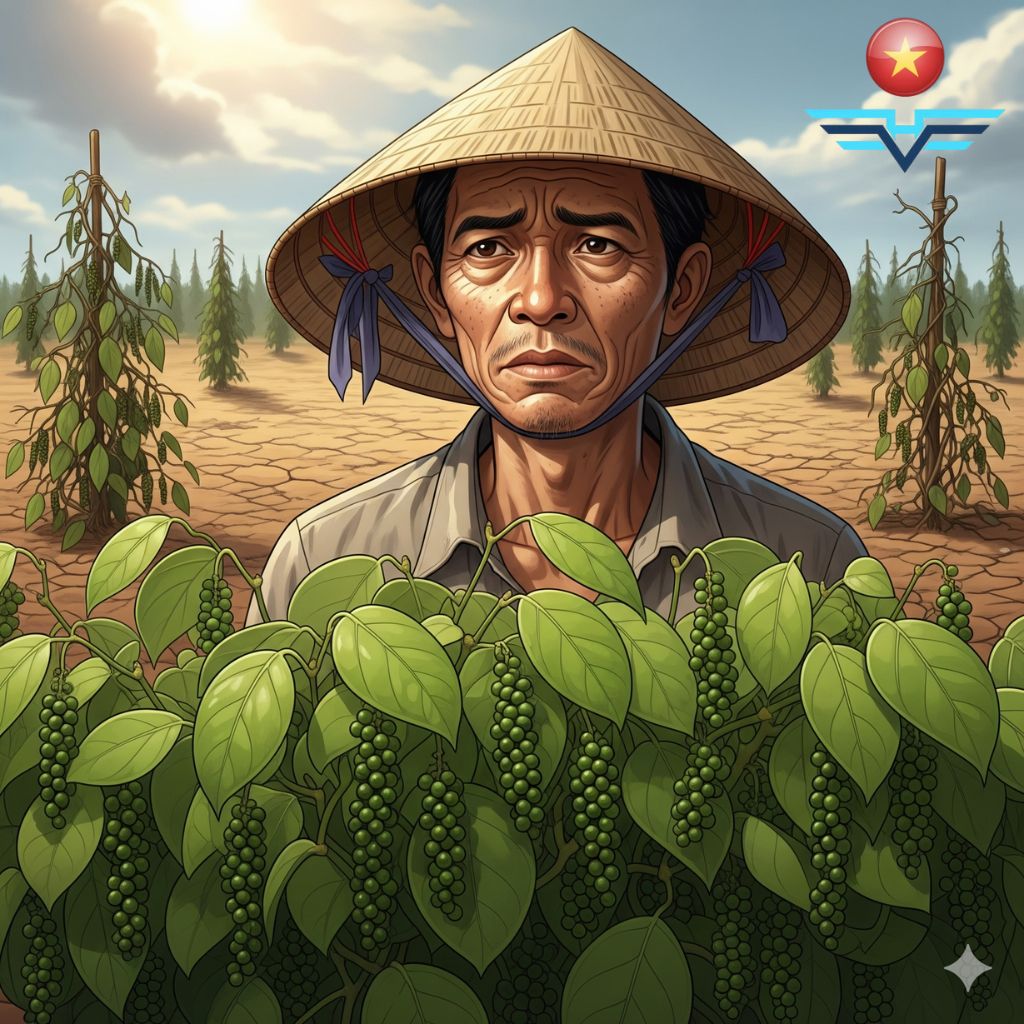
Gia Lai, Vietnam – As the 2024–2025 harvest season begins, black pepper growers across Gia Lai Province—especially in the traditional pepper hubs of Chu Se and Chu Puh districts—are struggling. Although pepper prices are higher than the same period last year, sharp declines in yield are leaving many farmers under financial pressure.
Steep Drop in Yields
Table of Contents
Reporters visiting the “pepper capitals” of Chu Se and Chu Puh describe a quiet harvest. Gone are the bustling scenes of previous boom years. To cut costs, many families now harvest their own crop instead of hiring workers.
Years of low pepper prices discouraged investment and led to neglected gardens. Combined with disease outbreaks and drought, production has plummeted.
-
Chu Puh District now has just about 1,500 hectares, nearly half the area it had in 2015–2016.
-
Chu Se District has 2,248 hectares, down roughly 1,000 hectares from earlier years.
Mr. Nguyen Ngoc Hoa of Nhon Hoa town once managed 4,000 pepper vines, but disease and drought have reduced his garden to just 300 vines. With current prices around 52,000 VND/kg, he fears that even the expected half-ton yield will not cover his 600 million VND bank debt. “I may have to sell my house to repay the loan,” he said.
Similarly, Ms. Nguyen Thi Hau of Hang Ring village has seen her pepper vines drop from 1,000 to 500 plants, and expects a 50% smaller harvest this year. Mr. Le Hung in Ia Blang commune reports that his 3-hectare plantation will yield under 10 tons, compared with 15 tons last year.
Long-Term Low Prices Discourage Investment
From 2020 onward, pepper prices fell to record lows—at times only 35,000 VND/kg—forcing farmers to cut back on inputs. As Mr. Hung explains, “We have been investing only at a minimal level just to keep the gardens alive. Each year the yield slips further. We hope for a strong rebound in prices to reduce our debts and re-invest.”
According to Nguyen Van Hop, head of the Chu Se Agriculture and Rural Development Office, pepper wilt diseases are currently under control. The main issue is that prolonged low prices left farmers without capital for replanting or rejuvenating their vines, causing yields to decline about 20% this season.
Linking Farmers with Processing and Export Chains
Mr. Hoang Phuoc Binh, Standing Vice Chairman and General Secretary of the Chu Se Pepper Association, notes that domestic stocks are nearly exhausted while national output is forecast to drop about 30% year-on-year. Large exporters in Ho Chi Minh City are now buying aggressively for export, creating a supply-demand gap that is already pushing pepper prices upward.
Local authorities aim to stabilize rather than expand pepper acreage. The plan is to:
-
Maintain the current area of about 12,000–13,000 hectares.
-
Encourage farmers to join cooperatives and production chains, focusing on organic and sustainable methods.
-
Link growers with processors and exporters to ensure stable markets and higher value through deep processing and traceability.
Mr. Nguyen Long Khanh, deputy head of the Chu Puh agriculture office, adds that the district is promoting cooperative models for key crops such as pepper, coffee, and fruit trees. Where pepper vines have died or become too old, farmers are being guided to switch to climate-suitable fruit or vegetable crops while maintaining market linkages.
Provincial Strategy for Sustainable Pepper
According to Doan Ngoc Co, Deputy Director of the Gia Lai Department of Agriculture and Rural Development, the province currently has 13,673 hectares of pepper, including nearly 12,582 hectares in full production and an annual average output of about 47,260 tons.
“Despite the recent years of low prices and drought,” Mr. Co emphasized, “pepper remains one of Gia Lai’s key cash crops. We will not expand the planted area, but will focus on organic production, deep processing, and brand promotion to enhance competitiveness and secure export markets.”
Meta Description: Gia Lai’s black pepper farmers face falling yields despite rising prices. Local authorities plan to stabilize acreage, promote organic production and strengthen links between farmers, processors and