
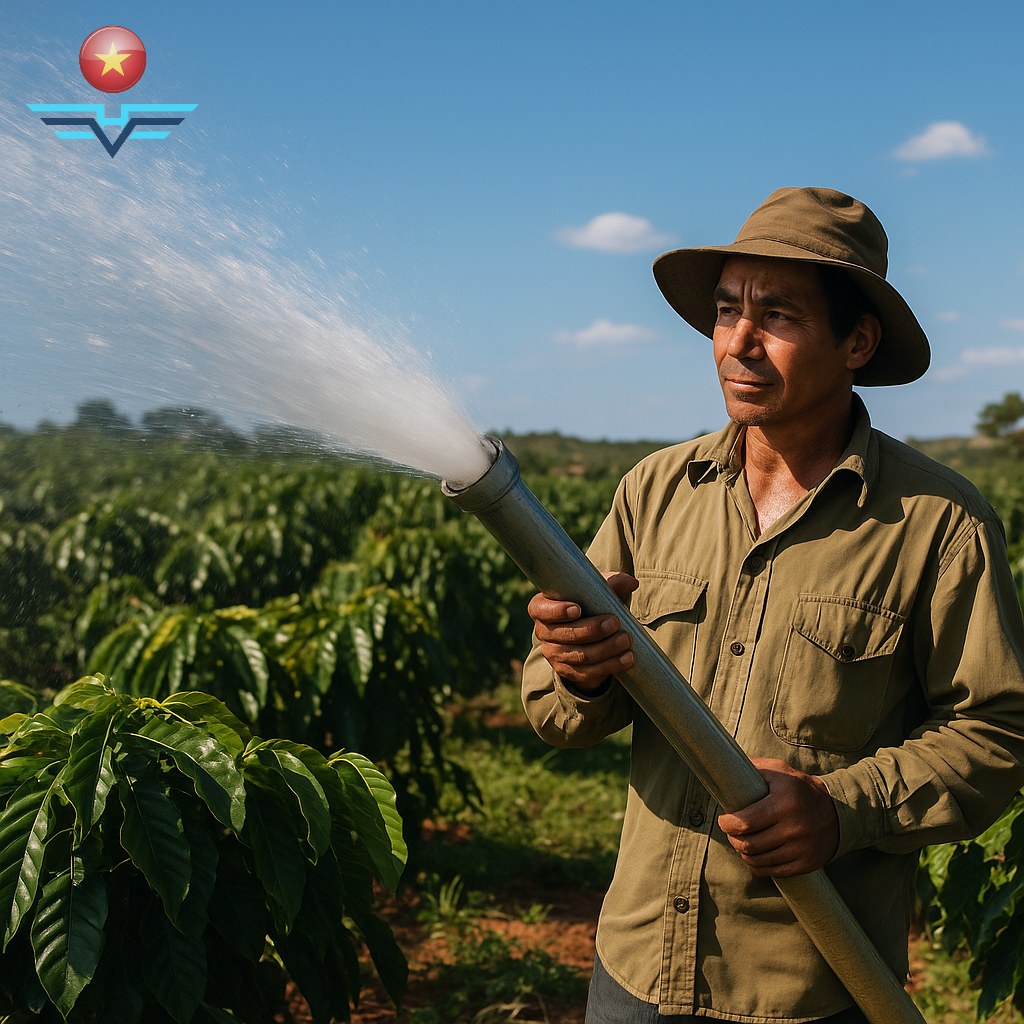
Coffee production in Vietnam’s Central Highlands—the country’s key Robusta-growing region—faces mounting challenges: fluctuating prices, rising input and fuel costs, pest and disease pressures, and above all, a chronic shortage of irrigation water during the dry season.
Why Coffee Needs Careful Water Management
Table of Contents
Shallow Root System, High Water Demand
-
Most Robusta coffee roots are concentrated in the top 0–30 cm of soil, spreading only about 0–50 cm horizontally.
-
This shallow root zone gives the crop a high water requirement and makes irrigation costs account for 25–30 % of total production expenses.
The Problem with Over-Irrigation
-
Many smallholders—especially ethnic minority farmers—water by experience rather than measurement, often applying 300–400 liters per tree per irrigation, far exceeding the crop’s actual needs.
-
Over-watering not only wastes scarce water but also leaches nutrients beyond the root zone, reducing soil fertility and long-term productivity.
WASI’s Water-Saving Recommendations
Timing the First Irrigation
The Western Highlands Agriculture and Forestry Science Institute (WASI) stresses that the first irrigation of the dry season is critical.
-
If soil moisture drops below 25–26 % before watering, drought stress can make it difficult or impossible for trees to recover and resume normal growth.
Recommended Irrigation Volumes
Joint research by WASI and Leuven University (Belgium) shows yields can be maintained—or even improved—while using much less water:
| Coffee Stage | Interval | Volume per Tree |
|---|---|---|
| Newly planted (Year 1) | Every 20–22 days | ≈120 liters |
| Year 2–3 | Every 20–22 days | ≈240 liters |
| Mature commercial production | Every 25–30 days | ≈500–600 liters |
-
For mature plantations, only three irrigations per dry season can sustain yields of 3–4 tons of green coffee per hectare.
Economic and Environmental Benefits
-
Lower production costs: Less water means reduced irrigation and pumping expenses.
-
Conserved groundwater: Helps counter depleting aquifers and dry-season shortages.
-
Improved soil fertility: Reduces nutrient leaching, preserving soil health for long-term productivity.
Adoption in Đắk Lắk and Gia Lai
This water-saving irrigation model is already widely applied in key Robusta-growing districts of Đắk Lắk Province and is now being promoted across the Central Highlands, including Gia Lai Province.
Local farmers are encouraged to adopt these techniques to:
-
Conserve scarce water resources,
-
Maintain high yields and quality, and
-
Increase economic returns—even under rising production costs and changing climate conditions.