
Overview and Impact
Table of Contents
Dieback and berry rot is the second most serious disease in coffee after coffee leaf rust. It dries fruit and branches and can even kill trees, causing heavy yield losses. First recorded in India in 1919 and epidemic in Kenya by 1960 (cutting production by about 50%), it was identified in Vietnam in 1930. As Arabica acreage has expanded in the Central Highlands, both incidence and severity have increased.
Surveys by the Plant Protection Department of the Coffee Research Institute (Đắk Lắk) found 4.6–20.4% of berries on trees infected, 6% of berries dropping due to disease (not counting 26% naturally dropped fruit), and about 12% of trees heavily affected. Yield losses average around 7% because 100-bean weight can be reduced by about 22.8%.
Causal Agents
Multiple factors can cause dieback and berry rot:
-
Fungus: Colletotrichum coffeanum Noack on berries causes Coffee Berry Disease (CBD).
-
Bacteria: Pseudomonas syringae, P. garcae.
-
Physiological dieback not linked to pathogens.
McDonald (1926) described three forms of C. coffeanum: saprophytic, mildly parasitic, and highly parasitic (causing CBD).
Colletotrichum spores germinate only in the presence of free water; germination occurs below 20 °C in water, or at 10–35 °C in nutrient medium (optimal germination in about 4 hours). Field incubation lasts 2–4 weeks. Evening rains spread spores and trigger berry infection.
In the Central Highlands, both physiological factors and fungal pathogens (Colletotrichum spp.) are present. Isolations from Catimor Arabica show:
-
On berries: C. coffeanum, C. gloeosporioides
-
On branches/leaves: C. gloeosporioides, C. capsici.
Symptoms
-
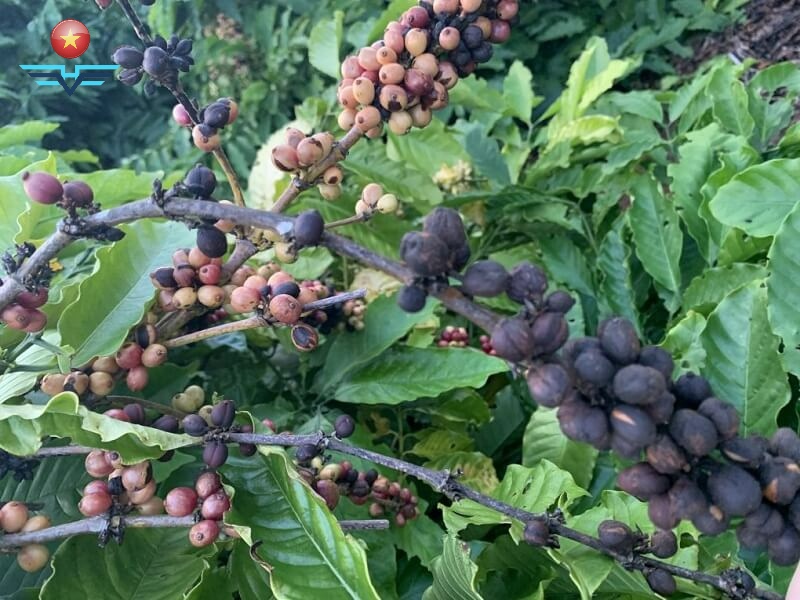
Berries: Small brown spots on the skin expand and darken; the infected area sinks. The fungus penetrates the bean, turning the fruit black and causing early drop. Infection often starts where the berry attaches to the stalk or where two berries touch and water collects.
-
Branches: Symptoms first appear mid-branch as small yellow-brown lesions that darken and sink. Leaves along the branch fall, the branch dries and eventually dies. Severe infections can spread to main stems.
-
Leaves: Brown spots enlarge and darken to deep brown or black.
Disease Development
Infections begin from flowering and are most damaging when fruit are young. Early irrigation that induces flowering before peak disease season can help avoid the critical overlap. In Đắk Lắk, the disease typically starts in May, peaks in June–October on berries; on branches it appears slightly later (August–October).
Dieback and berry rot is more common in high-yielding coffee (over 4 t/ha) when fertilizer inputs are low.
Control Measures
-
Resistant varieties: In Kenya, breeding for CBD resistance began in 1936; resistant lines such as K7, Blue Mountain, and Rume Sudan are now widely used.
-
Balanced fertilization: Adequate NPK reduces susceptibility.
-
Chemical control: In Kenya, monthly copper sprays during the rainy season are effective; captafol and systemic fungicides also work, though C. coffeanum can develop resistance.
– In Đắk Lắk, trials show Derosal 50 (0.2%), Tilt 250 EC (0.1%), or Viben C 50 BTN (0.2%) sprayed from the start of the rainy season (May–June), 2–3 times at monthly intervals, can control the disease. -
Biological control: Antagonistic fungus Trichoderma can suppress Colletotrichum. At points of contact, Trichoderma parasitizes the pathogen, causing it to shrink and die; it also produces antibiotic compounds that kill the pathogen without direct contact. Optimal temperature for Trichoderma growth is 25–30 °C.