
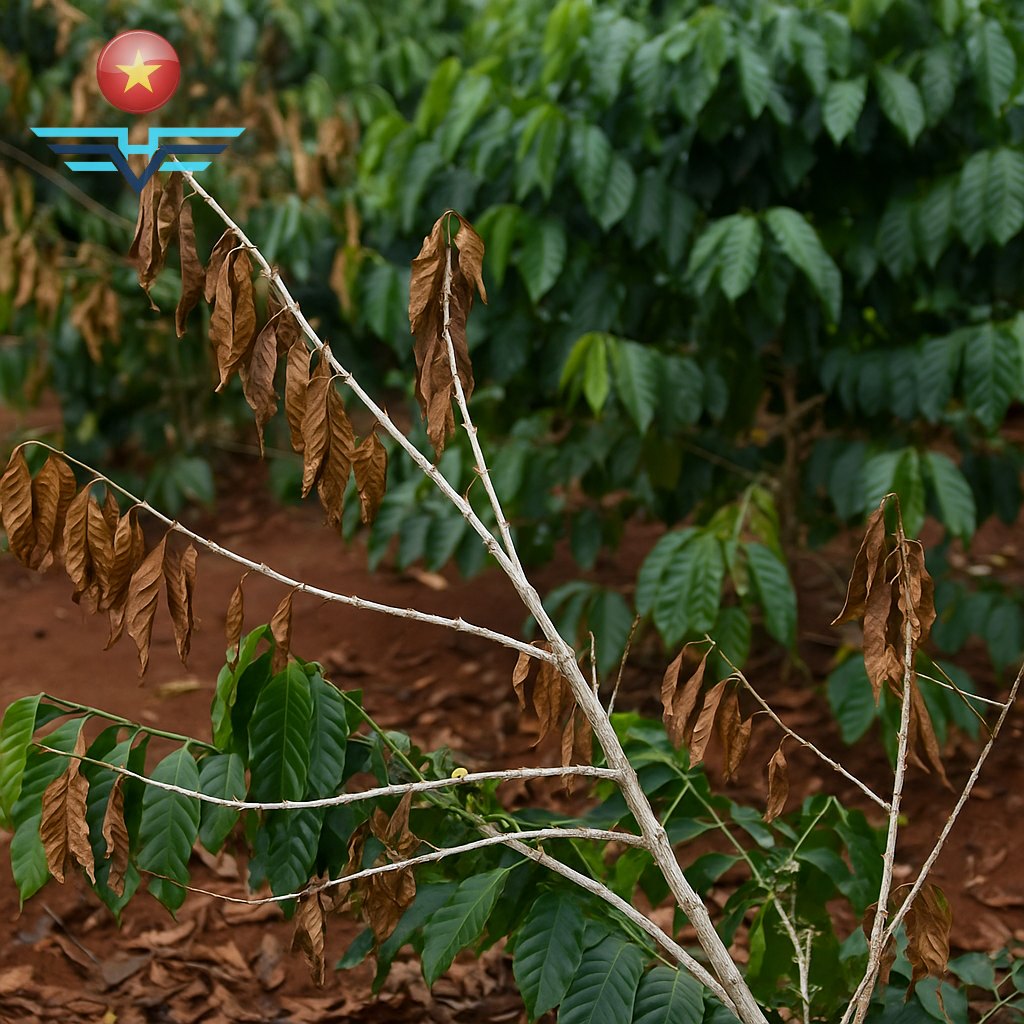
In the entire Xuan Truong commune (Da Lat City), there are about 1,200 hectares of high-quality Catimor and Moka coffee. Yet, in recent months more than 300 hectares have completely died and over 100 hectares are at risk of being uprooted.
Ha Phuoc Ta, chairman of the Xuan Truong People’s Committee, said that coffee trees across the commune are damaged, with 500 households suffering heavy losses.
Do Ngoc Hanh of Truong Xuan 1 hamlet planted 1.5 hectares of Catimor coffee three years ago; many trees have grown taller than head height, but now more than 60 percent of them are dying and the rest are close to withering.
Similarly, Le Tu Loc (hamlet 9, Truong An) planted four sào (about 0.16 ha) of Moka coffee; to date over 60 percent of his trees have also dried up. Nguyen Trong Binh, an agro-forestry officer of Xuan Truong, guided visitors through the coffee gardens and could not hide his frustration: “With coffee prices as they are, farmers could be making a profit—but before they can celebrate, this disease has struck.”
According to the Lam Dong Plant Protection Department, the culprit is the coffee stem-borer Xylotrechus quadripes Chev—known as the coffee white stem borer. The adult beetle lays eggs in cracks in the bark. When the larvae hatch, they bore circular tunnels around the trunk, cutting through the wood vessels. As they bore, they push frass and wood dust behind them to plug the holes.
Before pupating, the larvae bore outward toward the bark and stop just before breaking through, then pupate there. Because the galleries encircle the trunk, the tree is easily broken. This pattern of damage makes chemical control of the stem borer largely ineffective.
Da Lat’s Agriculture Department warns that if the pest is not contained immediately by isolating infested areas and cutting and burning affected trees, the threat will be far greater by October and November—when the insect’s eggs develop.