
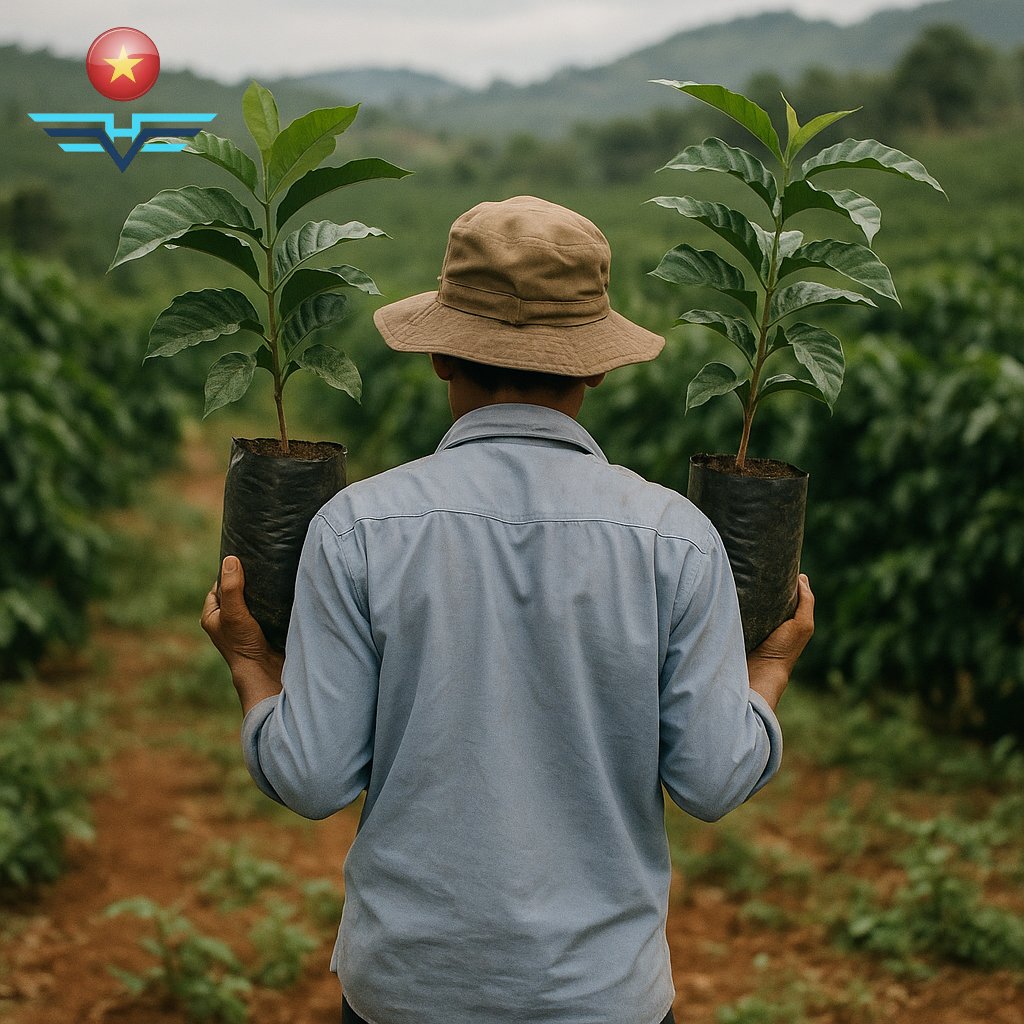
As the rainy season begins across Vietnam’s Central Highlands—the traditional time for planting—farmers are racing to plant more coffee, driven by prices that have at times surged above 140,000 VND per kilogram.
Expanding Coffee Plantations
Starting the new coffee season, Trần Văn Định in Đắk Đoa District decided to plant an additional 1.5 hectares of coffee. “Coffee here is relatively disease-resistant, yields well, and we already have plenty of experience growing it. Over the past year coffee prices have climbed several times higher, motivating my family to expand,” he explained.
Likewise, Phạm Văn Hanh in Đắk Song District, Đắk Nông Province, has just planted more than 11,000 coffee trees on over 7 hectares. “I chose coffee because it’s easy to grow and care for—and, most importantly, it’s selling at very high prices,” he said.
Demand for High-Quality Seedlings
Hòa Thắng Commune in Buôn Ma Thuột City—considered the “capital” of coffee seedlings in Đắk Lắk and the wider Central Highlands—has seen seedling prices climb sharply.
Seedlings grown from seed (thực sinh) now sell for 8,000–15,000 VND each, while grafted seedlings cost 15,000–25,000 VND each—nearly 50 percent higher than just a year ago.
A local nursery owner noted, “Because coffee prices are strong, farmers are expanding their plantings. Anyone wanting large numbers of quality seedlings must order in advance. We maintain stable profits but still carefully select seedlings to protect both farmers’ interests and our own reputation.”
Hà Văn Trọng of Chư Prông District, who has nearly a decade of coffee-growing experience, worries most about buying poor-quality seedlings. “If we plant inferior stock, after years of care the trees stay stunted and yield poorly—the economic loss is far worse,” he warned.
“We hope authorities will strictly monitor seedling producers and distributors to ensure healthy, pest-resistant, high-yield plants—especially important under today’s challenging climate,” Trọng added.
Expert Advice: Don’t Rush Replanting
A representative of the Western Highlands Agro-Forestry Science and Technology Institute cautioned farmers not to replant hastily without securing high-quality seedlings. If they rush and end up with poor stock, years of effort and investment could be wasted when low yields force them to replant again at much greater cost.