
Diversified Farming Boosts Income
Table of Contents
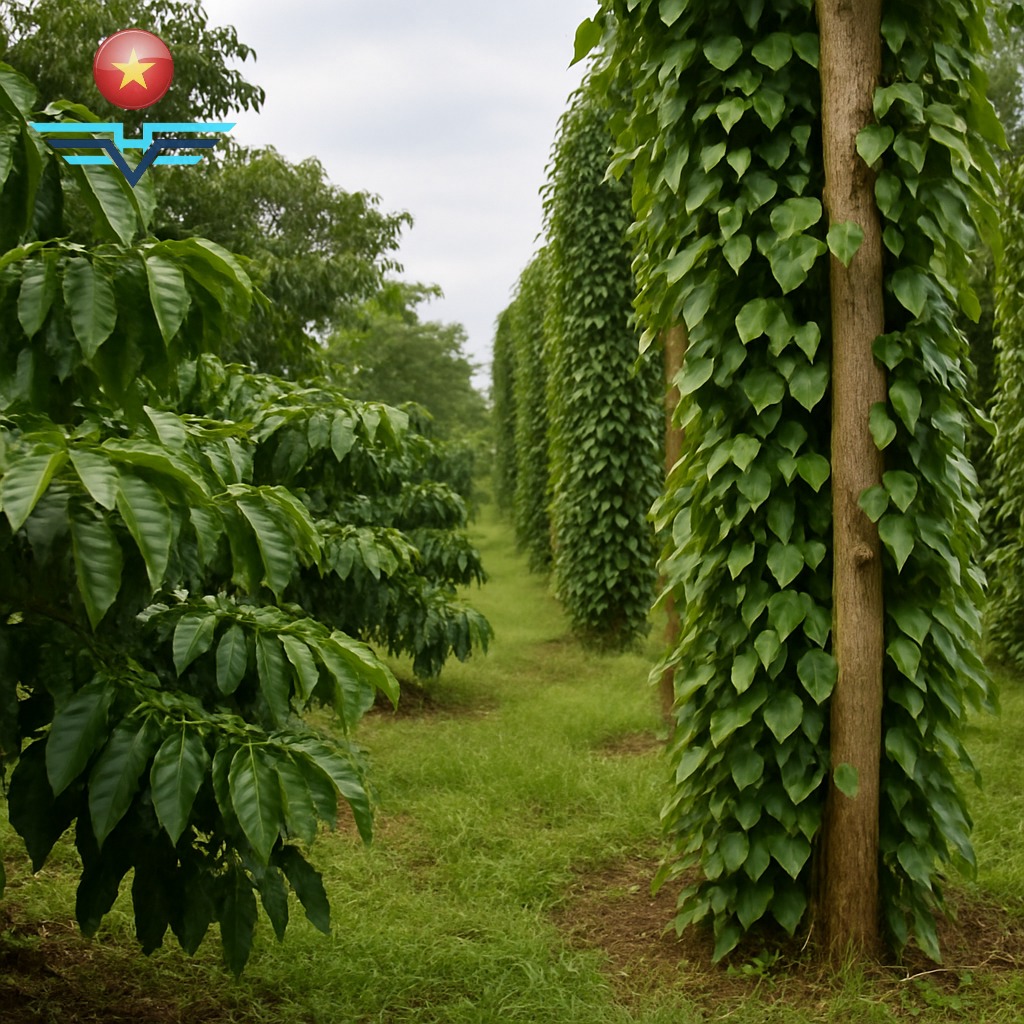
Diversifying crops on the same land helps farmers earn income from multiple products. A standout example is the coffee–pepper intercropping model now widely adopted in Bà Rịa–Vũng Tàu Province, delivering stable and higher profits.
This model was introduced in 2014 by the Eastern South Fruit Research Center in cooperation with the provincial Department of Science and Technology. Farmers report that one hectare of coffee alone used to bring in at most about 60 million VND in profit. When intercropped with black pepper, profits can nearly double.
Farmers Share Success Stories
Lê Sự, a farmer in Nông Trường hamlet, Hắc Dịch commune (Tân Thành district), said his two hectares of coffee once brought annual profits of only 50–60 million VND. Since interplanting pepper in 2014, his pepper vines began producing after two years, and now his profit reaches nearly 120 million VND—about double compared with coffee monoculture. Intercropping also reduces labor and fertilizer costs by 10–15%.
Similarly, Trần Duy Thanh in Tân Bình hamlet, Bàu Chinh commune (Châu Đức district) grows about 400 coffee trees intercropped with 1,000 pepper vines on 1.2 ha. After three years, he finds the two crops complement each other:
-
Coffee absorbs excess moisture, helping reduce pepper disease pressure during the rainy season.
-
Pepper vines provide shade in the dry season, reducing evaporation and irrigation needs for coffee.
Both pepper and coffee are high-value crops but their prices can fluctuate sharply. “If coffee prices fall, we still earn from pepper; if pepper prices drop, coffee provides income,” Thanh explained.
Local Authorities Support the Model
Hoàng Long Vỹ, Vice Chairman of the Bàu Chinh Farmers’ Association, noted that in recent years high pepper prices drove many farmers to cut down coffee for pure pepper cultivation, disrupting local agricultural planning. To curb this cycle of “plant–uproot–replant,” the association encouraged farmers to adopt the coffee–pepper intercropping model.
The results are clear: fertilizer costs are lower and cropping seasons differ, providing year-round jobs. Today, of the roughly 40 ha of coffee in the commune, about half is now intercropped with pepper.
According to Trần Thị Thiên Hương, Deputy Head of the provincial Agricultural Extension Center’s Technical Department, field trials confirm the model’s success and it will be expanded further across the province.
Highest Economic Return Among Intercropping Options
Beyond pepper–coffee intercropping, the Eastern South Fruit Research Center has also tested planting fruit trees such as pomelo and durian among coffee. Yet evaluations show that pepper–coffee delivers the highest economic return, with some intercropped plots already harvesting about 70 million VND profit per hectare annually.
In Châu Đức district alone, the success of this model has encouraged farmers to intercrop pepper within nearly 3,000 ha of coffee. The research center is finalizing technical guidelines to help farmers across the province stabilize production, create concentrated commodity zones, and reduce the old pattern of “plant–cut, cut–plant.”