
High interest rates on Vietnam’s official coffee-replanting loan program have left many growers—whose coffee trees are old and unproductive—having to fund replanting on their own.
Hard to Access Loans
In Gia Lai Province, the provincial Farmers’ Union has set up 2,039 credit groups with 42,702 farming households registered for the coffee-replanting loan program. Yet so far only 828 groups, with 14,368 households, have actually received funds; the rest have not been able to access the credit.
According to Đặng Ngọc Khôi, head of the province’s Farmers’ Union loan management board, many farmers cannot meet the requirements: some lack land-use right certificates, while others have already mortgaged their certificates for other bank loans. Under Government Decree 41 on agricultural production credit, these farmers are ineligible for replanting loans.
Even those who qualify hesitate to borrow: interest rates are high, repayment periods are short, and both weather and coffee prices fluctuate unpredictably, making them wary of taking on debt.
Old Plantations, Little Capital
Within Coffee Company 706’s area—about 700 ha company-owned coffee and roughly 400 ha of household plots—soil and water conditions are ideal and the region has long been a major coffee hub. But this also means the household coffee trees, planted 25–30 years ago, are now past their prime and need replacing.
Farmer Nguyễn Văn Hộ, with nearly 2 ha of coffee, says over half his trees are nearly 30 years old, yielding poorly. He would like to replant, but replacing that much land would cost over 100 million VND at once.
“Bank interest is high and repayment terms are short,” he says. “If the crop fails or prices drop, we could default—and you simply cannot default on the bank.”
Because of such concerns, most farmers stick to a cautious “slow and steady” approach and avoid the official loan program.
“Self-Replanting”
In Ia Sao and across Ia Grai District, a farm that produces only about 2 tons of green beans per hectare is considered unprofitable and must be renewed. But since farmers cannot access—or are unwilling to take—bank loans, many are practicing what locals call “tự tái canh”: self-replanting.
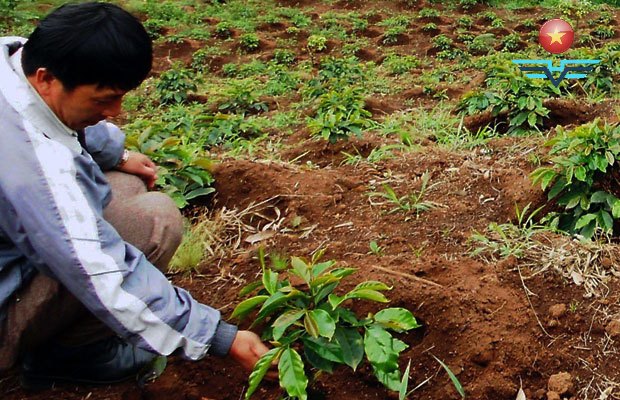
Mr. Hộ, for example, replaces individual old trees as he goes: each year, whenever he spots a tree too weak, he digs it out and plants a young seedling in its place. Over the years he has renewed several hundred trees in this piecemeal way. Neighbor Nông Văn Lưu has similarly replanted more than 100 trees.
This method avoids the burden of interest payments and allows farmers to work within their means. But it has serious drawbacks:
-
Older plantations were planted densely—about 1,273 trees/ha—whereas modern best practice is about 900 trees/ha to allow wider canopies and better yields. Replacing trees one-by-one keeps the plot permanently overcrowded, limiting productivity and bean quality.
-
Mixed ages in one field—old and young, large and small—make cultivation and harvesting more difficult because trees at different stages require different care.
As the saying goes, “necessity is the mother of invention,” but this kind of self-replanting cannot deliver the yields or quality needed for a sustainable coffee industry. Yet nationwide, smallholder farms like these account for the majority of Vietnam’s coffee acreage—meaning the challenge is widespread and urgent.