
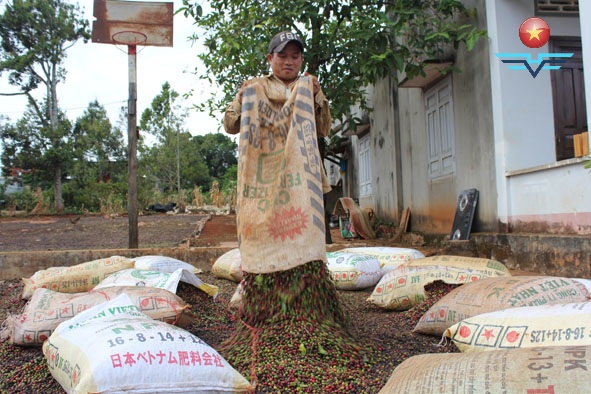
In recent years, every coffee harvest in Đắk Lắk has been marked by a shortage of workers, forcing plantation owners to scramble to hire pickers.
Struggling to Find Pickers
These days in key coffee-growing areas such as Krông Pak, Krông Năng, Cư M’gar, and Buôn Ma Thuột City, it is easy to spot farm owners actively looking for harvest labor. This year the going rate for pickers has risen to about 150,000 VND per day with lunch included (up from 140,000 VND last year).
Hoàng Thị Thúy Liên, from Lộc Tân Hamlet in Phú Lộc commune (Krông Năng district), said her family has 4 ha of coffee with an average yield of 3.5 tons of beans per hectare. “We need about 10 regular workers for a full month of picking, so it’s very hard to find enough people,” she explained.
Even when she manages to hire workers, she worries about their commitment: some only work hard when the owner is present, picking carelessly, breaking branches and leaving cherries unpicked.
Farmers estimate that one hectare of coffee requires roughly 60 labor-days to harvest. At 150,000 VND per day, labor costs reach about 9 million VND per hectare. With yields of around 3 tons/ha sold at 40,000 VND/kg, a farmer nets only about 50 million VND a year after expenses.
But many coffee trees are aging and yields have fallen to 2–2.5 tons/ha. After costs, profits may shrink to just a few dozen million VND annually. To save money, many families now pick the earliest ripe cherries themselves before hiring outside labor for the final harvest.
Nguyễn Văn Hùng, also from Lộc Tân Hamlet, said his coffee trees are old and producing small beans, only about 2 tons/ha this year. Fearing he won’t cover production costs, he and his wife began picking early themselves and will only hire workers later when the remaining cherries ripen all at once.
Similarly, Phan Văn Lưu from Tự An ward (Buôn Ma Thuột City) has 7 sào (about 0.7 ha) of coffee. Each year he relies on relatives from Phú Yên to send workers. “It’s very hard to find harvest labor,” Lưu explained. “Every year I had to hire a different group, and not everyone worked well—some drank and caused trouble, others were inefficient. It wasn’t until early 2004 that I finally found a team I’m happy with, and I’ve stuck with them ever since.”
Keeping Good Workers
Đắk Lắk currently has about 203,000 ha of coffee, including 191,000 ha in full production. Harvest season creates huge demand for labor, but local idle workers are few, so most growers must bring in help from other provinces.
Because coffee is a long-term crop and poor harvesting techniques can reduce next season’s yield and quality, once farm owners find a good team, they work hard to keep them for future seasons.
After more than 30 years of growing coffee, Lưu says his worries about finding workers have eased over the last decade. “Now, one phone call and the same team from Phú Yên comes up to harvest for me,” he said.
His six coastal workers are dedicated and responsible. “Even when I’m not in the field, they work diligently. Sometimes they even finish late into the evening to complete the day’s picking.” In return, Lưu occasionally gives them a chicken, a bottle of rice wine, or extra cash for transport and meals—especially if they help with drying the coffee beans. Because of this relationship, the team always harvests his coffee first before taking other jobs.
Trần Ngọc Cảnh from Khánh Xuân ward (Buôn Ma Thuột) also hires workers from his hometown. He farms 2 ha of coffee in distant Đắk Song (Đắk Nông), so during harvest he lives and sleeps on the farm for nearly two months alongside his hired pickers until the crop is in.
Huỳnh Quốc Thích, Deputy Director of the provincial Department of Agriculture and Rural Development, noted that coffee is Đắk Lắk’s main crop. “Every harvest season the demand for workers is huge. To ensure timely harvesting with 90–95% of cherries fully ripe, from the start of the season we issue guidelines, encourage villagers to form neighborhood watch groups to protect their crops and property, and advise farmers to complete all proper legal paperwork when hiring outside labor,” he said.