
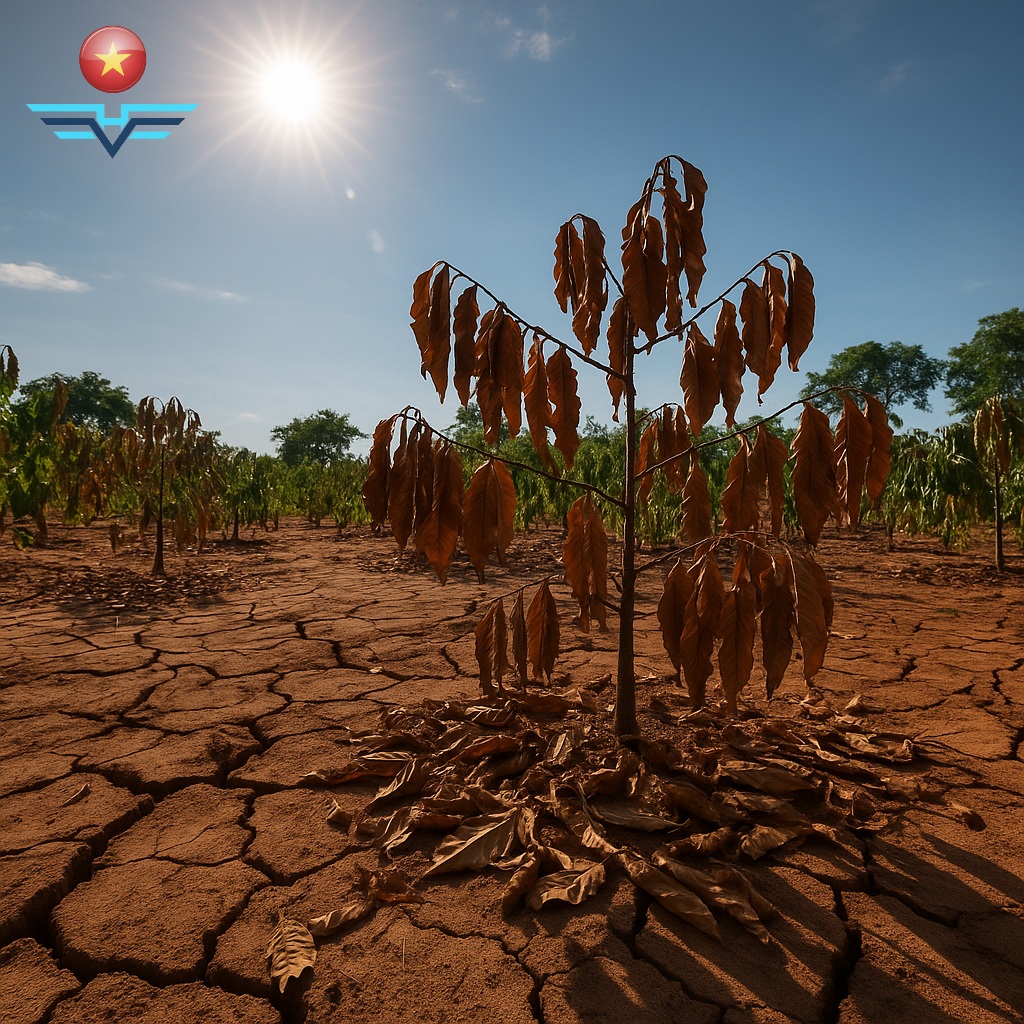
The Central Highlands has about 500,000 hectares of coffee, and more than 50% of the water used for irrigating coffee during the dry season comes from dug or drilled wells. Each dry season, farmers dig more wells to water their coffee, and this massive well-drilling has contributed significantly to the rapid depletion of the region’s groundwater.
Groundwater Levels Falling Fast
Under the blazing sun of early April, Nguyen Truong Thinh from Ia Tiem Commune, Chu Se District, Gia Lai Province, and his workers were digging a well to supply water for his family and to irrigate 2.2 hectares of coffee. Even after digging more than 20 meters deep, they found only dry soil and rock. This is not the first time his family has had to dig a well. Because his farm is far from natural water sources, irrigation depends mainly on dug wells. In previous years, with favorable weather, the well always held plenty of water, so he never worried. But this year, prolonged heat has left it dry. To save his coffee plantation from withering, he spent more than 30 million VND hiring people to dig a new well—yet still no sign of water.
In Dak Ha District (Kon Tum Province), nearly every household uses dug wells, with only a few drawing water from ponds or lakes.
Ho Van Quynh of Dak Mar Commune said: “Not just my family—almost all farmers here drill wells for coffee irrigation. Some have one well, others two or three. Yet during the dry season, sometimes there’s still not enough water.”
Similar conditions plague coffee-growing areas of Dak Lak and Dak Nong. When irrigation reservoirs dry up, residents of Ea Tul Commune (Cu M’gar District, Dak Lak) have had to dig wells right in the bed of the Ea H’ra irrigation reservoir to get water for their drought-stricken coffee trees.
Over the years, the coffee area in the Central Highlands has continued to expand, putting huge pressure on irrigation water—especially for farms far from natural sources. Dak Lak now has 190,000 hectares of coffee, with 56% of irrigation water coming from dug or drilled wells. Gia Lai has over 75,000 hectares of coffee, but only 20% of that area benefits from natural surface water near streams or ponds; the remaining 80% depends on rainfall and groundwater.
In Pleiku City (Gia Lai), the number of drilled wells skyrocketed from 47 in 2005 to over 200 in 2011, but only 70 were officially licensed. The rest were illegally drilled, polluting water sources and seriously damaging the local aquifer.
Unsustainable Exploitation
Le Thanh Xuan, deputy head of the Gia Lai Sub-department of Irrigation and Fisheries, warned: “For many years, people across the Central Highlands and in Gia Lai in particular have continuously dug and drilled wells, exploiting groundwater recklessly to irrigate coffee and crops. This has caused the groundwater level to drop relentlessly. Meanwhile, annual rainfall is declining, the dry season is longer, deforestation continues, and the surface geology is changing rapidly. Groundwater levels have fallen an average of 3–5 meters, in some areas 7–8 meters. This has serious consequences—puncturing aquifers and severely depleting groundwater in the Central Highlands. Without prompt action, desertification will be unavoidable in the future.”
Duong Dinh Hoanh, head of the Water Resources and Hydrometeorology Division of the Dak Lak Department of Natural Resources and Environment, agreed that rampant well-digging and drilling have degraded groundwater. Moreover, farmers are using water inefficiently.
According to the Western Highlands Agro-Forestry Science Institute, newly planted coffee requires only 120 liters of water per plant per irrigation, with a cycle of 20–22 days in the first year; for the next two years, the amount doubles with a cycle of 22–25 days. For mature coffee in production, about 500 liters per plant per irrigation is sufficient. But most farmers in the Central Highlands still irrigate five times per dry season, applying 600–700 liters per plant each time—wasting 300–400 liters per plant.
Rainfall continues to decrease, while headwater forests in the Central Highlands are being cut down—much of it for coffee cultivation—causing rivers, streams, lakes, and reservoirs to dry up earlier each year. The Ministry of Agriculture and Rural Development reports that from 2005 to 2012, the Central Highlands lost an average of 25,737 hectares of forest annually. If these headwater forests are not protected and irrigation water is not conserved, the region’s groundwater will become even more severely depleted.
A survey by the 704 Water Resources Planning and Investigation Team (based in Buon Ma Thuot, Dak Lak) confirms the crisis. Previously, wells in many parts of the Central Highlands could yield 600,000 m³ of water per day; now, output is only about 400,000 m³ per day. Compared with 2006, groundwater levels have dropped by about 3–5 meters. In the past, a 30-meter deep well could supply enough water to irrigate 2–3 hectares of coffee; now it cannot even water 1 hectare.
This decline is driven mainly by decreasing rainfall, shrinking forest cover, and farmers’ wasteful irrigation practices—pushing the Central Highlands’ groundwater reserves toward critical exhaustion.