
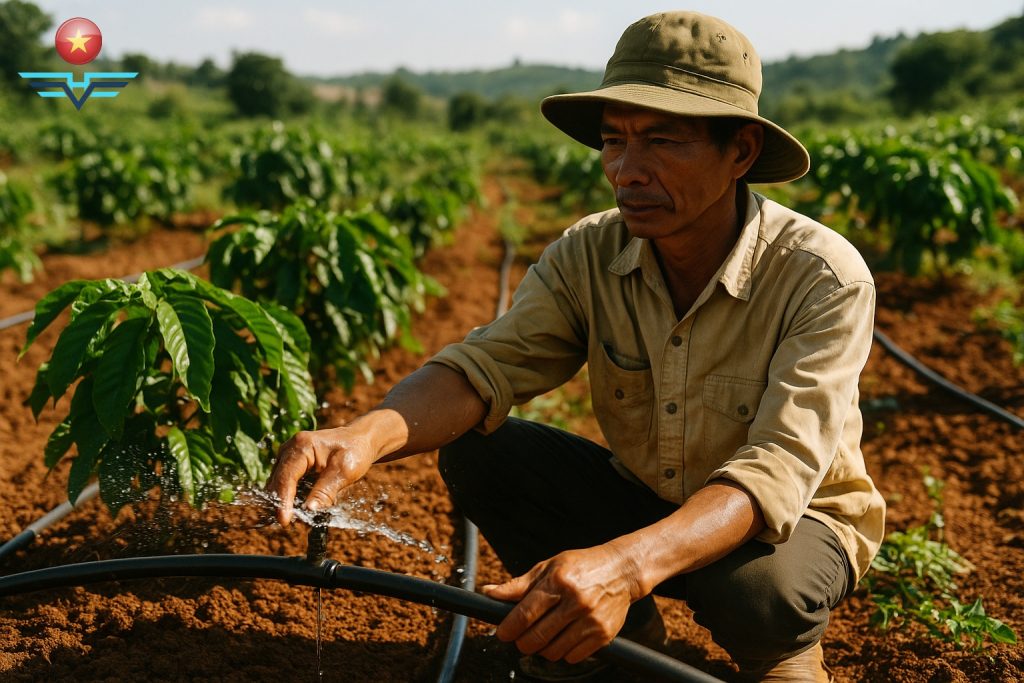
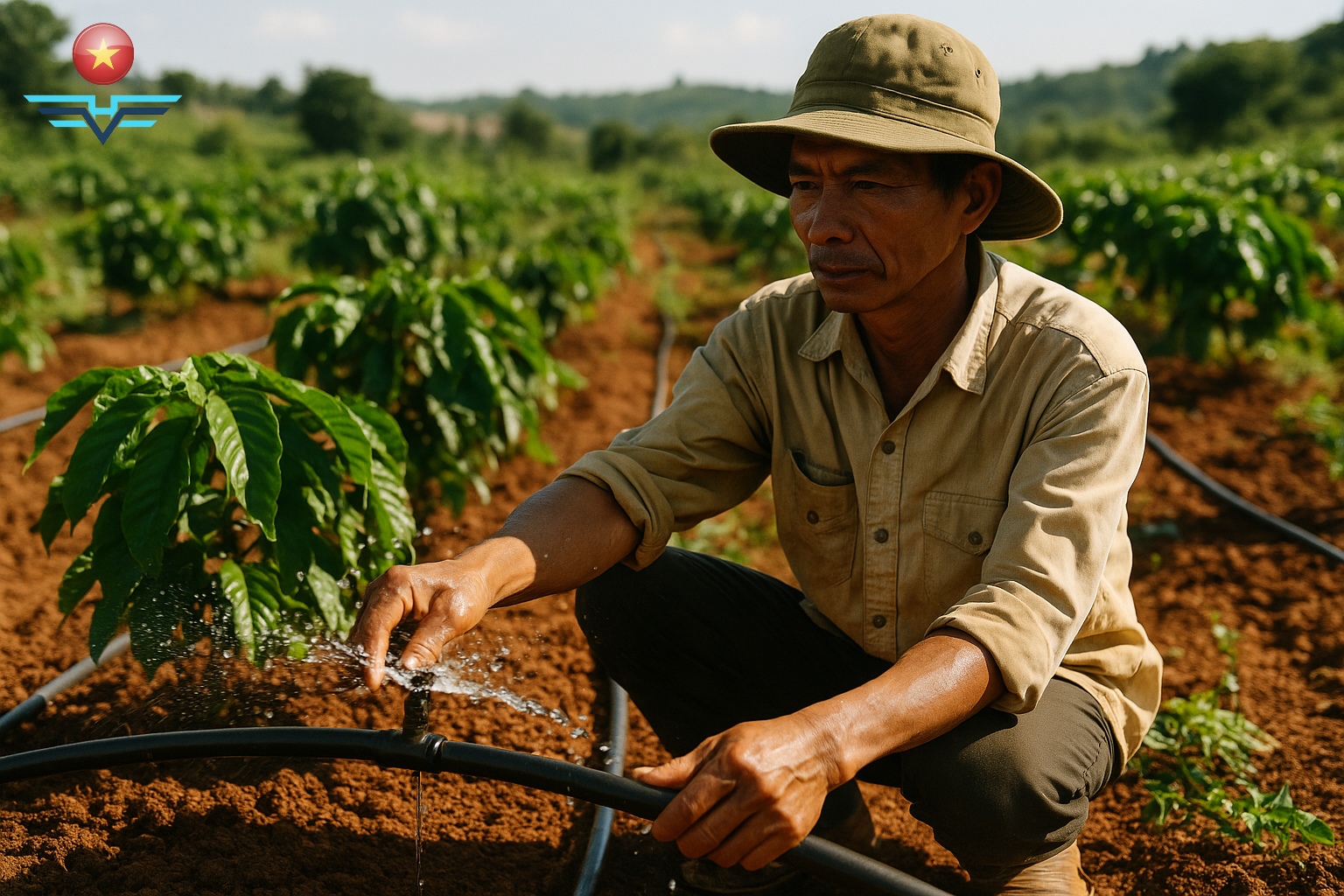
Recently, the water-saving irrigation (WSI) model has been widely adopted by orchard farmers in Dong Nai Province, bringing impressive results. This method of delivering water and fertilizer through a network of pipes has boosted crop yields, reduced pests and diseases, and significantly lowered input costs.
Farmers Sleep Easier
In Hung Loc Commune, Thong Nhat District—one of the localities where WSI is now common—nationally recognized farmer Nguyen Thanh Phuoc proudly shared: “Since installing this system, we can finally sleep well. No more dragging hoses around the orchard every day. Now, when it’s time to water or fertilize, I simply dissolve the fertilizer in water and press the button to activate the WSI system.”
Phuoc’s six-hectare orchard grows tangerines, rambutan, durian, and mango. Previously, with traditional basin irrigation, his 400 tangerine trees yielded about 5 tons of fruit with poor appearance. After installing WSI, output doubled to 10 tons with higher-quality fruit that fetches premium prices. Durian trees, in particular, now produce consistently (10–15 tons per hectare), with stable moisture levels preventing disease and avoiding damage from early-season rains.
Pioneers and Innovators
In Hung Loc, everyone knows two pioneering farmers: Nguyen Thanh Phuoc of Hung Nghia Hamlet and Vo Van Thanh of Hung Thanh Hamlet. They were the first to adopt WSI and later refined the system to make it easier to install and cheaper—20–25% less expensive than the rigid plastic-pipe systems they had originally studied in Xuan Loc.
Thanh’s two-hectare farm, with 800 pepper posts intercropped with coffee, is thriving. “Before, pests and diseases were overwhelming,” he said. “But just a year after installing WSI, my pepper harvest jumped from 1.7 tons on 800 posts to 5–7 tons, earning over 200 million VND per hectare—four times more than before. The investment in WSI paid for itself within a few seasons.”
Nearby, Nguyen Thien Liem (“Muoi Liem”) also adopted WSI for his 5,000 m² seedless guava orchard. During our visit at midday, the quiet orchard was cooled by the gentle mist of tiny WSI nozzles spraying from the base of each tree. “The best thing is how this system cuts costs and saves labor,” Liem said. “When the trees are fruiting and the sun is hot, just turning on the system cools the entire orchard within minutes.” Previously, watering 800 guava trees took two full days with hoses; now, with WSI, it takes about five hours.
Widespread Adoption
According to Bui Dinh Buoi, head of the District Agriculture and Rural Development Office, nearly 1,400 hectares of perennial crops in the province—pepper, mango, pomelo, coffee, durian—now use WSI and apply fertilizer through pipes. Many vegetable growers have followed suit. The system cuts labor by up to 90% and saves 30–50% of irrigation water.
From an idea sparked in 2000 after observing a model in Xuan Loc, Phuoc and Thanh have since introduced WSI to more than 100 households in Hung Loc, covering 120 hectares of fruit trees. Demand has spread across the district, with “WSI neighborhoods” emerging. Two dedicated “rapid-response teams” now help farmers in other provinces such as Tien Giang, Ba Ria–Vung Tau, and Binh Duong install the system. In the last two years alone, nearly 1,000 additional hectares of perennial crops in Thong Nhat, Cam My, and Trang Bom have adopted WSI, proving it a breakthrough innovation for Dong Nai’s agriculture.