
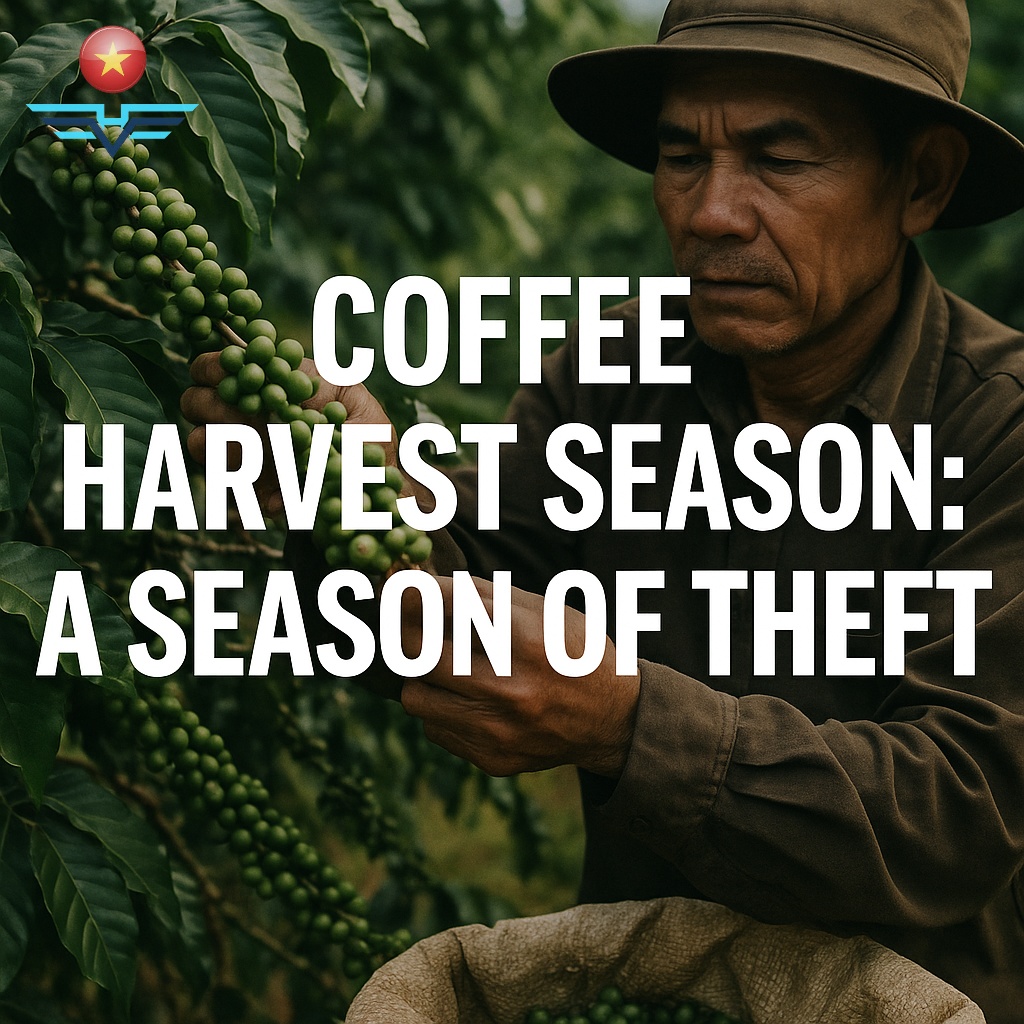
As the rainy season ends and the coffee cherries are still unripe, farmers rush to pick their crop early—driven by fear of thieves. Everyone knows harvesting green cherries reduces both yield and quality, but what choice do they have?
In Cư M’Gar District (Đắk Lắk), farmer A Ma Gel was already stripping green cherries from his coffee trees—at least two weeks before they would fully ripen. “We sweat and toil to grow this crop,” he said bitterly. “If we don’t pick it now, thieves will.”
When coffee prices rise, he explained, thieves swarm “like ants.” Wherever they roam, plantations are left devastated. Across the region, farmers have built makeshift huts right in their fields to guard their coffee.
Nearby, husband and wife Đặng Minh Thuận were in shock after thieves stripped every cherry from their 500 trees—about half a hectare—in a single night. “Report to the commune authorities immediately!” Thuận urged his wife. He barked orders to his two strong sons: “Bring the four dogs here. Tie one to each corner of the plot. And bring me a hammock.” He was determined to camp out in the field.
Living in Constant Fear
Taking no chances, Phan Thanh Hải in Tây Hoà Hamlet, Chư Pao Commune, Krông Buk District, pointed to a hut by his coffee trees: “As soon as the cherries start to harden, I pitch my tent to guard them. I don’t wait for them to fully ripen.”
In Hợp Thành Hamlet, Thống Nhất Commune, farmer Nguyễn Hồng Lam said theft had become so rampant that locals formed volunteer night-watch teams. “Every evening at about 4:30 p.m., these ‘farmer patrols’ head out to roam the plantations, crossing from Thống Nhất to Ea Siêng, keeping watch until dawn,” he explained.
Meanwhile, the commune loudspeakers broadcast daily warnings: urging farmers not to harvest green cherries and announcing: “After 5 p.m., anyone found in the coffee fields is assumed to be a thief and will be brought to the commune offices.”
“But these plantations stretch for thousands of hectares—no one can guard every tree,” Lam sighed. In Buôn Hồ, one of the oldest coffee regions of the Central Highlands, some growers even enlist local army units to help guard their crops.
According to Lam, thieves are well equipped: they carry cell phones, study the terrain, and learn each household’s routines. They strike when families are busy eating or resting, harvesting whole sections unseen. In Chư Pao Commune, there are even rumors of entire hamlets devoted to coffee theft, some using tractors to haul away stolen cherries. More commonly, thieves ride motorbikes, quick and mobile, striking across the Central Highlands.
“What Can We Do?”
Across the region, more than 500,000 hectares of coffee are expected to yield about 24 million bags this season—worth an estimated 1.7 billion USD in exports.
Yet even as church leaders publicly urge people not to steal—“It is shameful!”—coffee still vanishes, sometimes even as the priest is preaching. “Just a few minutes and a thief can strip a ton of fresh cherries worth six million đồng,” calculated a roadside tea-seller along Highway 14. “What job pays that easily?”
Local authorities in Đắk Lắk repeatedly warn farmers not to harvest green cherries, since doing so reduces yield by 15–35 % and, worse, damages Vietnam’s coffee reputation on the global market. “But if we wait for full ripeness, the thieves will get it first,” said one farmer in Krông Buk.
“The loudspeakers keep telling us not to pick green cherries,” added Phan Thanh Hải, “but the plantations are vast—who can patrol them all? The thieves roam freely. We can’t expect the police to guard every coffee field; that’s impossible.”