
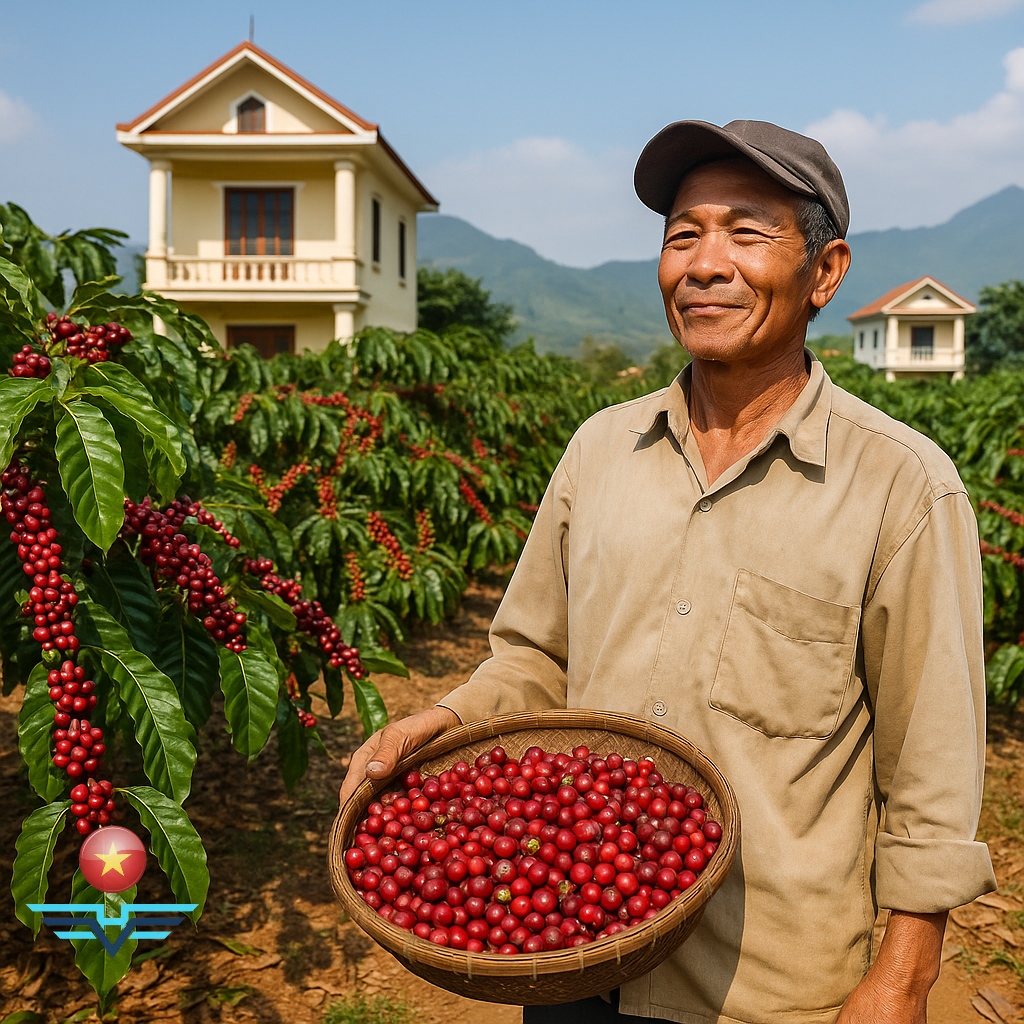
Once again, farmers in Hua La Commune (Sơn La City) are enjoying a successful coffee harvest. This year the yield may not be as high as expected, but the purchase price for fresh coffee cherries remains strong.
Under a week of blazing sun, the ripening of cherries in the fields has accelerated. Groups of hired pickers, faces wrapped in scarves, work swiftly, stripping the bright red cherries into sacks. By late afternoon, from 5 to 6 p.m., the roads leading to Hua La’s hamlets are bustling and noisy. Buyers and sellers crowd in, and trucks queue up to haul coffee away.
A “Two-Storey House” Hamlet
From his coffee field, Nguyễn Văn Tiện led us back to his home in Hoàng Văn Thụ hamlet. Among the vast green coffee landscape stand striking two-storey villa-style houses.
In recent years, alongside tending 1.8 hectares of coffee, Tiện has also opened a small processing workshop at home. His family’s beautiful multi-storey house was built entirely thanks to coffee. “This year, flowering and fruit set were favored by good weather. My family should harvest over 16 tons of coffee—worth more than 120 million đồng,” he said.
In 2009, total revenue from coffee growing and processing in Hua La reached 41 billion đồng—two-thirds of the commune’s total output. Today only 68 out of 1,448 households remain poor.
Hoàng Văn Thụ hamlet alone has 52 households; nearly every family grows coffee—at least 1 hectare, some as much as 3. “Our hamlet now has 66 hectares under coffee and could expand to 100 hectares next year,” said village head Nguyễn Xuân Thuyết. Many families also lease land in other hamlets and communes of Sơn La City or Mai Sơn District to plant more coffee.
Not only ethnic Kinh families but also many ethnic minority households have prospered from coffee. For example, Lều Văn Yên, a Thái farmer in Sàng hamlet, has for years been recognized as an outstanding provincial coffee grower.
Coffee provides jobs for thousands of local workers and draws hundreds of seasonal laborers from Sông Mã and Yên Châu districts at harvest time. On average, a coffee picker earns about 100,000 đồng per day, with skilled pickers making up to 200,000 đồng.
Support for Coffee Farmers
Coffee has been grown in Hua La for about 20 years, but only in recent years has it delivered real economic returns. According to Lèo Văn Toan, Chairman of the Hua La Farmers’ Association, introducing new coffee varieties and expanding technical training have steadily raised both yield and quality.
The commune now has more than 800 hectares under coffee, including 106 hectares newly planted in 2010. The Farmers’ Association is encouraging residents to convert mixed gardens into coffee plots. Poor or low-income households receive preferential loans from the Social Policy Bank.
Hua La’s 1,448 households live in 15 hamlets, and 95% of the population are ethnic minorities. The ability to adopt new farming techniques varies widely. Local authorities and the Farmers’ Association have organized mutual-help programs—better-off households mentor poorer ones, and Kinh families share their experience with ethnic minority neighbors. Each year the city’s Farmers’ Association, in cooperation with the provincial Agricultural Extension Center, holds training sessions to improve coffee cultivation skills.
Even with these gains, farmers here still worry about weather and disease. “If we have heavy frost, not only will yields fall, but our livelihoods could collapse as coffee trees die en masse,” Tiện explained. “Symptoms like flower drop from frost and brown spot disease on young leaves have appeared in Sơn La coffee for many years, but no scientific agency has yet provided us with an effective solution.”