
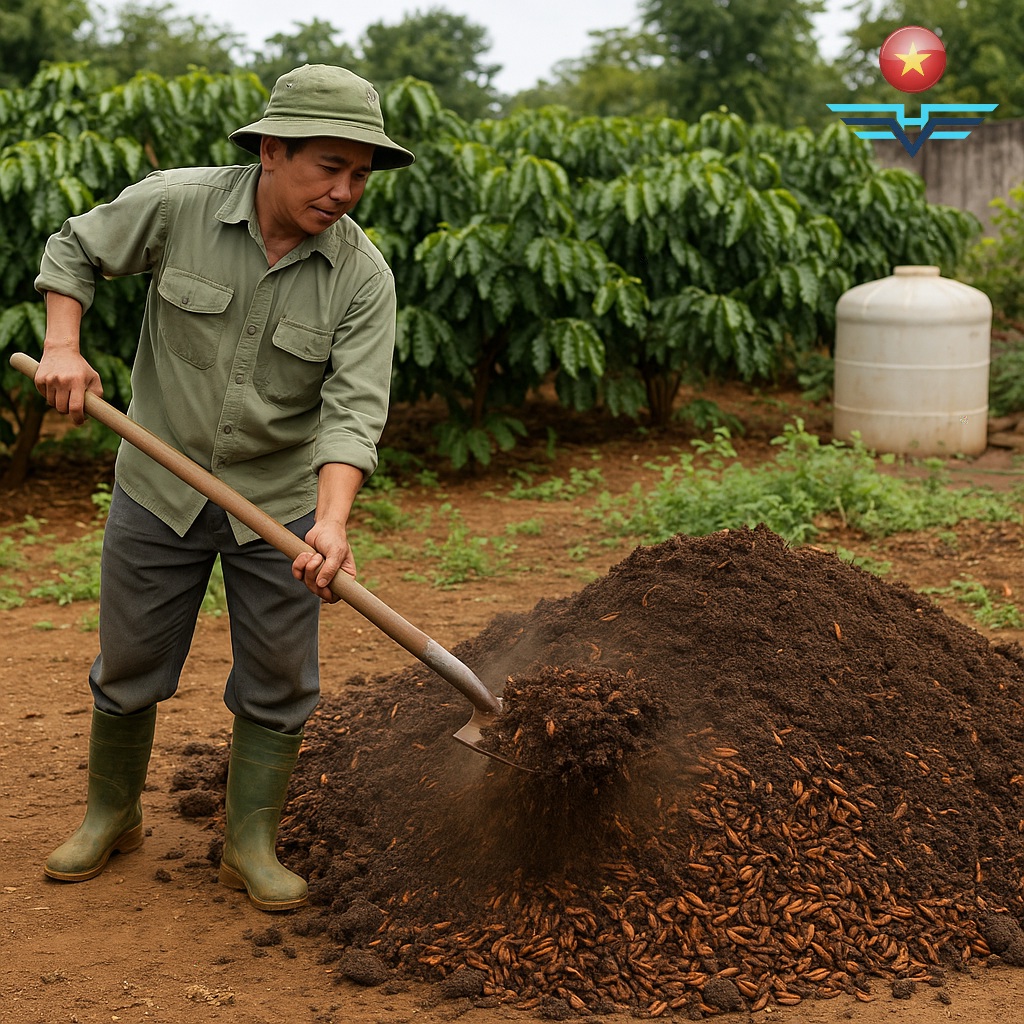
Đắk Lắk Province has a large supply of agricultural by-products, especially coffee husks, that can be converted into compost. To protect the environment and help farmers cut costs, the People’s Committee of Thiện An Ward (Buôn Hồ Town) is guiding households to turn coffee husks into organic bio-fertilizer.
Coffee-Growing Area and Waste Challenge
Table of Contents
Thiện An Ward has around 1,142 hectares of coffee and nearly all households depend on coffee for income. In the past, coffee husk waste after harvest caused serious environmental concerns for both authorities and residents.
Adoption of Bio-Fertilizer Production
Over the last two years, nearly half of local households have started to recycle coffee husks. Initially, just over 10 families tried the method, but when its effectiveness became clear, many others followed and began producing their own organic bio-fertilizer.
Training and Technical Support
In early 2009, after receiving technical guidance from 333 Fertilizer Company, the ward’s agricultural extension station held training sessions. Farmers learned how to create bio-fertilizer from coffee husks, corn husks, and cashew shells. This process cuts costs, reduces pollution and greenhouse-gas emissions, and can replace 30–70% of chemical fertilizers.
Economic Benefits and Cost Savings
Turning 10 tons of coffee husks into organic fertilizer requires only eight workdays and costs about 600,000–700,000 VND per ton, taking less than three months to complete—while natural decomposition would take nearly two years and produce lower-quality fertilizer.
Improved Soil and Crop Health
The once common sight of discarded coffee husks and other by-products has largely disappeared. Organic compost enriches the soil and provides high nutrient content. Unlike chemical fertilizers that can harden soil and leave chemical residues, organic fertilizer keeps coffee plants healthy and productive. Farmer Nguyễn Ánh Dương reported saving about 5 million VND per hectare in fertilizer costs while maintaining high coffee yields.
Ingredients for Bio-Fertilizer
Farmers combine decomposed animal manure with lime, phosphate, Trichoderma fungus, and other biological agents. This method turns animal waste into income while reducing environmental damage, though some additives still need to be sourced from other provinces.
Wider Impact and Sustainable Development
The bio-fertilizer model is now spreading beyond Thiện An Ward. Farmers from neighboring wards and districts are coming to learn and replicate the model, contributing to sustainable agricultural development in Đắk Lắk.