
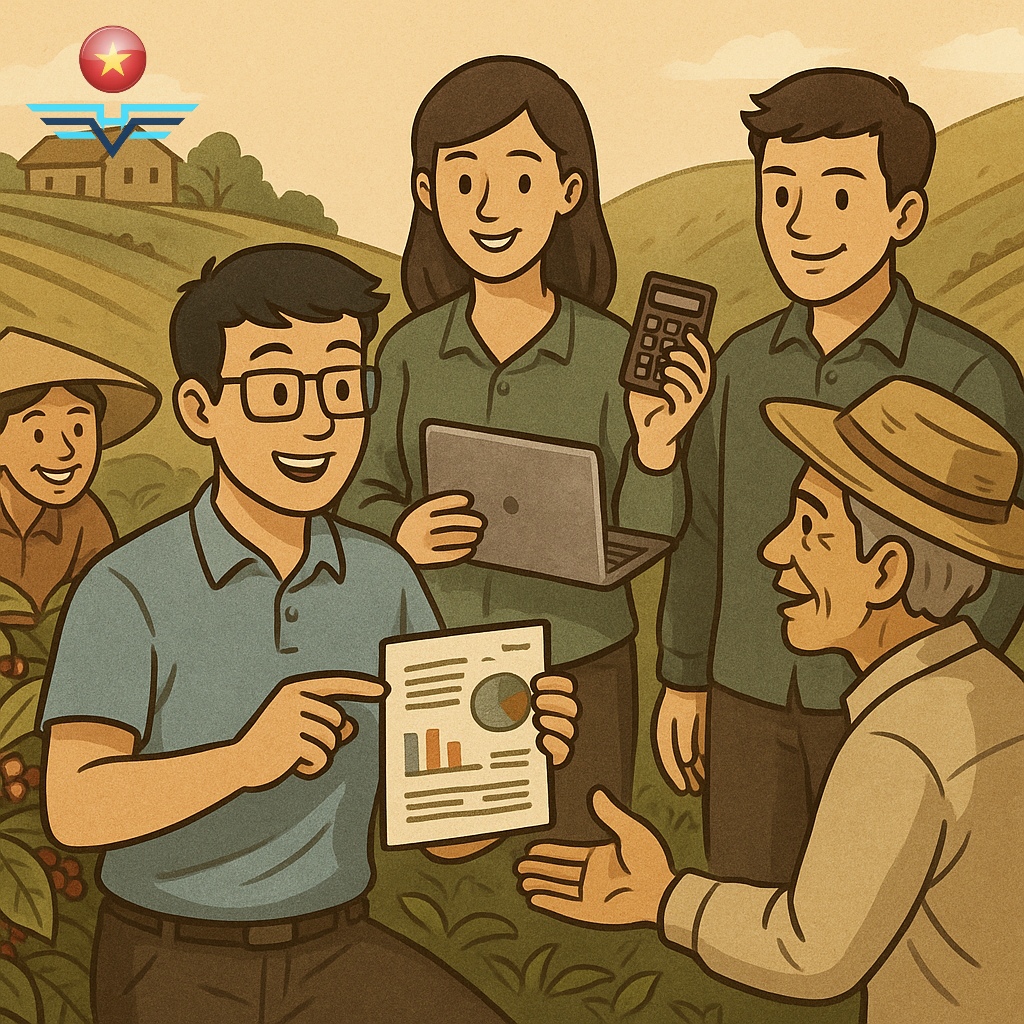
Over the past year, 72 students from the SIFE team of the University of Economics Ho Chi Minh City fanned out in three directions to carry out three projects that helped local farmers save more than 90 million VND. More importantly, these projects are giving farmers long-term, practical solutions tied to everyday life.
Helping Salt Farmers Count the Costs
Table of Contents
Although Vietnam has the natural conditions to produce salt, the quality is often low and faces competition from imported salt. Fourteen SIFE students traveled repeatedly by motorbike to Can Gio to study local salt-making practices.
Team leader Khoa explained that most families still worked the traditional way: channeling seawater into earthen fields to evaporate. The resulting salt was mixed with soil and sold cheaply. The students proposed a simple upgrade: lining the fields with PVC sheets. This method produces clean, white salt crystals as good as refined salt.
The biggest challenge was financing. Since salt farmers have no collateral, the students researched micro-credit options that allow poor households to borrow without assets. They connected the farmers to four local loan funds supporting women, youth start-ups, and poor households.
To prove the benefits, the team prepared cost-benefit spreadsheets comparing old and new methods, trained farmers to register for loans, and even showed them how to research micro-credit opportunities online. Khoa added that next they plan to develop job options for farmers in the off-season to diversify income.
Turning Coffee Husk Waste into Bio-fertilizer
Another group of fourteen SIFE students went to Tân Hà (Lâm Hà, Lâm Đồng), where more than 70% of residents grow coffee and produce around 14,000 tons of coffee husk waste annually. Left to decompose, the husks can spread disease and pollute the environment.
The students partnered with a company supplying microbial cultures to turn the husks into organic fertilizer. After convincing local officials of the plan’s value, they brought in experts to train farmers. For just a few tens of thousands of dong worth of microbial starter, farmers could mix and turn the husks a few times; after 45 days the waste became a rich fertilizer.
This method saves local growers tens of millions of dong every year and reduces the use of chemical fertilizers by about 8.5 tons annually, protecting both soil and environment. The team also connected economics lecturers with farmers to help them gauge coffee market trends and plan harvest sales.
Marketing Safe Vegetables
What exactly counts as “safe vegetables” or GAP-certified produce? The confusing terms leave both consumers and growers uncertain. A third SIFE group visited Cu Chi and Binh Chanh districts—major vegetable-growing areas around Ho Chi Minh City—to bridge the gap between growers and shoppers.
They assessed farms against international GAP (Good Agricultural Practices) standards and chose the Tho Viet cooperative for a pilot program. There, they trained sales staff in marketing techniques—how to present the farm’s certifications and appeal to customers’ senses of sight, sound, and taste.
With support from the Big C supermarket chain, the team organized a public tasting and information session. The event raised consumer awareness and will be replicated at other outlets such as Lotte Mart and Binh Tay market.
Four Projects, One National Award
Although funding was difficult because the projects were purely community-oriented, the SIFE team leveraged every resource to launch four initiatives. Beyond the three agricultural projects, their “Green-agers” program taught children how to save electricity at home.
These four projects won second prize at the 2010 national SIFE competition, themed “Business Intelligence, Heart for the Community,” surpassing ten other university teams. First place went to the National Economics University in Hanoi, which will represent Vietnam at the SIFE World Cup in Los Angeles in October 2010.