
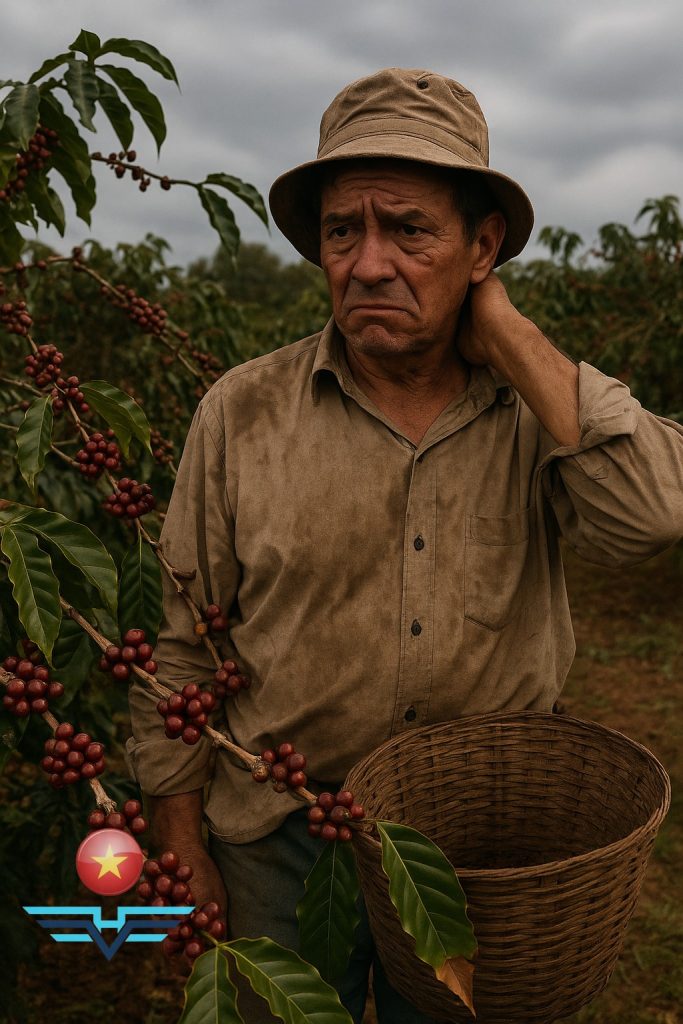
For more than ten days now, coffee prices across Vietnam’s Central Highlands have been climbing steadily. But while prices rise, local coffee farmers can only sigh—there’s no coffee left for them to sell.
At present, coffee prices stand at about 26,200 VND per kilogram in Đắk Lắk and Lâm Đồng; 26,000 VND in Gia Lai (up 100 VND from June 19); and 26,000 VND in Đắk Nông (also up 100 VND from June 19).
Prices Rise—But Stockpiles Are Gone
This year’s coffee yields are down, so farmers had been hoping for prices high enough to offset a year of hard labor. Yet many sold early, as soon as prices touched break-even levels in May.
Trần Ngọc Tùng of Nam Yang commune, Đắk Đoa district (Gia Lai), said his family harvested about 6 tons of green coffee beans. When prices reached 25,000 VND/kg, he sold everything to pay off bank loans and reinvest. “Now prices have passed 26,000 VND/kg—I regret it, but what can I do? I’ve already sold it all,” he admitted.
Tùng added that nearly no one in Nam Yang still has coffee in storage. Others were less fortunate: strapped for cash, some farmers had to accept advance payments from small traders on very unfavorable terms. After harvest they were forced to deliver their coffee at prices two “grades” lower than market rates—or gamble by pre-selling their crop while it was still on the tree, regardless of how the market moved.
Similarly, Lê Anh Khuê of Chư Pơng commune, Chư Sê district (Gia Lai) said his family sold 7 tons at 25,000 VND/kg. “That price just broke even, but we had to hire laborers. Without selling, how could we pay the bank and fund the next crop?”
The Need for Careful Financial Planning
Recent market swings show how volatile coffee pricing can be. After the London coffee exchange closed one session, local prices dipped only 100 VND/kg. When the exchange reopened the next day, domestic prices jumped 200 VND/kg. Many expect continued fluctuations.
About 10 percent of growers with stronger finances are still holding beans, hoping for higher prices. But coffee prices are driven largely by speculative forces, so anyone trading must stay cautious.
In Gia Lai, many coffee buyers play it safe: they secure a resale contract first, then purchase beans for quick turnaround, earning only a small margin but keeping risk low.
To actually profit from a grueling year of work, experts advise farmers to plan finances carefully—divide their harvest into portions: some to repay debts, some for reinvestment, and, if possible, hold a small part to sell later if prices rise. But if prices already ensure a healthy profit, it’s often wiser to sell rather than hold out for a possible spike.
According to Võ Ngọc Hiếu, Director of Gia Lai Coffee Company, even at more than 26,000 VND/kg, prices haven’t truly offset the higher costs and steep bank interest rates. “Many who sold early in the season at 24,000 VND/kg are not really any worse off than those selling now,” he noted.