
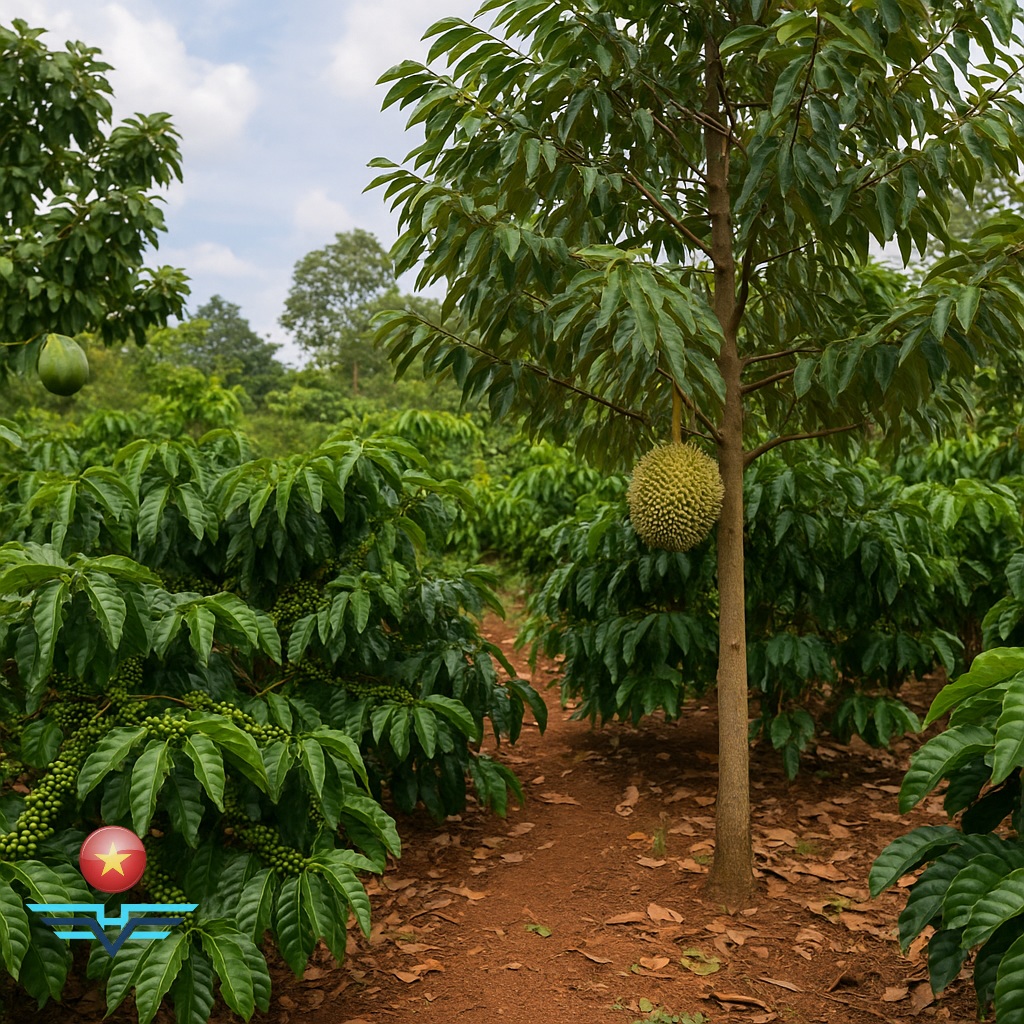
District Leads in Mixed-Cropping Models
Table of Contents
Cư M’Gar District, a key coffee-growing region of Đắk Lắk with over 30,000 hectares of robusta, has expanded thousands of hectares of diversified perennial cropping systems. These intercropping models deliver far higher economic returns than planting coffee alone and make the district a provincial leader in crop diversification.
Ethnic Minority Farmers Invest in High-Value Fruit Trees
After learning from successful examples, many ethnic minority households have intercropped high-quality fruit varieties—such as grafted buttery avocados, seedless golden-flesh durians, sweet oranges, tangerines—and even black pepper among their coffee trees. These additions bring steady extra income while maintaining robust coffee yields.
Economic Gains from Diversification
According to the Cư M’Gar People’s Committee, one hectare of mature coffee interplanted with 160–280 pepper vines on living supports—or about 370 vines on dead supports—can produce 2.8–3 tons of green coffee beans and at least 1 ton of black pepper annually. Interplanting durian at about 90 trees per hectare adds more than 20 million VND per household each year once the durian begins fruiting.
Successful Farmer Examples
-
Nguyễn Văn Hùng of Ea M’Nang commune planted 80 grafted avocado trees in his 1-hectare coffee plot. After three years, each avocado tree yields 800,000–1 million VND, while coffee output remains steady at 3 tons per hectare. In the 2009–2010 season, his family earned nearly 144 million VND, with avocados contributing about 75 million.
-
Hồ Văn Sỹ of Ea Pốk town intercropped 160 black pepper vines climbing on lồng mức shade trees in his coffee field, earning nearly 50 million VND in addition to 3 tons of coffee beans.
Lower Water Use and Environmental Benefits
Intercropped perennial fruit trees thrive with minimal care and reduce the number of irrigation rounds. In this year’s prolonged dry season, diversified coffee gardens required only 3–4 irrigations compared with 5–6 for pure coffee plots.
Expert Insights on Sustainability
MSc. Nguyễn Thị Tuyết of the Western Highlands Agriculture and Forestry Science Institute highlights that diversifying crops on coffee land reduces risks when coffee prices fall, increases farm-product variety, and improves the microclimate by raising humidity and lowering temperatures. This not only maintains ecological balance and supports healthy plant growth but also significantly boosts farmer profits.