
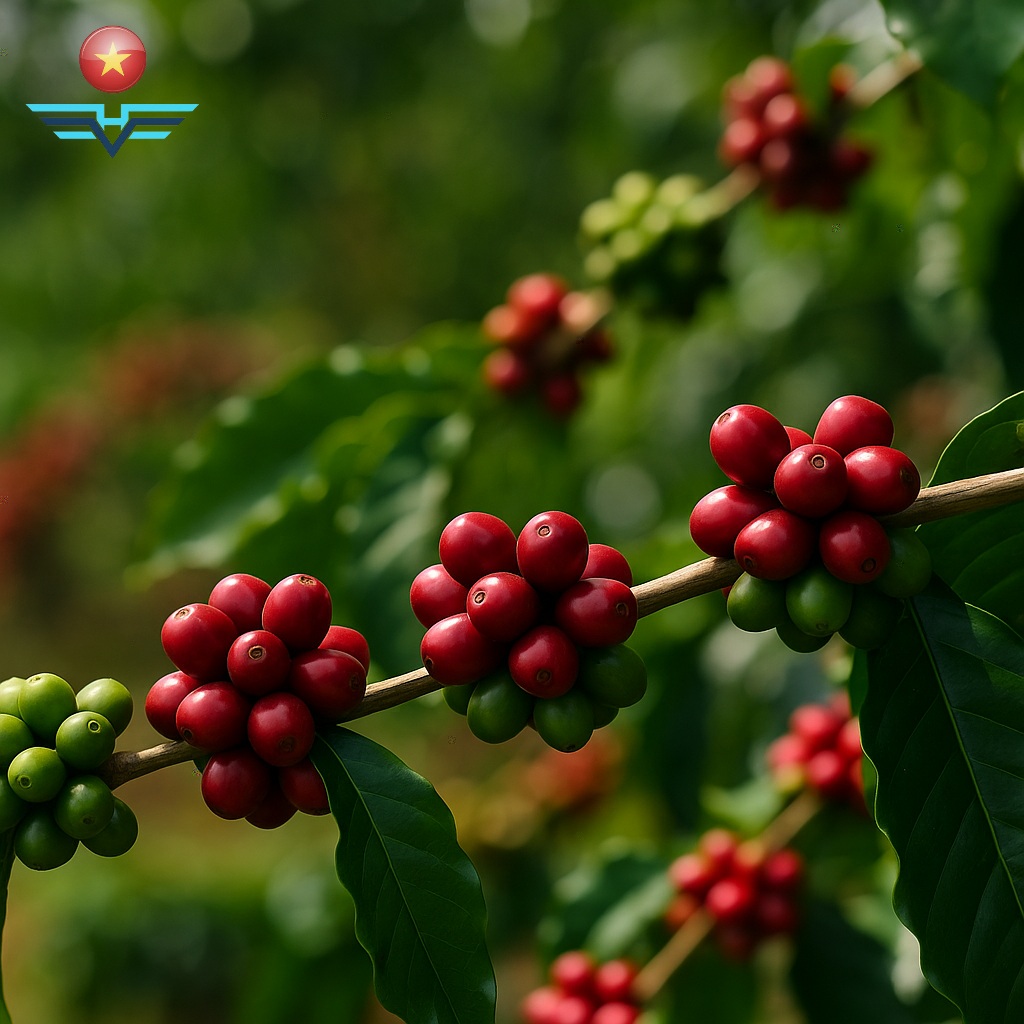
Returning to Ea Bar—the rare highland area in western Phu Yen where coffee trees have endured the harshness of nature and the ups and downs of the market—you now see coffee flowers blooming white across the hillsides and many newly built, solid homes.
Remembering the Early Days
Twenty-four years ago, Y Rức, a young Ê Đê boy from Buôn Thứ village, Sông Hinh District, guided officials from the Phu Khanh Coffee Company with his machete through more than 7,500 hectares of wild, sun-scorched grassland at 450 m above sea level.
Like soldiers on a mission, the pioneers carried the mandate: within six years, 1,000 ha of coffee had to be planted under a Vietnam–Poland cooperation agreement. Even before the first seedlings left their nursery, the new farm had to feed and clothe over 400 workers. Each weekend, I would hitch a ride on the farm’s IFA trucks from Hai Rieng town to take photos. Workers lived in teams under simple thatched huts. Despite shortages, everyone saved to send photos home. Young love quickly blossomed on this new land—Deputy Director Đặng Văn Trung joked that in 1991–92 alone nearly 200 weddings were celebrated.
Weddings were modest—no lavish banquets—but photos and singing were essential. The very first wedding united Phan Thanh Quyền (now Head of Sông Hinh District Culture & Information) and Trần Thị Kim Phượng, both known for their singing. Quyền once wrote in his journal that perhaps his child would one day become a journalist and tell the story of his youth here. A year later, his wife gave birth to baby Phương on June 21. Within a year of those weddings, hundreds of children were born—the first babies’ cries to echo across this once-empty land. I photographed parents proudly holding infants beside young coffee trees, the images traveling back to distant home villages.
“Swimming Across the River” Alone
After four years, 400 ha of coffee blanketed the hills, 24 ha already flowering. Then came hard times. In 1990, geopolitical changes ended the agreement with Poland. Central funds dried up, the new province of Phu Yen had none to spare. Director Lê Văn Trung appealed everywhere but was told simply: “You’ll have to swim across the river on your own.”
Disaster followed: in 1991 volcanic ash from the Philippines yellowed leaves and stripped them; in 1992 borers spread; in 1993 historic storms and floods hit. Coffee failed to fruit. How to protect the six billion VND already invested and feed 450 employees and their families, many unpaid for a year? Some workers left.
To survive, management dared the unthinkable—selling unripe coffee. They reorganized labor and allocated land and coffee plots directly to families, making each household responsible for production. Workers grew rice, beans, sesame, and raised poultry and livestock—“grow rice and beans in order to grow coffee,” as the farm slogan said. This strategy worked: hundreds of workers stayed.
By 1993–95, with 600 million VND from government programs 120 and 327/CT and another half-billion VND in loans, the farm built roads, wells, a school, planted 150 ha of forest and protected 200 ha of watershed. With land and plots in their own hands, workers invested and cared for their coffee. By the 1995–96 harvest the farm produced nearly 300 tons of green beans worth over five billion VND, with some plots yielding 1.2 tons/ha.
Prosperity from Coffee
I eventually reached Station 2, once Team 6, home of “old man” Trung (affectionately named to distinguish him from the two leaders—Director Lê Văn Trung and Deputy Director Đặng Văn Trung). Now 75 and a 52-year Party veteran, he is still energetic. Though his son is a university lecturer in Đà Nẵng and a PhD student in France, and though he owns property elsewhere, he and his wife still live in the pretty house amid the coffee trees he planted himself.
“I was the one who opened this land,” he explained. “I brought people here and urged them to stay through the hardest years. How could I leave when I’m still healthy? I love the Arabica coffee I introduced. It’s peaceful here.” In 1990, under his leadership, one hectare of Arabica was trial-planted to replace Robusta; it proved far more productive and valuable. The entire farm later converted to Arabica.
Today the Ea Bar Coffee Farm—now Ea Bá Coffee Company—remains rooted in this fertile basalt soil. It taught local ethnic minority families to cultivate coffee and helped make Ea Bar prosperous. Arabica yields three times more than Robusta: about 14 tons of fresh cherries per hectare, with seven tons of cherries producing one ton of green beans. At an average export price of 3,000 USD per ton, each hectare earns roughly 50 million VND. Most worker families now manage two hectares, and the company’s 1,000 ha of Arabica generates some 50 billion VND annually. In addition, it maintains 321 ha of three-year-old rubber and 60 ha of paddy rice to secure local food supply.
Nearly twenty-five years have passed, yet many of the young workers I met in their late teens or early twenties have stayed, devoting their youth to coffee and building wealth by their own labor. For them, this once-strange land has truly become home. They will never forget those years—just as musician Xuân An wrote in a song for the farm: “Do you understand why the sweet fruit of the coffee tree carries the lingering taste of bitterness?”