
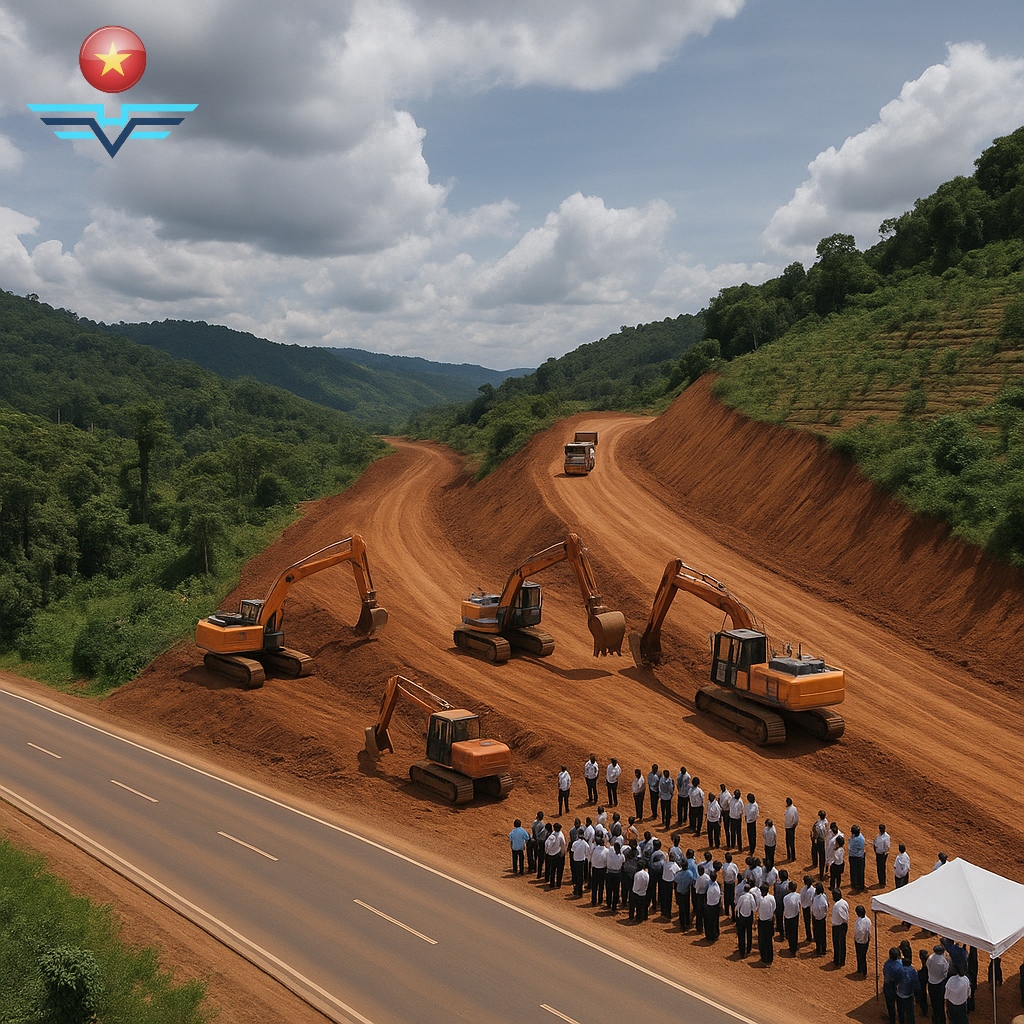
Despite maintaining GDP growth of over 10% annually since 2001—at times double the national growth rate—the Central Highlands remains an underdeveloped region whose potential has yet to be fully realized, according to Mai Văn Năm, Standing Deputy Head of the Central Highlands Steering Committee.
To help “awaken” this still-untapped land, the Steering Committee hosted a meeting with businesses and investors on the morning of August 12 to prepare for the Central Highlands Investment Promotion Forum 2009, scheduled for September 5 in Buôn Ma Thuột (Đắk Lắk).
35–40 Trillion VND Needed for Development by 2010
At the meeting, Deputy Minister of Planning and Investment Nguyễn Bích Đạt outlined the key issues facing the Central Highlands. While the regional economy has grown rapidly, it remains unsustainable. Agriculture and forestry dominate the GDP structure, yet forest protection is highly complex. Industry has developed, but still lacks competitive products and has very limited exports.
“Compared to the rest of the country, foreign direct investment (FDI) projects in the Central Highlands account for only about 1.4% of total projects and less than 0.5% of total investment capital. In particular, while Vietnam attracted over USD 70 billion in FDI in 2008 and more than USD 10 billion in the first seven months of 2009, the Central Highlands has barely participated in this inflow,” Đạt noted.
He estimated that the region would need about 35–40 trillion VND in development capital by 2010. The state budget can meet only about 35% of that demand, leaving 65% to be mobilized from other sources such as ODA, FDI, and domestic capital.
Not Just About Money
For businesses, however, the challenge goes beyond financing.
Nguyễn Văn An, Chairman of Thái Hòa Group—Vietnam’s leading exporter of roasted coffee—shared that delays in securing bank guarantees had postponed the operation of Thái Hòa’s instant coffee processing plant in the Central Highlands until 2011.
According to An, raising capital itself is not difficult; many financial institutions were willing to provide project loans. But such financing requires a strong domestic bank to provide guarantees. This, he said, is the greatest barrier, delaying projects and altering key objectives in the company’s development strategy.
Dương Văn Hoà, Deputy General Director of Vietnam National Coal and Mineral Industries Group (TKV), highlighted multiple “bottlenecks” that remain when investing in the Central Highlands: difficult land clearance, weak infrastructure, and a labor force that is both limited in quantity and quality—even for unskilled work.
For example, both main road systems leading into the Central Highlands are narrow and degraded, making transportation and logistics challenging. Land ownership disputes slow land clearance, and compensation levels are often too low to reach agreements with landowners. Hoà noted that with TKV projects worth thousands of billions of đồng, even a few months’ delay means a significant increase in interest costs.
TKV even had to select 11 local students who had not qualified for domestic university entrance to send abroad for special training—another sign of the difficulties in recruiting skilled staff. Hoà also revealed that among the thousands of workers in TKV’s Central Highlands projects, only a small proportion are from ethnic minority communities, despite the large local population.
Drawing on years of experience in the region, Thái Hòa’s chairman emphasized that increasing the added value of Central Highlands agricultural products must be given serious consideration as a key driver of regional economic growth. At present, selling only raw, semi-processed agricultural goods means the region is losing roughly 35% of the potential value these products could bring.
For major investors like TKV and Thái Hòa, the obstacles in the Central Highlands are clearly about far more than just capital.