
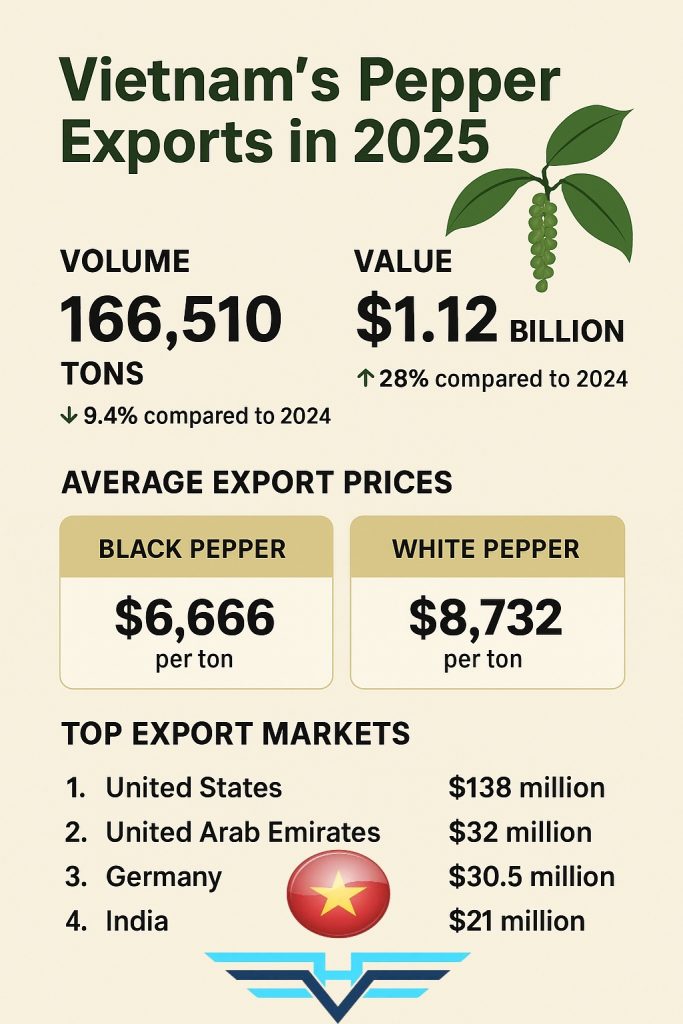

Vietnam’s pepper industry has demonstrated remarkable resilience in 2025, achieving significant export revenues despite a decline in volume. According to the Vietnam Pepper and Spice Association (VPSA), the country exported a total of 166,510 tons of pepper in the first eight months of 2025, including 142,627 tons of black pepper and 23,883 tons of white pepper. This represents a 9.4% decrease in volume compared to the same period in 2024.
Export Value Soars Amidst Volume Decline
Despite the reduction in export volume, the value of pepper exports surged by 28% year-on-year, reaching over $1.12 billion. This growth can be attributed to a significant increase in average export prices. The average export price for black pepper rose to $6,666 per ton, marking a 41.5% increase, while white pepper prices climbed to $8,732 per ton, up 38% compared to 2024.
Monthly Performance Highlights
- August 2025: Vietnam exported 21,464 tons of pepper, valued at $139.8 million. This was a 2.6% increase in volume and a 1.7% rise in value compared to July 2025. Compared to August 2024, export volume grew by 10.6%, and earnings jumped 19.5%.
- January–February 2025: In the first two months, exports totaled 27,416 tons, generating approximately $184.9 million in revenue. The average export price during this period was around $6,746 per ton, reflecting a 68.2% year-on-year increase.
Export Destinations
Vietnam’s pepper exports reached over 100 countries, with the United States, United Arab Emirates, Germany, and India being the top importers. In 2024, the United States imported $138 million worth of black pepper, accounting for 28.5% of Vietnam’s black pepper exports. Other significant markets included the UAE ($32 million), Germany ($30.5 million), and India ($21 million).
Outlook for the Remainder of 2025
Looking ahead, Vietnam’s pepper industry aims to achieve export revenues of $1.5 billion in 2025, driven by sustained high prices and stable global demand. However, challenges such as climate-related impacts, fluctuating global demand, and trade policies in key markets may influence future performance. The industry remains optimistic about maintaining its position as a leading global supplier of high-quality pepper