
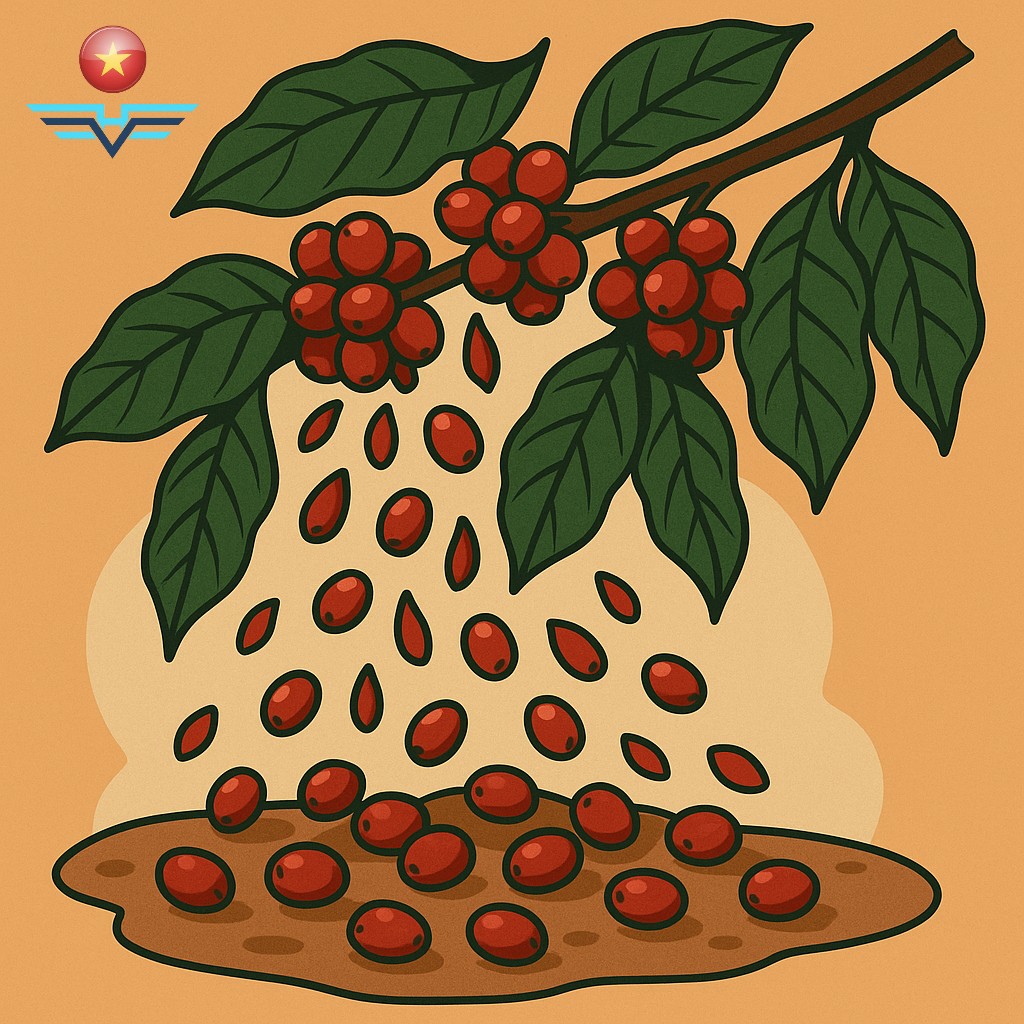
Many coffee plantations in Đắk Lắk are experiencing widespread cherry drop, with some gardens losing up to 50% of their fruit—causing major losses for farmers.
According to Dr. Hoàng Thanh Tiệm, Director of the Central Highlands Agroforestry Science and Technology Institute, coffee trees typically shed fruit for three main reasons: natural physiological thinning (when clusters carry too many cherries and must shed some), pest and disease damage, and nutritional deficiencies.
Surveys of coffee farms across Đắk Lắk show that the main cause of fruit drop is a lack of balanced nutrients. Rising fertilizer prices have led many farmers either to skip fertilization altogether or to apply only nitrogen, while neglecting phosphorus, potassium, and essential micronutrients. As a result, the trees do not receive enough nutrition to sustain the developing cherries, leading to massive fruit drop.
To prevent cherry drop during the rainy season, scientists recommend balanced fertilization: applying a proper mix of nitrogen (N), phosphorus (P), and potassium (K), and supplementing with foliar feeding to nourish the young fruit.
For example, when using Bình Điền fertilizers, farmers can apply to the base of the trees 700–1,000 kg of 16-8-16 + 13S per hectare, or a combination of 300 kg of 16-16-8 plus 150 kg of urea and 175 kg of KCl.
In addition, researchers advise spraying foliar nutrients such as HCR or Dinh Dưỡng specialty fertilizers once a month, ensuring an even mist over the fruit clusters and canopy.
At the end of the rainy season, growers should again apply balanced fertilizers to the root zone, and continue foliar sprays—such as Food-MX4—one to two times per month. This helps prevent cherry drop and provides enough nutrients to produce dense, well-filled beans, improving both yield and quality. It also encourages even ripening, making harvest easier and ensuring beans meet export standards.
Local authorities are urged to disseminate these recommended practices through public media so that farmers across ethnic communities can adopt proper care and intensive farming techniques to achieve high and stable coffee yields.