
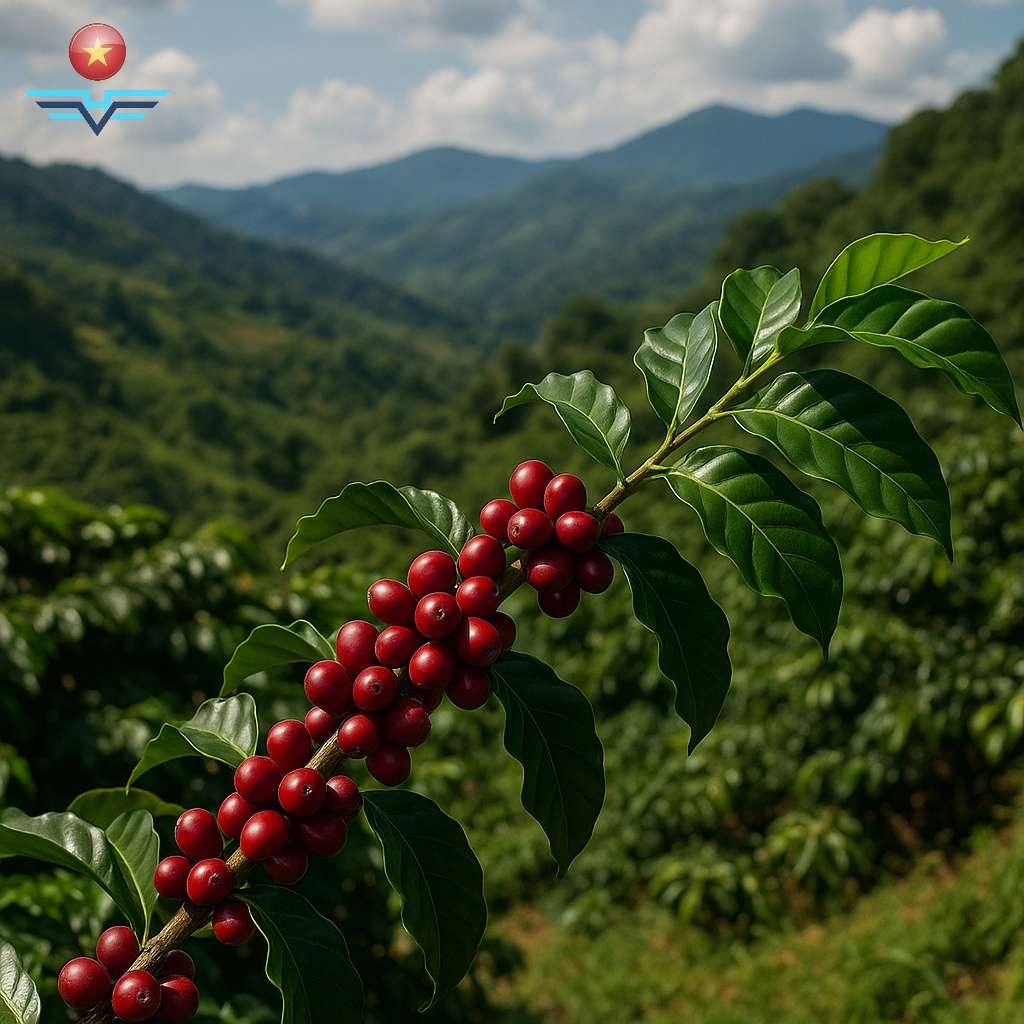
In Vietnamese, Cà phê Chè refers to Arabica coffee (scientific name: Coffea arabica). The name “Chè” (tea) comes from its resemblance to the tea plant — small leaves and short, bush-like stature — both of which are familiar features in Vietnam’s agricultural landscape.
Currently, there are two main Arabica varieties cultivated in Vietnam: Moka and Catimor.
Moka
Table of Contents
Moka is known for its captivating aroma and light, delicate flavor. However, it has very low yields, making it less popular among farmers despite its high export value — often two to three times higher than Robusta. In the domestic market, Moka’s price remains modest because it is not exported in large quantities, and local production costs are too high to make it profitable for most growers.
Catimor
Catimor has a strong fragrance and a slightly acidic taste. Its export price is about double that of Robusta, but it does not adapt well to the Central Highlands climate — the main coffee-growing region of Vietnam — because the fruit ripens during the rainy season and lacks uniformity, resulting in high harvesting costs. Recently, experimental and large-scale Catimor plantations in Quảng Trị Province have shown very promising results.
Economic Importance
Arabica is the most economically valuable coffee species in the world, accounting for about 61% of global coffee production. Depending on its origin, it is classified differently in the trade:
-
Brazilian Milds – from Brazil
-
Colombian Milds – from Colombia
-
Other Milds – from other producing countries
Among these, Brazil and Colombia are the largest exporters and produce some of the highest-quality Arabica coffees. Other significant Arabica producers include Ethiopia, Mexico, Guatemala, Honduras, Peru, and India.
Botanical Characteristics
Arabica coffee thrives in high-altitude areas, typically between 1,000 and 1,500 meters above sea level. The trees have broad, dark-green oval leaves and can reach 4–6 meters in height (or up to 15 meters in the wild). The fruit is oval-shaped, each containing two beans.
Arabica trees begin to produce fruit after 3–4 years, with their productive lifespan lasting up to 25 years, though the trees themselves can live for about 70 years. The ideal growing conditions are temperatures between 16–25°C and annual rainfall exceeding 1,000 mm.
Market Value
Arabica is considered superior to Robusta (Coffea canephora) due to its rich aroma, smoother flavor, and lower caffeine content. On average, a 60-kg bag of Arabica sells for twice the price of Robusta.
Although Vietnam ranks second in global coffee exports, most of its production consists of Robusta coffee. As of 2005, Arabica plantations made up only about 10% of Vietnam’s total coffee-growing area (approximately 40,000 hectares out of 410,000 hectares).
Challenges in Vietnam
The main reason Arabica remains less developed in Vietnam is altitude and climate. The country’s major coffee regions — Buôn Ma Thuột (Đắk Lắk) and Bảo Lộc (Lâm Đồng) — sit at elevations between 500 and 1,000 meters, which is lower than the ideal altitude for Arabica. Additionally, the species is more susceptible to pests and diseases, making it less economically viable compared to Robusta in Vietnam’s conditions.