
Insects Unfazed by Pesticides
Table of Contents
For many months now, residents of Di Linh District—long known as the “coffee kingdom” of Lam Dong Province—have endured the deafening, nerve-jangling calls of cicadas from dawn to dusk.
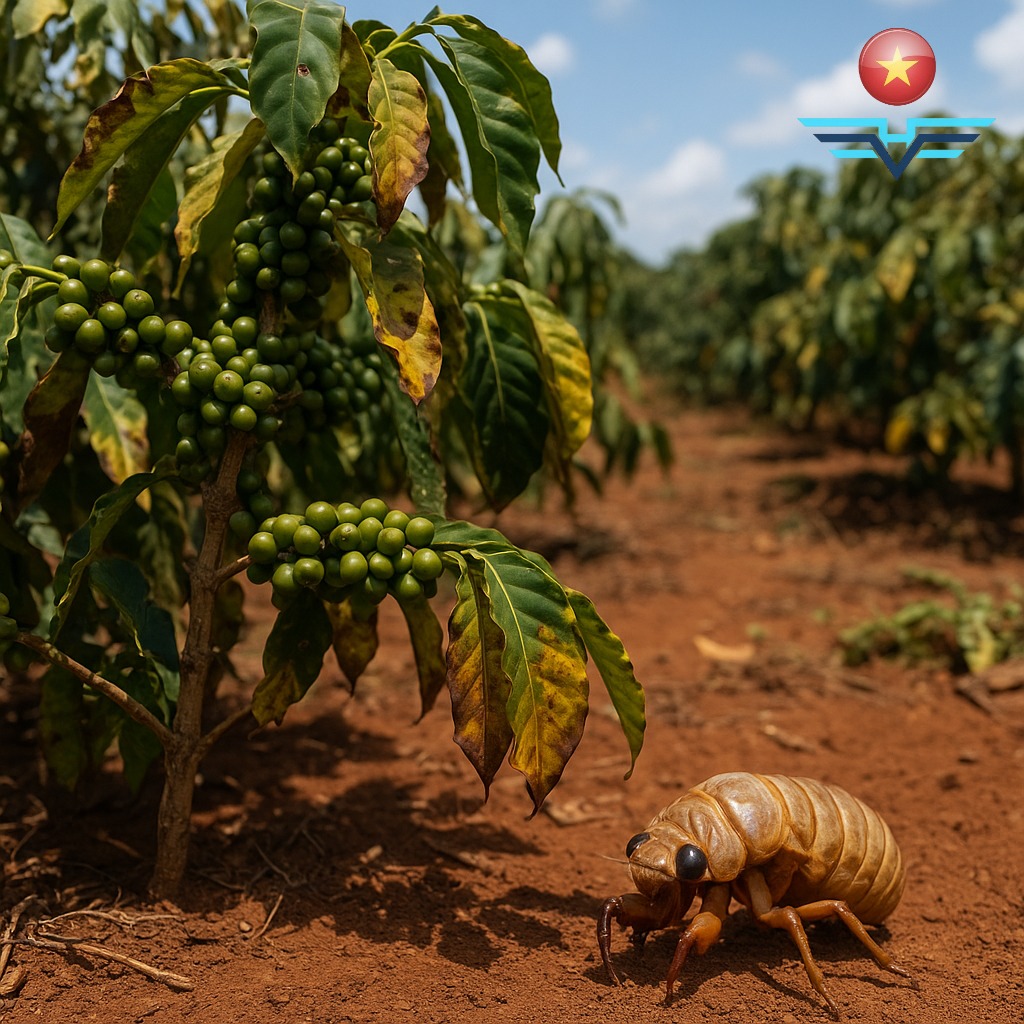
Worse still, coffee growers in communes such as Tan Chau, Tan Nghia, Tan Lac, Tan Thuong, the Dinh Trang Thuong state farm and Di Linh town are alarmed. Tens of thousands of hectares of coffee trees heavy with fruit—just months away from harvest—are at risk of serious crop loss as cicada larvae attack and feed on their roots.
Nguyen Van Hai of Di Linh town reports that his three hectares of coffee, laden with cherries, are showing worrying signs: stunted growth, yellowing leaves, small foliage, and heavy fruit drop. Despite applying several different pesticides to the soil and foliage, he has seen no improvement.
At Dinh Trang Thuong state farm, more than 400 hectares of coffee share the same fate. Even after multiple control measures, the problem has not abated. Some, like farmer Thai Loc in Tan Chau, have spent 20–30 million VND on pesticides to kill the larvae—only to lose money while the pest persists.
Others say they even captured live cicada nymphs and directly tested insecticides such as Pasudin and Phuradang—products normally used on rice—but the larvae survived contact with the chemicals.
Duong Cu, deputy director of the Di Linh District Agricultural Center, admitted this is the first recorded large-scale outbreak of cicada damage in the area, and no effective control measures are yet available. According to the latest figures, 29,038 of the district’s 36,000 hectares of coffee are already infested.
Rapid Spread Across the Central Highlands
The problem is not confined to Di Linh. In Thong Nhat commune, Krong Buk District (Dak Lak Province), over 1,000 hectares are affected and both farmers and officials are at a loss.
In Dak Mil District of Dak Nong Province the situation has reached crisis levels: of the district’s 18,500 hectares of coffee, more than 10,000 are infested. The hardest-hit communes include Duc Manh, Duc Minh and Dak N’drot, where some trees have already died. Farmers report that cicadas first appeared in November 2005, but their population exploded in June–July 2006, with densities in some places reaching 100 larvae per tree.
Growers are distressed: they have each spent an average of over 600,000 VND per 1,000 m² on chemicals without any result. A simple calculation shows that for Dak Mil’s 10,000 infested hectares, that’s roughly 6 billion VND wasted—before even considering the damage across the entire Central Highlands.
Identifying the Pest
Entomologists say the cicadas in Di Linh have not yet been identified to species, but in Dak Lak the pest has been recognized as Oncotympana maculaticollis (family Cicadidae).
These cicadas have two general life cycles: some populations emerge every 13–17 years, others every 2–7 years. Adult females lay eggs in clusters (or “egg nests”) in small branches, about 10–20 eggs per cluster, totaling 400–600 eggs per female. After 4–14 weeks—depending on climate, temperature, and humidity—the eggs hatch and the nymphs fall to the ground. The nymphs then burrow 15–40 cm underground, where they may live for 12–17 years feeding on plant roots.
They emerge at night to molt into adults (“eclose”). Depending on the species, mass emergence occurs in April–May or in July–September. Adults live only 2–4 weeks, feeding on tree sap.
Tran Nhat Thi, a technician at the Di Linh Agricultural Center who has surveyed the outbreak, explains that as the nymphs pierce and suck nutrients from the coffee roots, they deprive the trees of essential nutrition, slowing growth. The weakened plants become susceptible to secondary infections such as fungal diseases and coffee leaf rust, and can die easily—especially during the dry season when water is scarce.
Control Remains Elusive
Although the pest has been clearly identified, no specific pesticide is available on the market. The larvae’s habit of living deep underground makes them extremely hard to kill.
Recently, a local farmer, Dang Van Siu of Di Linh town, reportedly discovered that the product Nitoc 30EC can kill cicada nymphs. However, trials show that to achieve good results, farmers must first clear and level the soil basins around coffee trees—cutting many fine roots and risking further damage—while the region’s highlands often lack sufficient water for spraying.
Until researchers develop a reliable, targeted treatment, coffee growers across Vietnam’s Central Highlands must continue to contend with the destructive cicada larvae.