
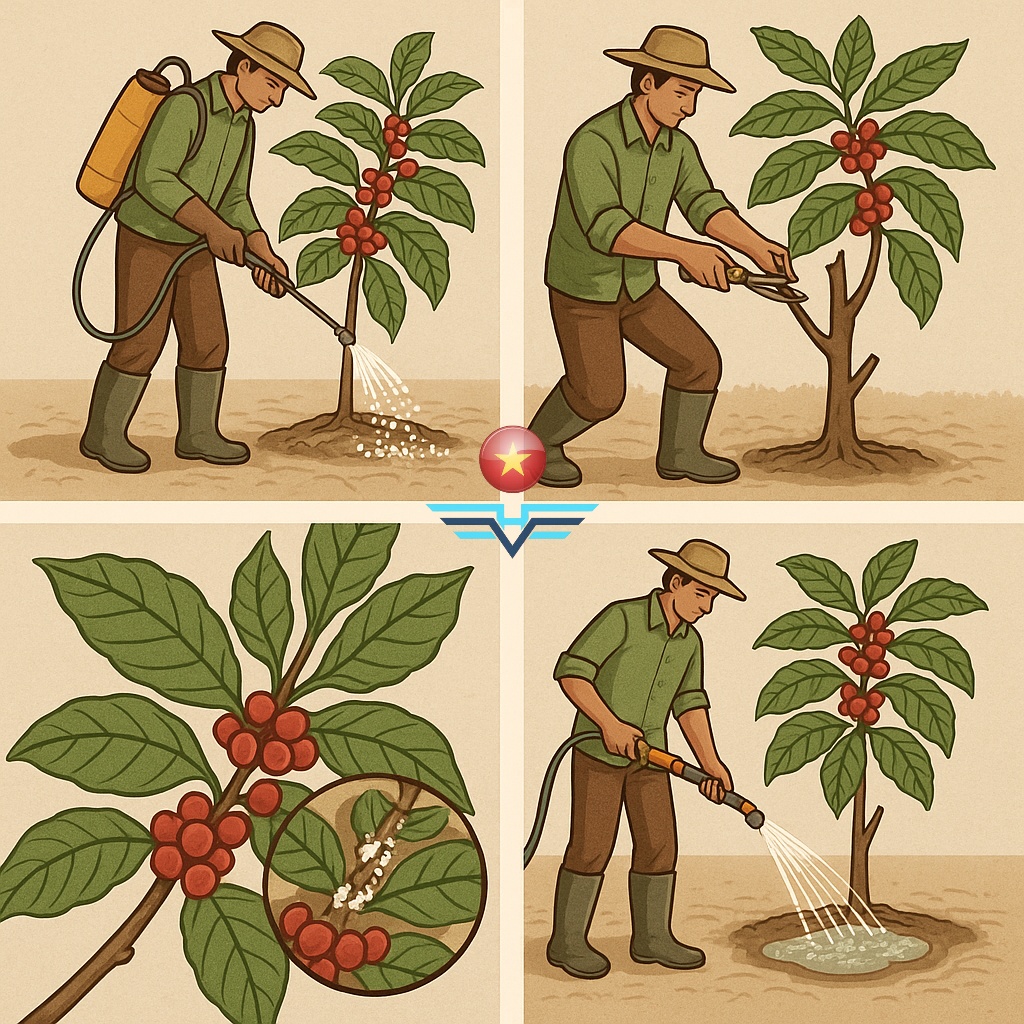
The dry season in the Central Highlands typically lasts from November through mid-April. Early in the dry season, cold winds can bring low temperatures; by mid- to late-season, prolonged hot sunshine drives temperatures much higher.
This is also the stage when coffee plants differentiate flower buds, set blossoms, and develop young fruit—critical phases that determine yield and bean quality. Below are practical guidelines for fertilizer use, irrigation, pruning, and pest control to help coffee trees stay healthy, produce high yields, and deliver good quality beans while improving farmers’ income.
1. Fertilization
1A – Nutrient needs during the dry season
After a year of bearing fruit, coffee trees have already transferred large amounts of nutrients into the cherries and beans. Harvesting removes much of this organic matter, leaving the trees depleted and in high demand for nutrients.
-
Nitrogen (N) is essential for vigorous growth under hot, dry conditions and for good flowering and fruit set. A nitrogen shortage causes stunted growth, sparse leaves, and poor yield and quality.
-
Phosphorus (P) is crucial for flower-bud formation, blooming, and increasing the number of flowers and fruit. Without enough phosphorus, flower initiation stalls, fruit set is low, and yields drop. Dry-season heat and soil dryness can “lock up” phosphorus, so applying soluble phosphorus fertilizers is especially important.
-
Potassium (K) helps improve fruit set, strengthens resistance to pests and unfavorable weather, and prevents premature leaf drop—especially when cold early-season winds arrive. Potassium deficiency causes thin leaves with dry edges, early leaf fall, poor flowering, more single-seeded cherries, and low yields and quality.
-
Secondary nutrients such as sulfur, magnesium, and calcium promote strong flowering, high fruit set, and good bean quality. Sulfur deficiency makes young leaves thin, brittle, and yellow. Lack of magnesium or calcium weakens branches, causes fruit drop, and reduces yield.
-
Micronutrients—zinc, iron, copper, manganese, boron, molybdenum, and chlorine—are also vital for flower formation, fruit set, and reducing young fruit drop. They help plants withstand pests and intense dry-season heat. Deficiency leads to stunted plants, crinkled or elongated young leaves, poor pollen, low fruit set, and higher pest pressure.
1B – How to fertilize
Many farmers traditionally apply only quick-dissolving nitrogen fertilizers such as urea or ammonium sulfate (SA) during the dry season along with irrigation. While this provides some nitrogen, it does not meet the plant’s need for phosphorus, potassium, or secondary and micro-nutrients at this critical flowering and fruit-setting stage. Historically, few dry-season fertilizer options were available, which is why farmers often relied on just urea or SA.
2. Pruning
Pruning is needed year-round, but the main pruning is done right after harvest. Remove dry, diseased, old, stunted, or non-productive branches, especially secondary shoots inside the canopy or those growing too densely above it. Use sharp saws or pruners to make clean cuts that won’t tear the bark. Cut at the proper point to maintain a balanced canopy—not too tall or too wide.
By late dry season, after fertilizing, some branches will have elongated and new shoots will have emerged. Prune again to adjust the canopy so nutrients are concentrated in fruit production for higher yield.
3. Pest Control
During the dry season, watch carefully for mealybugs, scale insects, and stink bugs, with special attention to mealybugs. Spray immediately when pests are detected; once mealybugs spread into the fruit clusters they are difficult to eliminate.
Recommended treatments:
-
Mealybugs: Fastac 5EC, Motox 2.5EC, or Butal 10WP
-
Scale insects: Binhmor 40EC
-
Stink bugs: Cypermap 10EC
By combining balanced fertilization, well-timed pruning, and vigilant pest management, coffee growers can maintain healthy trees and secure high yields and good-quality beans throughout the Central Highlands’ long dry season.