
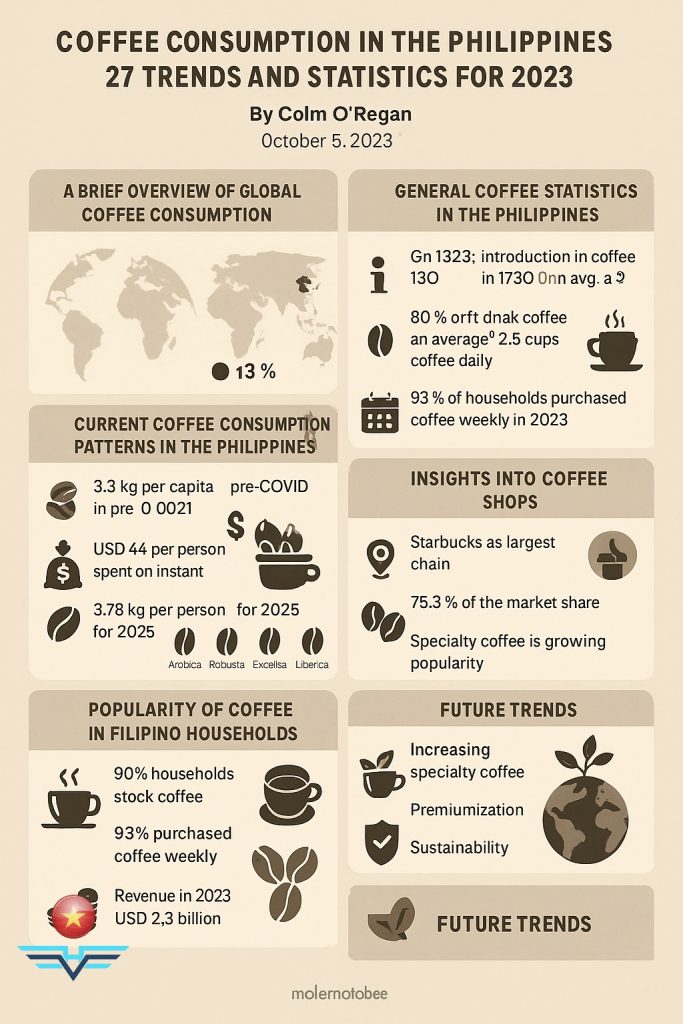
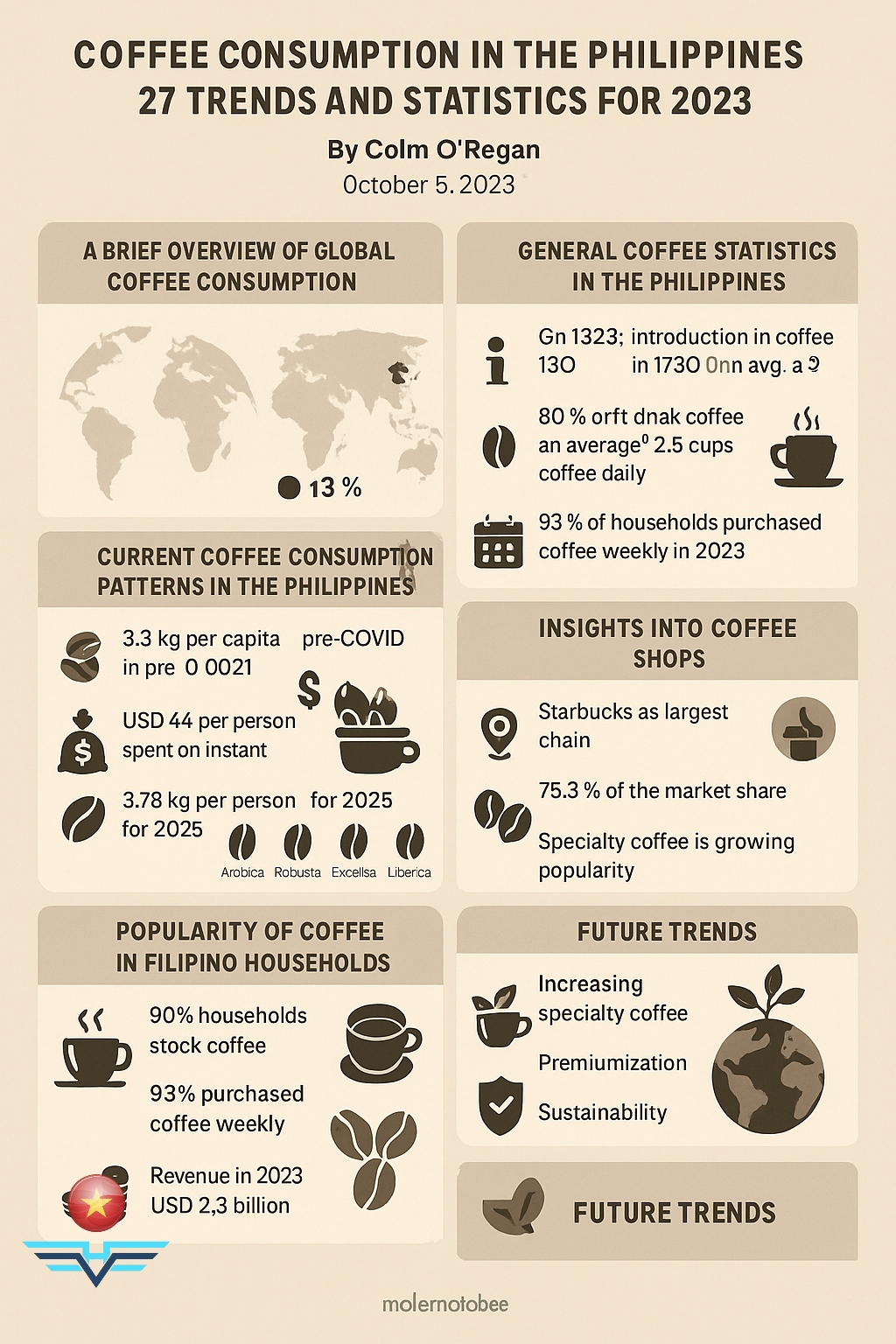
Coffee Consumption in the Philippines
Table of Contents
Tourism and coffee. If there’s a better combination, I don’t know it.
Right now, we’re heading to the Philippines to enjoy some great coffee.
This article outlines 27 statistics and trends in coffee consumption in the Philippines that you need to know in 2023.
Here are the key numbers:
-
The Philippines is the second-largest coffee consumer in Asia, with per capita consumption expected to rise to 3.78 kg per person by 2025.
-
Instant coffee is the most popular choice among Filipinos, with an average spending of USD 44 per person on instant coffee in 2022.
-
The country is a major player in the Asian coffee consumption market, with an estimated annual growth rate of 4.4%.
-
By 2025, the nation is projected to consume 7.4 million 60-kg bags of coffee.
-
Coffee spending is expected to increase at an average annual rate of 8.1% from 2022 to 2025.
Want to know more? Let’s dive deeper into these statistics.
A Brief Overview of Global Coffee Consumption
To see where Asia (and the Philippines) stands in global coffee consumption, take a look at the chart below.
In terms of percentage, the Asia-Pacific region ranks just behind Europe in coffee consumption.
General Coffee Statistics in the Philippines
Coffee was introduced to the Philippines in 1730 by a Spanish Franciscan friar.
Since then, coffee has become an important part of the country’s culture and economy. In recent years, coffee consumption in the Philippines has been rising.
Some general statistics on coffee in the Philippines include:
-
In Q1 2023, coffee production (green beans) in the Philippines was estimated at 9.42 thousand tons, up 1.3% YoY (Philippine Information Agency).
-
While consumption has been rising, the production value of coffee declined, reaching about 3.37 billion PHP in 2022 (Statista).
-
Filipinos are now considered heavy coffee drinkers: 80% drink an average of 2.5 cups daily (JKSIA).
-
In 2023, 93% of households in the Philippines purchased coffee weekly (The Business Manual).
-
The Philippines is not among the top coffee-producing countries. In 2023, it ranked 24th worldwide, behind Indonesia, Vietnam, and Brazil.
-
Despite not being a top producer, the Philippines has a thriving coffee industry with many local cafés and roasters.
-
The country is also known for unique coffees like Barako coffee from Batangas.
Current Coffee Consumption Patterns in the Philippines
Do you know how much coffee Filipinos consume yearly, per capita, and daily? Here are some statistics:
-
Pre-COVID, Filipinos consumed 3.4 kg of coffee per person per year.
-
In 2021, total coffee consumption was about 3.3 million 60-kg bags.
-
In 2022, Filipinos spent an average of USD 44 per person on instant coffee.
-
By 2025, consumption is projected at 3.78 kg per person.
Coffee Types Produced in the Philippines
-
Arabica
-
Robusta
-
Excelsa
-
Liberica
Robusta is the most widely consumed, followed by Arabica. Excelsa and Liberica are less popular.
Factors influencing consumption include income levels, age groups, lifestyle, and preferences.
According to Statista, the Philippine coffee market is expected to grow at an annual rate of 8.22% (CAGR 2023–2028), driven by the country’s expanding coffee culture.
Key facts:
-
In 2021, Filipinos consumed 3.05 kg per capita.
-
The Philippines is the 2nd largest coffee consumer in Asia.
-
By 2025, consumption is expected to rise 4.4% YoY to 7.4 million 60-kg bags.
-
Coffee spending is expected to grow by 8.1% annually (2022–2025).
Overall, coffee consumption in the Philippines will continue rising thanks to the growing domestic coffee culture. Filipinos are projected to spend more on coffee, with the market expanding further.
Popularity of Coffee in Filipino Households
Coffee is an essential part of Filipino culture and daily life.
-
About 90% of households in the Philippines keep coffee in their pantry.
-
93% of households buy coffee weekly, making Filipinos some of the heaviest coffee drinkers worldwide.
-
Instant coffee is the most popular form due to affordability and convenience, accounting for 90% of the coffee market.
-
Specialty coffee is gaining popularity, with Starbucks as the largest chain.
At home, coffee is brewed through various methods: drip, French press, and pour-over.
Coffee plays a big role in Filipino social life. It’s a staple during breakfast and merienda (afternoon snack), and often served at events like birthdays and funerals. Cafés are popular gathering spots for family and friends.
Insights into Coffee Shops
With rising demand, more cafés are opening across the country.
Key details:
-
Starbucks is the largest coffee chain in the Philippines, operating over 420 stores nationwide.
-
Other popular chains: Coffee Bean & Tea Leaf, Tim Hortons, Dunkin’ Donuts.
-
Two major segments: Chains (75.3%) and Independent cafés (24.7%).
-
Specialty cafés are on the rise, offering high-quality beans sourced locally and unique brewing methods.
-
Main challenge: competition. With so many cafés, standing out is difficult.
-
To cope, many cafés focus on innovation and differentiation (unique flavors, brewing methods, or technology to enhance customer experience).
-
Another challenge: sustainability. Many cafés are adopting eco-friendly materials and sustainable practices.
Coffee vs. Other Beverages and Trends
-
Tea consumption is also rising, with the market expected to grow at 5.91% CAGR (2023–2028).
-
COVID-19 boosted demand for health-related drinks like herbal teas and fruit juices, posing some competition to coffee.
-
Despite this, cafés remain highly popular, with espresso-based drinks and specialty coffee driving demand.
-
Coffee market revenue in 2023: USD 2.3 billion.
-
COVID-19 negatively impacted the café industry as many shops had to close or scale down.
-
Rising tea culture and health drink demand may challenge coffee, but the growing coffee culture provides ample opportunities for innovation.
Future Trends
As the Philippine coffee industry grows, watch for:
-
Specialty coffee: Rising demand for high-quality, unique beans.
-
Premiumization: Consumers are willing to pay more for premium, rare coffee.
-
Sustainability: Increasing interest in ethical sourcing and eco-friendly practices.
-
R&D: Government investment to improve coffee quality and yield, fostering new varieties and better farming practices.
Conclusion
The future of coffee in the Philippines looks bright.
With growing demand for specialty coffee, premiumization, sustainability, and continuous R&D investment, there are vast opportunities for growth and innovation.
So next time you’re there, make sure to try some of their excellent coffee!
FAQs
How much coffee do Filipinos consume?
-
In 2021: 3.05 kg per capita.
-
Projected 2025: 3.78 kg per capita.
-
2020/21 total: 3.3 million 60-kg bags.
How does Philippine coffee consumption compare to other Southeast Asian countries?
-
The Philippines is the 2nd largest consumer in Asia, ahead of Vietnam, Indonesia, and Thailand.
Which age group consumes the most coffee?
-
Millennials (survey 2023) are the biggest consumers, willing to spend up to 100 PHP (~USD 1.90) per cup.
Do Filipinos prefer coffee or tea?
-
Most Filipinos prefer coffee. Cafés are very popular, and coffee is part of daily routines.
What is the projected coffee consumption by 2025?
-
Expected to rise 4.4% YoY to 7.4 million 60-kg bags.
What is the impact of coffee exports on the Philippine economy?
-
Coffee is a key export commodity.
-
In 2023, the coffee market value was projected at USD 1.33 billion, with Filipinos spending an average of USD 44/person on instant coffee.