
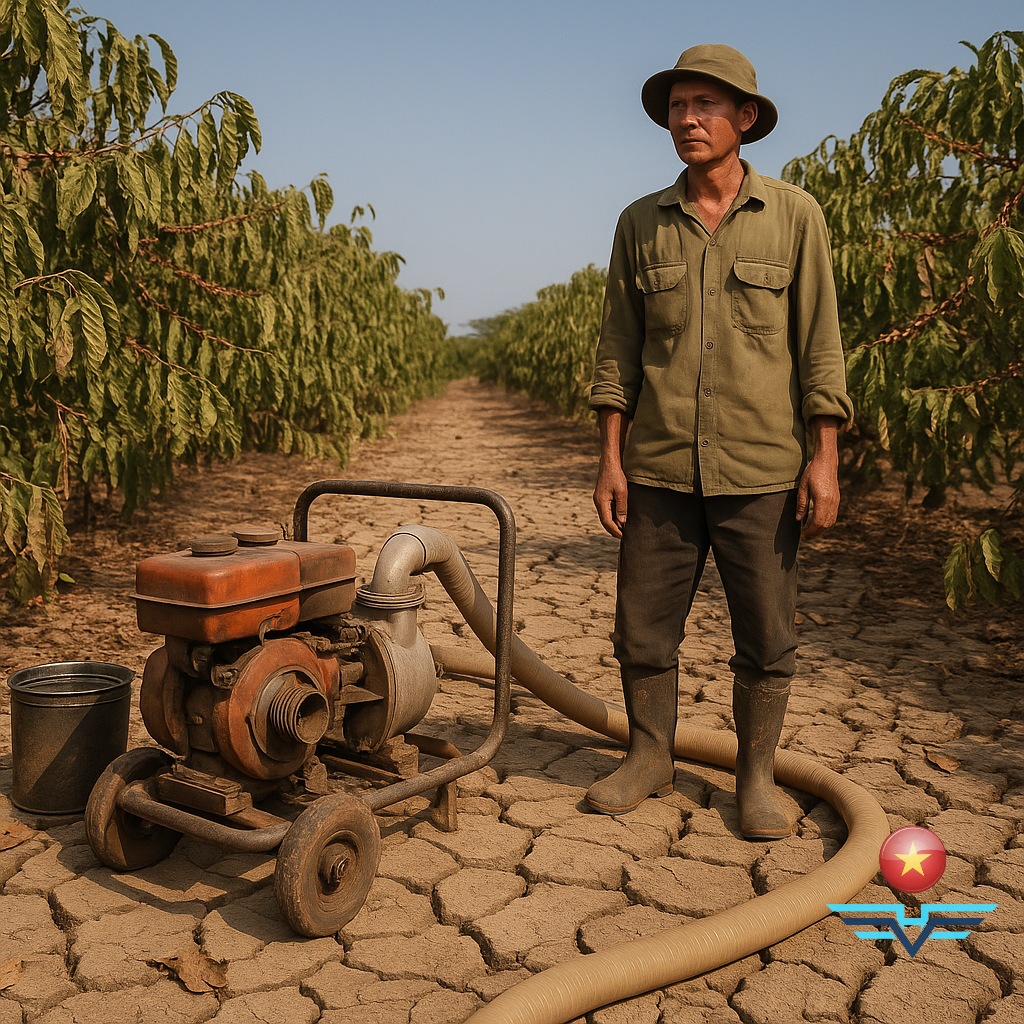
As the coffee and pepper irrigation season begins in Vietnam’s Central Highlands, many farmers are unable to buy diesel to run their irrigation pumps in time for the crop cycle.
Fuel Shortages Across Đắk Lắk
On the morning of February 21, reporters found numerous gas stations in Đắk Lắk province selling only small amounts of fuel—or none at all. Some, such as Thế Mỹ 1 (281 Phan Bội Châu, Buôn Ma Thuột City), Đức Năng (provincial road 8, Ea Tul Commune, Cư M’gar District), Thu Thảo (34 Hùng Vương, Buôn Hồ Town), and Ánh Trầm (Buôn Hồ Town), were completely closed.
Farmers drove tractors and carts loaded with cans and barrels to buy diesel but returned empty-handed.
At Sĩ Thảo fuel station (hamlet 3, Pơng Drang Commune, Krông Buk District), the owner explained: “This year the fuel volume supplied by the company is barely half of last year’s, so there isn’t enough to sell. For the past two days we’ve mainly sold only to customers who reserved fuel before the Lunar New Year or to our most regular clients. Farmers in urgent need of diesel to irrigate their coffee can only buy a few liters at best.”
Most other fuel dealers reported similar difficulties.
Surging Demand and Hoarding
By noon, Petrol Station 38 in Buôn Hồ Town (managed by Nam Tây Nguyên Petroleum) was still crowded with people lining up for fuel. According to Phạm Hùng Cường, in recent days sales volume has been about 15 times higher than during the same period in 2010. From early morning until late afternoon, residents from Buôn Hồ, Krông Buk and neighboring areas flocked here, and the station sold an average of around 40,000 liters a day—mostly diesel.
Nguyễn Huynh, Director of Nam Tây Nguyên Petroleum, said that although the company sold 17,500 m³ of fuel in February 2011—higher than last year—it could still only meet the needs of its own retail agents and authorized private outlets.
He noted that some distributors were facing difficulties and had reduced their sales; others were deliberately hoarding fuel in anticipation of price hikes. To alleviate the shortage for agricultural production, Nam Tây Nguyên Petroleum increased supply tenfold in Krông Buk, Buôn Hồ Town, and Krông Păk District.
Authorities Investigate
Nguyễn Thị Phương Lan, head of the Trade Management Division of Đắk Lắk’s Department of Industry and Trade, said the department had reported the issue to the Ministry of Industry and Trade and sent formal requests to major petroleum suppliers for solutions. Inspectors and the market-management force would step up checks on dealers suspected of hoarding.
Recent inspections revealed 49 fuel outlets in Đắk Lắk operating only partially or shutting down completely, showing signs of hoarding to wait for higher prices.
The same situation was reported in other Central Highlands provinces such as Gia Lai and Lâm Đồng. In Gia Lai, of roughly 260 fuel outlets, many have closed since the Lunar New Year, citing excuses such as “attending temple ceremonies,” “waiting for an auspicious date,” “medical check-ups,” or “no staff available.”
In Lâm Đồng, provincial officials instructed market-management teams to tighten inspections, yet the problem not only persisted but more retail outlets continued to close, apparently hoarding stock.
In Kon Tum City, on the morning of February 21, reporters observed that while Petrolimex stations (including its agents) were still open, most outlets of the Military Petroleum Corporation were closed, some even posting signs reading “Out of fuel.”
With irrigation pumps stalled for lack of diesel, vast areas of coffee and pepper face severe drought stress—threatening serious crop losses if the fuel shortage continues.