
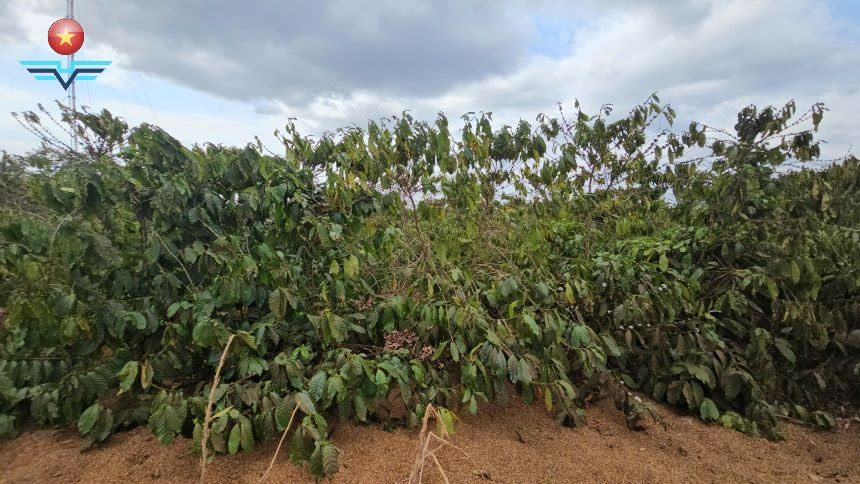
Unseasonal rains are hitting the Central Highlands just when coffee trees need a dry spell, disrupting flowering and fruit setting.
In recent days, many areas of Đắk Lắk—Vietnam’s largest coffee-growing province—have experienced unexpected showers, making farmers anxious.
Đoàn Văn Đoái, a farmer in Hamlet 3, Ea Khăl Commune, Ea H’leo District, said frequent out-of-season rain is harming his coffee trees. “This is the time when the plants need dry weather to initiate flower buds, but the rain interrupts that process, causing uneven blooming and reducing both yield and quality,” he explained.
“The rain came too early, before the trees had enough time to differentiate flower buds. The flowers are now sparse and irregular. Moreover, rainwater carries acids that are not good for the trees during flowering and fruit set,” Đoái added.
Nguyễn Văn Toàn from Cư M’gar Commune in Cư M’gar District noted that heavy rain while coffee trees are in their dormant phase can stimulate the growth of tender new roots. “If hot, dry weather follows, these young roots can be easily damaged, reducing the plant’s vitality and its ability to absorb nutrients for fruit development,” he said.
To reduce the negative effects, Toàn supplements nutrients after these unseasonal showers to help his coffee trees build resistance.
Such rains also create favorable conditions for fungal diseases—especially branch dieback, berry rot, and leaf drop. High humidity encourages pink disease, coffee leaf rust, and other pests and diseases, further threatening both yield and bean quality.
According to the Đắk Lắk Department of Agriculture and Rural Development, the province currently has more than 212,000 hectares of coffee—by far the largest area in Vietnam. However, climate change is bringing increasing challenges, requiring farmers to adopt flexible measures to protect coffee yields and quality.