
Depending on the coffee variety and the local climate, coffee can be harvested once or several times a year. Flowering and fruiting follow the cycle of the rainy season: the trees bloom during the rains, and the cherries ripen about 9–11 months later. Fully ripe cherries are bright red, firm, and glossy.
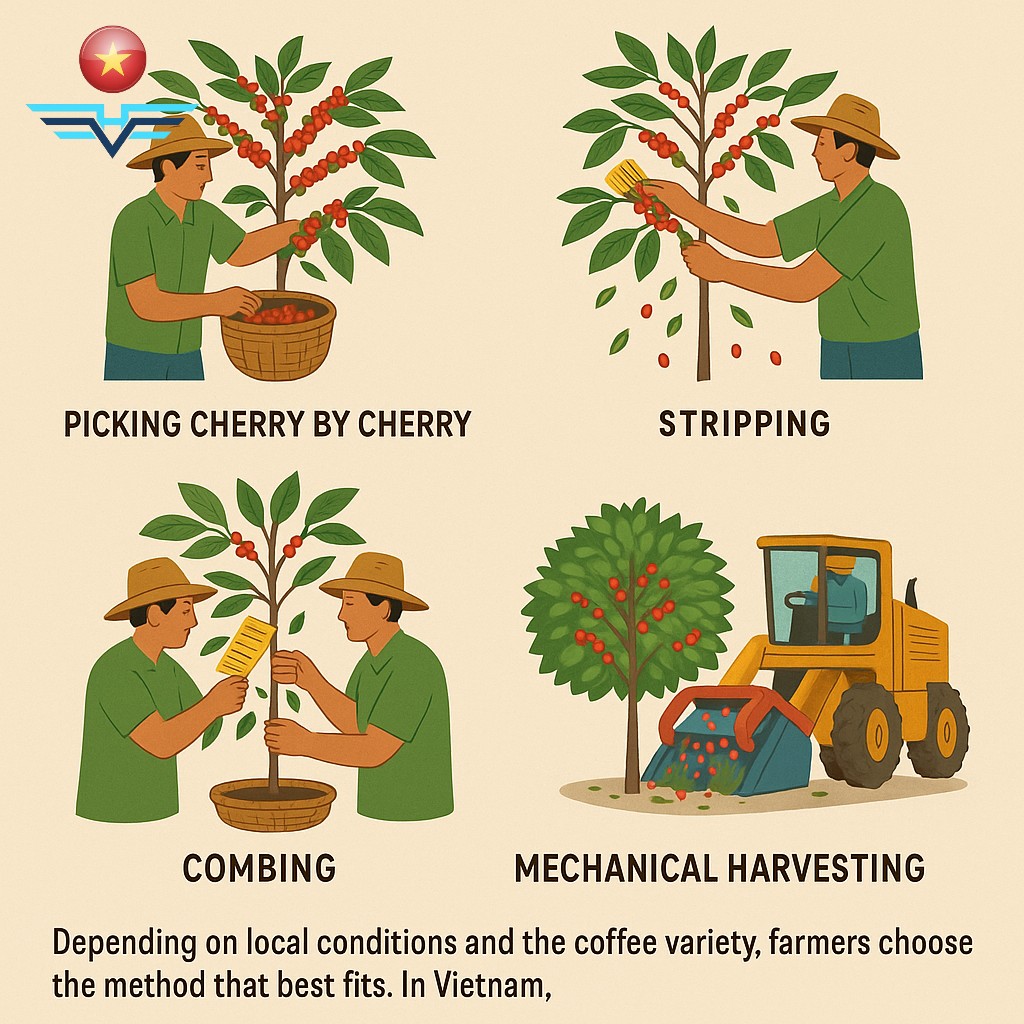
There are several harvesting methods:
-
Picking cherry by cherry: Only the fully ripe red cherries are hand-picked, while unripe green ones are left to ripen for later harvest. This method is time-consuming but produces the highest quality crop, since green fruit can mature naturally.
-
Stripping: Farmers strip everything from the branch by hand—ripe, unripe, overripe fruit, and even flowers. This method saves time and is common in regions where labor costs are high, such as parts of Africa and Brazil.
-
Combing: A special comb is drawn along the branch to remove only the ripe cherries.
-
Mechanical harvesting: Machines shake the tree so that the ripe fruit falls, or some machines strip the branches—flowers and leaves included.
After harvesting, cherries are taken to processing facilities, except in dry-process systems where the fruit is sun-dried on the farm itself.
Depending on local conditions and the coffee variety, farmers choose the method that best fits. In Vietnam, two approaches are most common:
– Stripping for Robusta, and
– Careful hand-picking of individual ripe cherries for Arabica.
(The reasons for these differences—labor, quality, and plant characteristics—will be discussed in a separate article.)
Always read and follow detailed guidelines before applying a specific harvesting method.