
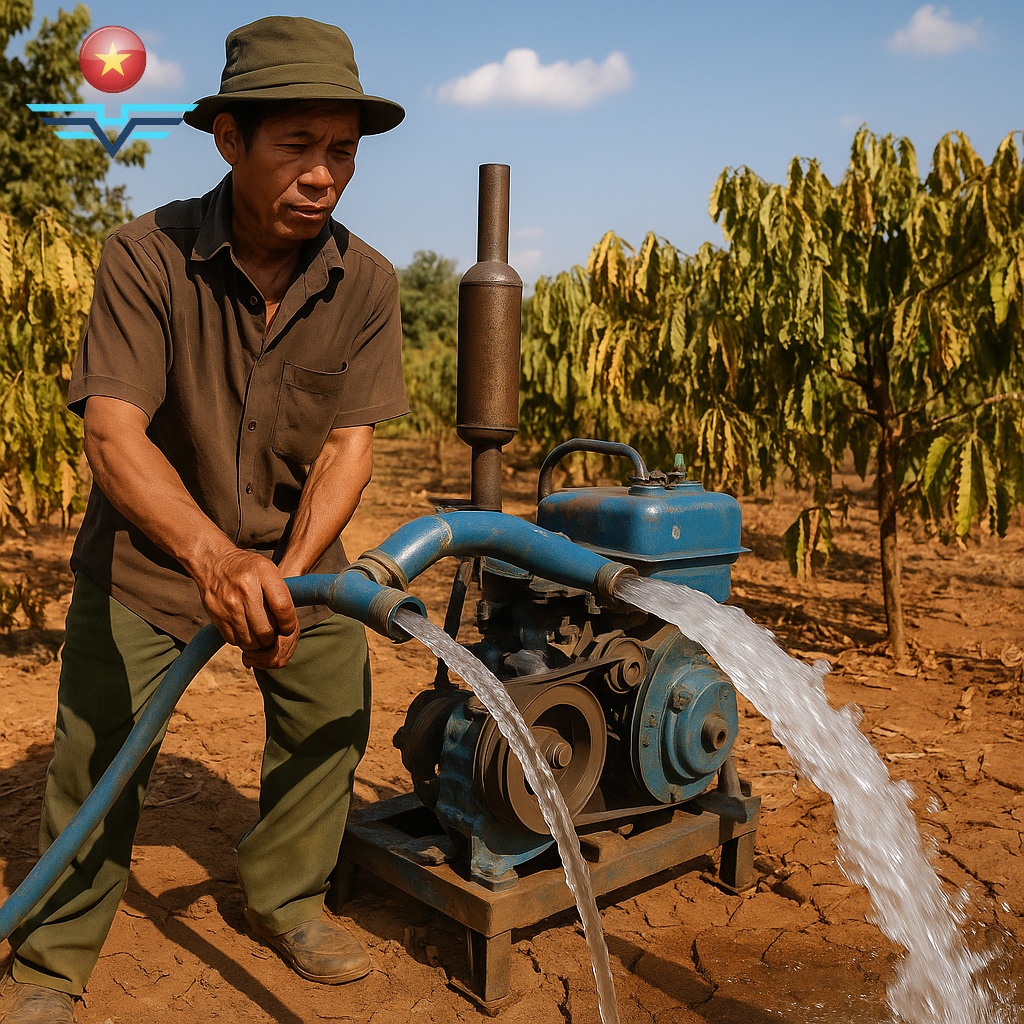
Many coffee-growing areas in Đắk Lắk are suffering from severe drought while farmers are also struggling with soaring costs.
Drought Devastation
The road from National Highway 14 into Ea Kroa village, Cư Né commune, Krông Búk District crosses the K’Đrô reservoir. Anyone passing by is stunned to see the reservoir’s bottom cracked and dry under the scorching dry-season sun.
Downstream, farmers with bare backs and sweat-soaked shirts are busy digging new wells or deepening old ones to find water for their coffee trees. Lương Văn Sâm, Chairman of the Cư Né Farmers’ Association, said the K’Đrô reservoir irrigates nearly 200 hectares of coffee but dried up after just one watering round—while coffee normally needs at least three.
Sâm lamented, “With the northeast monsoon winds still blowing hard, the drought will last. Of the commune’s more than 2,000 hectares of coffee, nearly half already lack water. We may not lose the crop completely, but a major drop in yield is certain.”
Most reservoirs and streams in neighboring Cư Pơng commune have also run dry. Standing on the parched bottom of Ea Liăng reservoir, Ae Nghi of Ajun village pointed to the hill where his family’s two hectares of coffee grow. “We didn’t finish the second watering before the reservoir went dry. I can’t afford to dig a new well, so we must wait for rain,” he said.
Nearby, Ae Hék’s one-hectare plot faces the same fate: leaves are wilting and flowers have turned black. Observers agreed the coffee will not hold its young fruit when the branches and foliage are already shriveling.
According to Nguyễn Văn Pháp, head of the district agriculture office, Cư Né and Cư Pơng are the hardest hit areas. Krông Búk has more than 21,000 hectares of coffee in flowering and fruit-setting stage, but nearly 5,000 hectares lack water. The district’s 37 small irrigation works can irrigate only about 20% of its coffee area.
Đắk Lắk’s disaster-prevention committee reports drought in 10 of the province’s 15 districts and towns, affecting 12,575 hectares of crops—including 10,090 hectares of coffee—with estimated losses exceeding 320 billion VND. They forecast another 10,155 hectares of crops, nearly 9,500 of them coffee, will soon be hit.
Skyrocketing Costs
While battling drought, coffee farmers in Đắk Lắk are reeling from soaring expenses. Ae Nghi of Ajun village sighed, “My two hectares are far from any water source, so pumping costs are huge. Two watering rounds have already used nearly 500 liters of diesel—over 10 million VND.”
Diesel prices are up more than 6,000 VND per liter compared with a year ago, throwing input-cost calculations into chaos. Phạm Văn Thành of Ea Kroa noted: “Last year each watering cost about 3 million VND per hectare; this year it’s more than 4 million.”
Fertilizer and labor costs have also jumped. In 2010, NPK fertilizer for one hectare cost about 10 million VND; now it is 13 million. Daily wages for irrigation workers have leapt from 300,000 to 450,000 VND. Y Zơn of Ea Túk village spent over 30 million VND to dig a well more than 20 meters deep to save a coffee garden planted just last year. “Hiring well diggers now costs 1.5 million VND per meter of depth—one and a half times last year,” he said.
Phạm Tiến San, head of the Đắk Lắk Irrigation Department, explained that rising coffee acreage has sharply increased pressure on water supplies. The province’s 643 irrigation works, with a total capacity of more than 500 million cubic meters, can irrigate only about 100,000 hectares of coffee. The remaining 90,000 hectares rely on groundwater from dug and drilled wells.
San added that deforestation in many coffee-growing regions has reduced forest cover and lowered groundwater levels, driving up the already steep cost of securing water—especially in newly planted coffee areas where irrigation is hardest to arrange.