
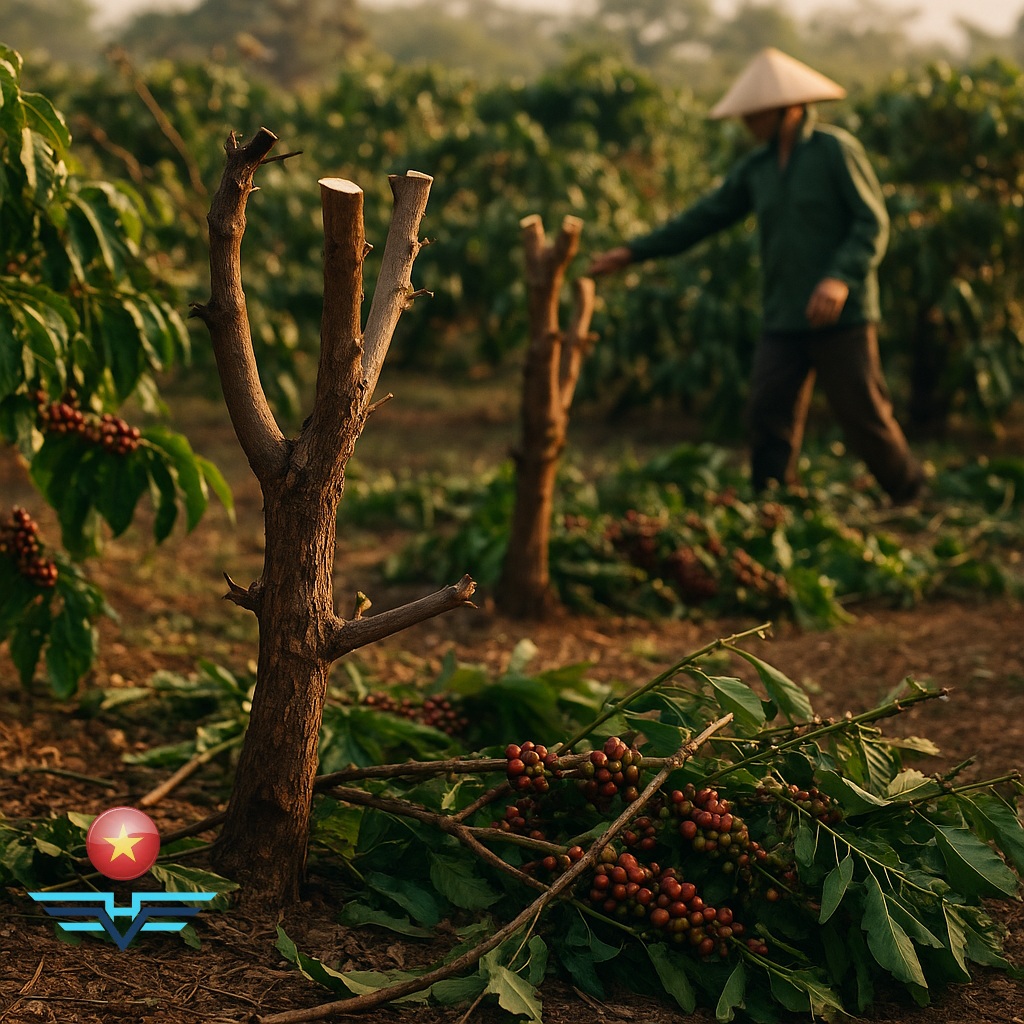
Every coffee harvest season, Vietnam’s Central Highlands faces a wave of brazen theft and looting, forcing growers to strip unripe, green cherries just to protect their crop. Entire plantations have had branches hacked down to bare trunks; beans drying in yards have been stolen; even storage warehouses have been cleaned out overnight.
“Farmers Can Only Despair”
At dawn, Trần Thanh Phong of Gia Lâm commune (Lâm Hà district, Lâm Đồng) was stunned to find his coffee garden “massacred.” Trees once heavy with ripe cherries now stood with nothing but bare trunks.
Pointing to trees stripped of fruit-laden branches, Phong exclaimed, “This isn’t just theft—it’s sabotage! The best-producing trees of the season were targeted. Thieves clipped every primary branch, leaving my seven-sào (about 0.7 ha) coffee plot ragged. After all the hard work, the loss is huge.”
Nearby growers, such as Vũ Văn Đa and Phạm Văn Cường, suffered the same fate. Sitting beside a pile of branch stubs stripped of cherries and dumped beneath a mango tree, Cường lamented, “If thieves keep running rampant like this, we coffee farmers are finished.”
“Coffee thieves” have also struck Di Linh, Bảo Lâm and Bảo Lộc City. One Di Linh grower said some thieves even cut down entire trees to drag them to secluded areas for easier stripping. The boldest case was the midnight looting of Trần Văn Lộc’s storage shed in Bảo Ninh, Di Linh.
“At dawn a truck stopped in front of Lộc’s house. Several young men jumped down and carried bag after bag of coffee onto the truck. We saw it but assumed he was selling,” a neighbor recalled. “Those 20 fifty-kilogram bags had just been brought from the field and hadn’t even been dried,” Lộc added, pointing to a section of B40 wire fence the thieves had cut.
Desperate Measures to Guard the Crops
A coffee grower in Đức Trọng district admitted, “I’ve never seen a coffee thief seriously punished. Once I caught some and took them to the commune office, but they were released after a simple warning.” He now keeps a heavy chain ready: if he catches a thief, he plans to chain them to a coffee trunk until family members pay for the damage.
Other Lâm Đồng growers resort to scare tactics: hanging signs like “Beware of vicious dog,” “Trap set—keep out,” or “Electric fence—do not enter,” or erecting watch huts with scarecrows and lights glowing through the night. “These fields are too vast to guard around the clock. These are only temporary deterrents—the real effect is minimal,” Cường said.
Farmers also share stories of a more “sophisticated” method: thieves cut two holes in a burlap sack to slip their arms through and tie part of the opening around their neck. Pressing the sack’s mouth directly against heavily fruited branches, they strip the cherries silently—far neater than the old way of spreading tarps and breaking branches.