
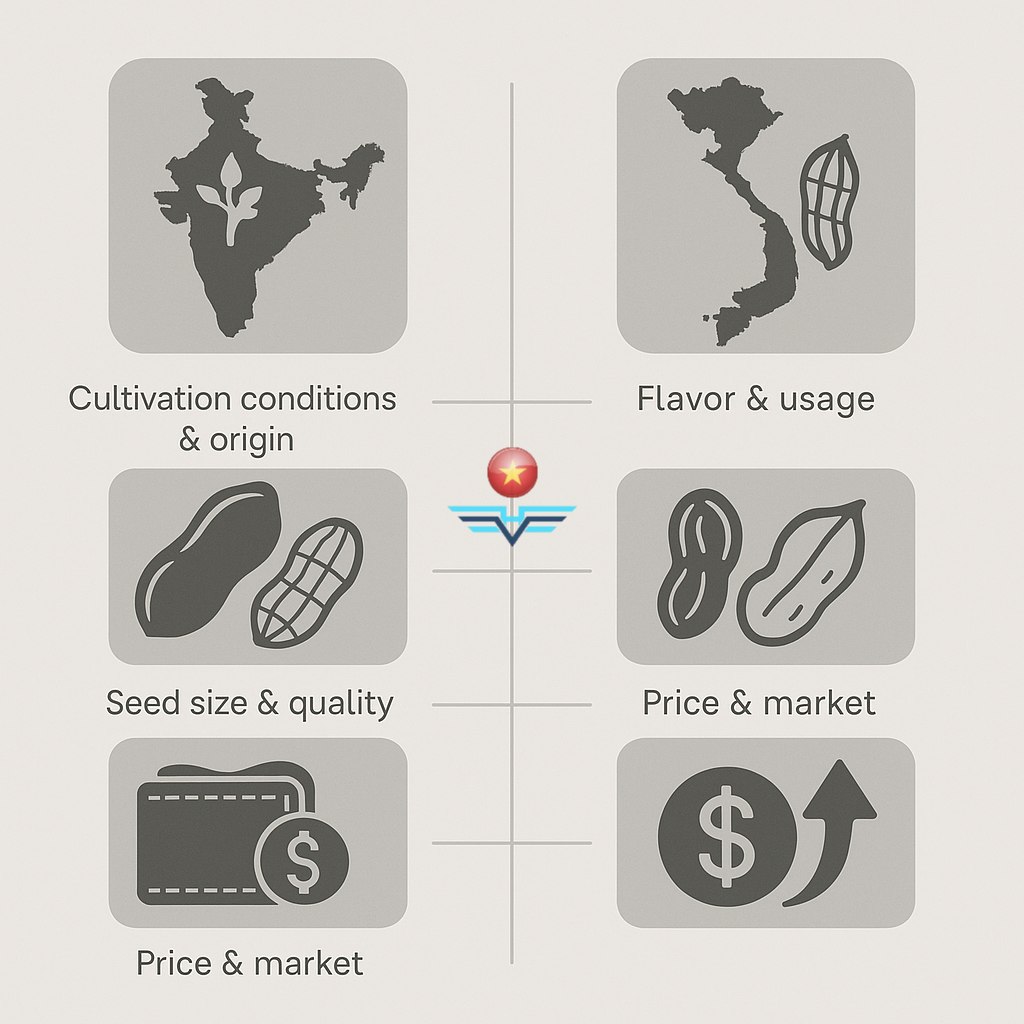
Criteria |
Indian Peanuts |
Vietnamese Peanuts |
|---|---|---|
| Cultivation Conditions & Origin | – Grown in hot, arid regions (Gujarat, Rajasthan, Andhra Pradesh) – World’s 2nd largest producer – Sandy & alkaline soils → thick-shelled, large seeds – Large-scale farming with modern tech & strict export standards |
– Grown in tropical monsoon regions (Central Vietnam, Central Highlands) – Sandy loam & red basalt soils → natural growth, smaller scale – Mostly smallholder farms, less industrialized |
| Seed Size & Quality | – Large, uniform seeds – Harder shells – High oil content (40–50%) → good for oil extraction & industry |
– Smaller, less uniform seeds – Thinner, easy-to-crack shells – Lower oil content but sweeter, nuttier flavor |
| Flavor & Usage | – Rich, fatty taste – Used for peanut butter, vegetable oil, industrial food processing – Exported to Middle East, China, Southeast Asia |
– Milder, natural taste, less fatty – Consumed directly or used in traditional foods (candies, sweet soups, stir-fry dishes) |
| Price & Market | – Cheaper due to large-scale, high yield – Lower production costs (climate & labor advantage) – Strong position in international markets (meets export standards) |
– Higher price due to small-scale, higher costs – Mainly domestic market, limited exports – Focus on quality over quantity |
| Advantages | Low cost, abundant supply, suitable for large-scale industrial processing | Sweet, natural flavor, ideal for direct consumption & specialty foods |
| Disadvantages | Less aromatic when eaten directly | Higher price, less competitive in global scale |