
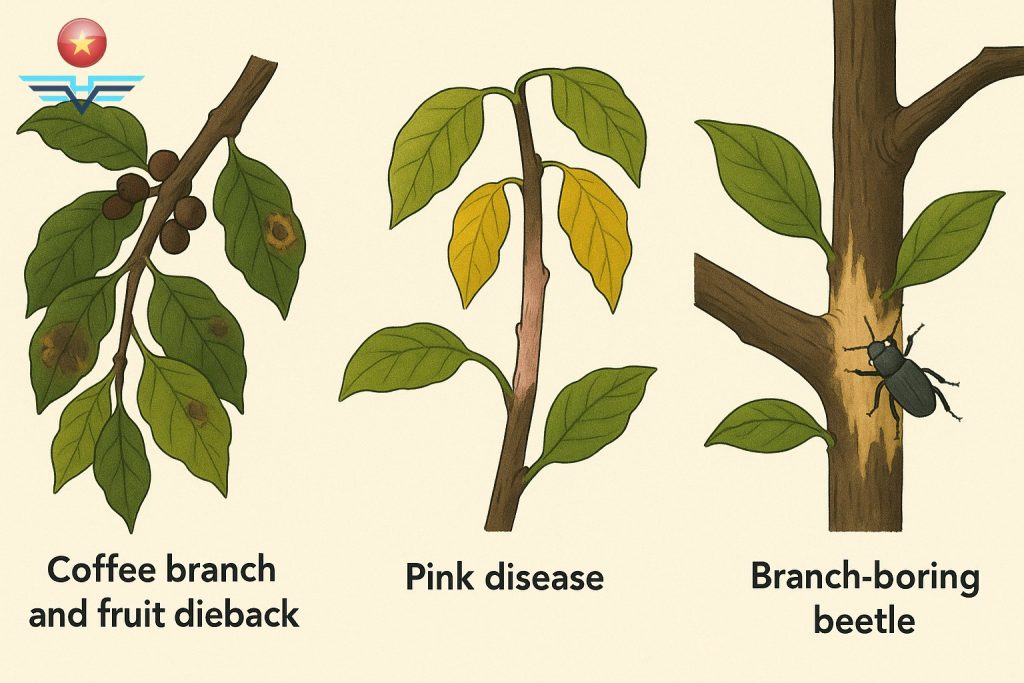
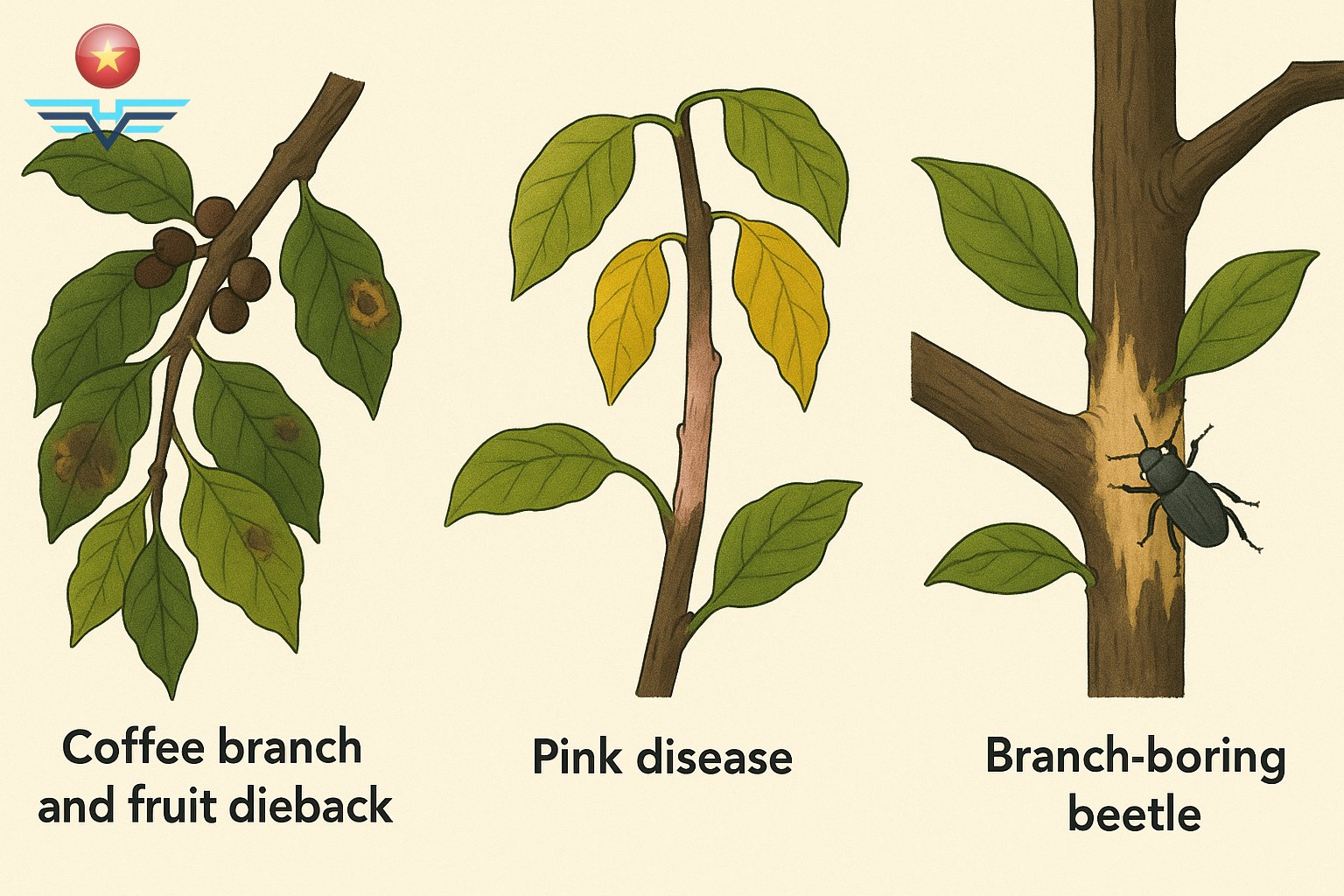
If your coffee trees are losing leaves and the branches look bare, you need to inspect the plantation carefully and identify the exact problem before treatment.
1. Coffee branch and fruit dieback (Colletotrichum gloeosporioides)
This fungus attacks from flowering through to fruit ripening, causing blackening and dieback of leaves, fruits, branches, and even stems.
-
Leaves: Spots show concentric rings, often starting at the leaf tip where the tissue dries and burns back.
-
Branches: It typically infects woodier fruit-bearing shoots, creating sunken brown lesions at the tips. The bark turns dark brown to black and gradually dries out. Severe cases spread to larger branches and even the main stem, leaving dry, black, leafless twigs.
-
Fruits: Sunken lesions develop on the skin; the fruit turns pale brown, then black and dry before dropping prematurely.
Prevention and treatment:
Apply a balanced fertilizer (N, P, K) with trace elements such as molybdenum (Mo) and magnesium (Mg) to strengthen trees during fruiting. Spray Dipomate preventively when fruit sets or at the start of the rainy season (around May). If symptoms appear or rainfall is heavy (June–July), spray fungicides such as Carbenzim, Thio-M, or Bendazol twice, two weeks apart.
2. Pink disease (Corticium salmonicolor)
This fungus attacks branches, especially near branch junctions. Early lesions appear pale pink, then thicken and become a more intense pink with a fine powdery layer of spores. The lesion gradually girdles the branch. Leaves, fruit, and twigs above the infection yellow, drop early, and the branch eventually dies. Warm, humid weather and dense canopies favor rapid spread.
Control:
Prune and burn infected branches. On large branches near the trunk, paint Bordeaux mixture 5% or Validamycin (e.g., Vanicide 5SL) at 5% strength directly onto lesions; repeat after 7 days if needed. If the disease threatens to spread, spray Bordeaux 1% or Vanicide 5SL at 1.5–2% over the remaining healthy trees.
3. Branch-boring beetle
This insect is difficult to control. Typical signs are dieback of leaves and stems extending from the beetle’s tiny (<1 mm) entry hole on the underside of the branch. Within 5–7 days the branch wilts as the beetle tunnels and hollows out the wood. It attacks mainly in the dry season (March–May/June).
Control measures:
-
Cut and destroy infested branches.
-
Plant shade trees to reduce beetle activity.
-
Use systemic and fumigant insecticides such as Dragon, Pyrinex, Sago Super, Gà Nòi, or Lancer, which are more effective than standard insecticides.
Recently, farmers in some coffee-growing regions have successfully used a mixture of SK99 mineral oil (20 cc) + Sago Super 20EC (25 cc) per 8 L of water, or SK99 (20 cc) + Dragon (10 cc) per 8 L, achieving good control of both branch borers and coffee mealybugs.