
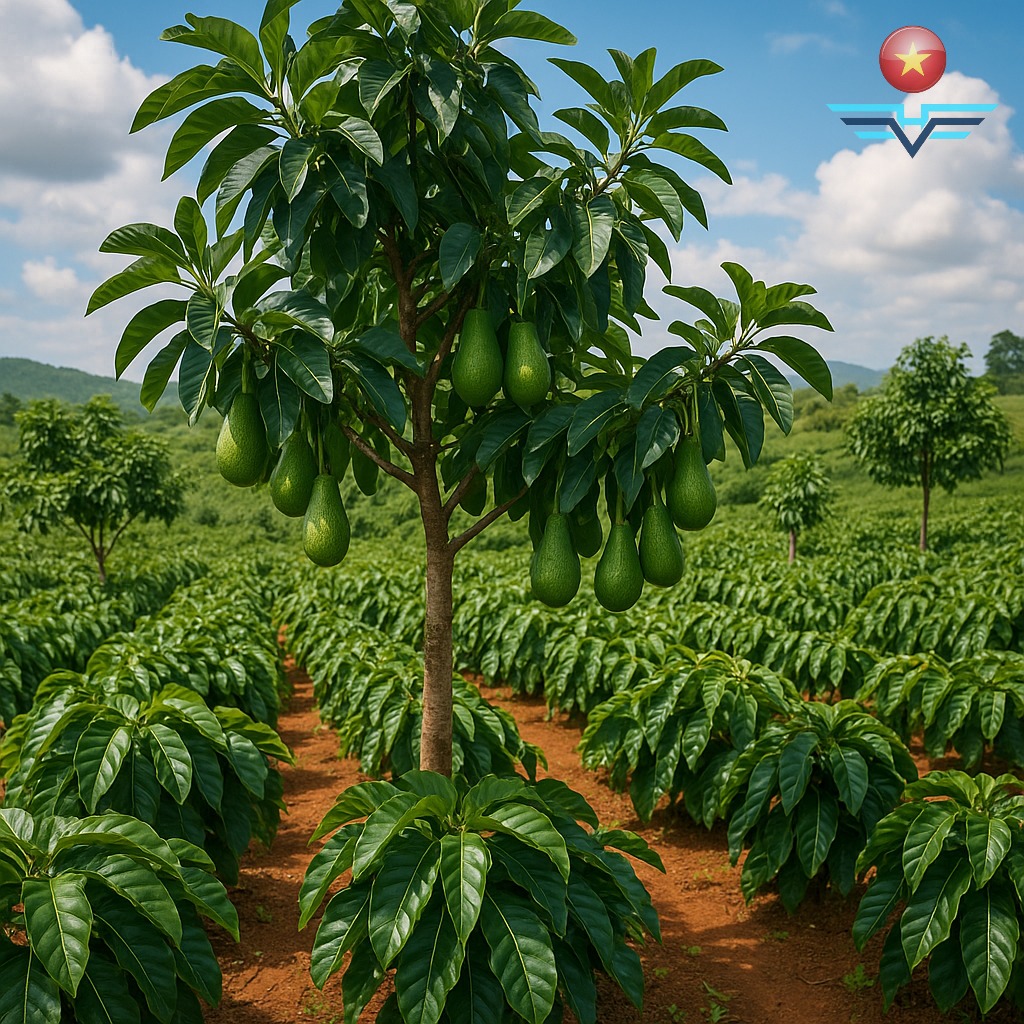
Avocado–Coffee Intercropping Brings Higher Profits
Table of Contents
In recent years, many farming households in Cư M’gar District (Đắk Lắk Province) have adopted a smart model: planting grafted avocado trees between coffee rows. This practice provides natural shade for coffee plants and significantly increases household income per hectare.
Farmer Success Stories
Nguyễn Văn Trình’s 0.8 ha Coffee Farm
-
Six years ago, Trình planted 30 grafted avocado trees in his eight sào (0.8 ha) coffee field after attending coffee-farming workshops.
-
The avocados grew quickly, creating ideal shade and helping the coffee stay green even in the dry season—while requiring fewer irrigations.
-
Annual harvest: Each tree produces 250–300 kg of fruit.
-
Income: With prices of 10,000–15,000 VND/kg, Trình earns over 40 million VND per season from avocados alone, while his coffee yield remains high at 400–450 kg of beans per sào—better than with monoculture coffee.
Trình notes that avocado cultivation is simple: if he cannot hire pickers, he sells fruit wholesale for 1–1.7 million VND per tree.
Nguyễn Văn Lợi’s 5-Sào Plot
-
In 2007, Lợi planted 50 grafted avocado trees among five sào of coffee in Hiệp Nhất Hamlet, Quảng Hiệp Commune.
-
After just two years of harvest, he now earns over 40 million VND from each avocado crop.
District-Wide Adoption
-
Ea Kpam Commune now has over 10 ha of avocado trees intercropped in coffee plantations.
-
According to Trương Bảy, Deputy Head of the District Department of Agriculture and Rural Development:
-
The model protects coffee plants from sun and wind.
-
Avocado harvests do not overlap with the coffee season, reducing labor pressure.
-
It offers strong economic returns and is worth expanding across the district.
-
Training and Future Plans
Cư M’gar’s agricultural sector plans to:
-
Organize more training sessions on pest and disease control.
-
Support marketing of avocado products after harvest.
Intercropping grafted avocados with coffee not only improves coffee health and yield but also diversifies farm income, proving to be a highly profitable and sustainable farming model for the Central Highlands.