
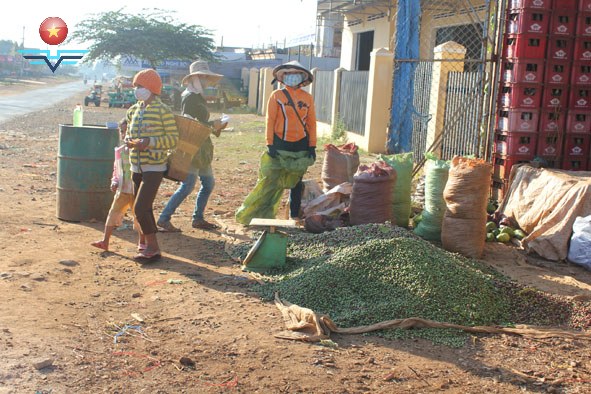
Every year, from around October through the end of January, people in many parts of Đắk Lắk eagerly enter the coffee harvest season after months of hard work tending their crops. This is also the time when many earn extra income by mót cà phê—gleaning the leftover coffee.
A Job that Pays Well
Coffee gleaning is familiar work that provides a good source of income during the slack farming season. Gleaners pick up cherries that have fallen to the ground or those left on the branches after the main harvest.
This work doesn’t require special skills—elderly people, children, even regular harvest workers often glean during their break to earn a little extra.
Y Sơn Niê from D’liêya commune (Krông Năng district) said his family cultivates only about half a hectare of coffee, so they usually finish harvesting earlier than most. To make use of the idle time, he and his wife go gleaning every year to supplement their income.
According to Y Sơn, today’s coffee growers usually hire laborers for picking. Many hired workers are not thorough; they work for daily wages and often leave a lot of cherries on the branches. Moreover, when harvesting, farmers typically spread large tarps under the trees. These sometimes tear or get snagged on branches, causing cherries to drop through to the ground.
After the main harvest, garden owners usually allow others to glean. This not only tidies the orchard but also reduces pests and diseases that could linger from one crop to the next. Each day, Y Sơn and his wife can glean about 80–100 kg of fresh coffee cherries. At the current price of 10,000 VND/kg, they earn roughly 800,000–1,000,000 VND a day.
Because the work is so profitable, their seventh-grade son sometimes joins them on days off. In An Lạc ward (Buôn Hồ town), some of Trịnh Thị Ngọc’s hired pickers also spend their lunch break gleaning to sell cherries for extra cash.
Trần Văn Sinh, who came from Bình Định to pick coffee for hire, shared that besides his regular 180,000 VND daily wage, he uses the noon break (about 12–1 p.m.) to glean about 5 kg of cherries—earning another 50,000 VND.
Concerns and Drawbacks
Although gleaning can bring in a decent income, it also causes problems. With coffee theft already a growing issue, gleaners often face suspicion or even bans from farm owners and local security teams.
Trần Huyền Như from Ea Pôk town (Cư M’gar district) explained that while no one objects to honest gleaning, some people have abused it as a cover for stealing from neighboring plots that have not yet been harvested. Because farms are close together and harvests don’t occur simultaneously, theft can be hard to control. As a result, many villages now forbid anyone from gleaning after the main harvest is done.
Similarly, residents of Hamlet 3 in Cư Êbur commune (Buôn Ma Thuột City) have, for the past two years, barred all gleaning—even by neighbors or local children—after incidents where children herding buffalo used “gleaning” as a pretext to break off heavily laden branches and were caught stealing.
To protect their crops, villagers decided to ban gleaning altogether.
Trần Cảm, Vice-Chairman of the Cư Êbur commune People’s Committee, said gleaning is in principle a good way for poorer households to earn extra income. However, some exploit it to steal. Each year, the commune directs village self-management groups and local police to raise public awareness, strengthen security patrols, and immediately report theft to the authorities.
Gleaning not only provides valuable supplementary income but also reduces post-harvest losses. Still, those who glean must act responsibly and help maintain community security and protect everyone’s property and harvest.