
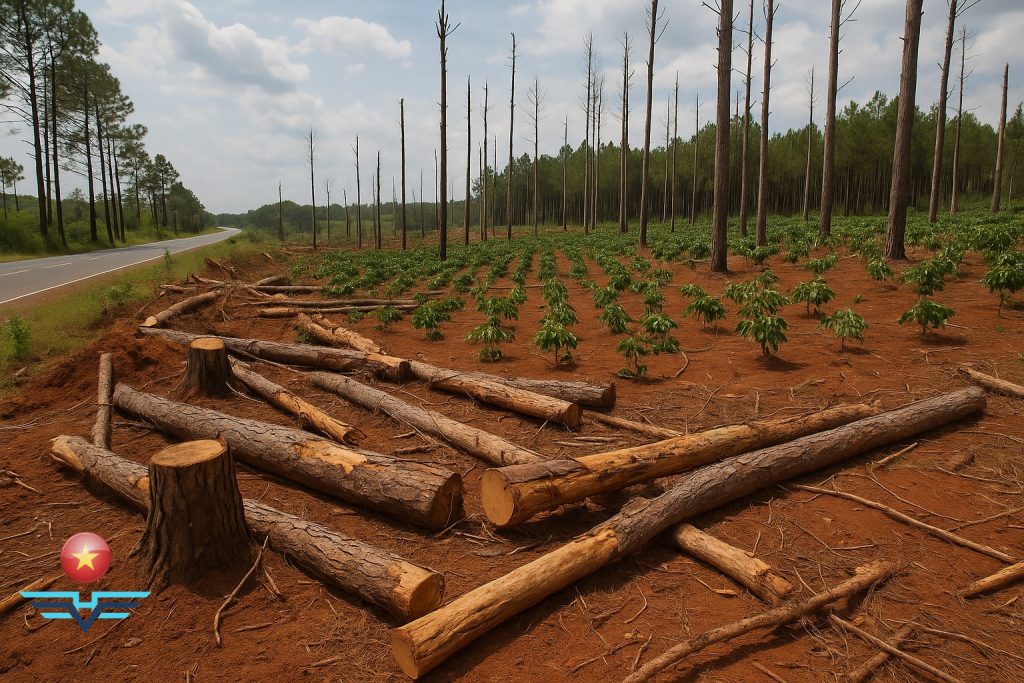
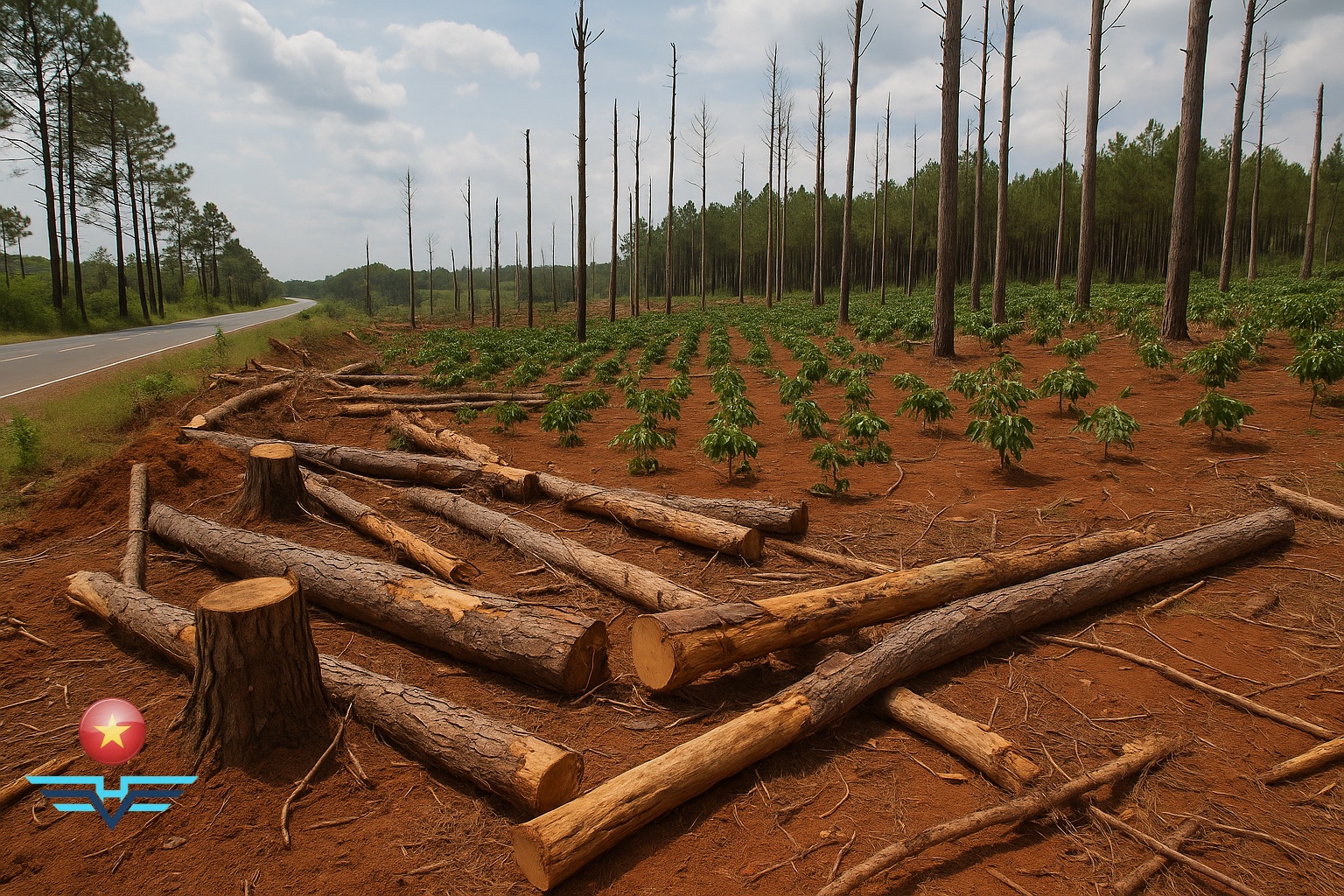
Hundreds of hectares of protective pine forests along National Highway 14—stretching across the districts of Krông Búk and Ea H’Leo in Đắk Lắk—planted between 1982 and 1986, are being stripped bare and dying off to make room for other crops.
Pine Forests Decimated
In early June 2011, during a field trip along the highway bordering Krông Búk and Ea H’Leo, we were shocked by the devastation. Thousands of pine trees, each 35–40 cm in diameter, lay felled right beside the road.
At Hamlet 6 in Cư Né Commune, many pines nearly as thick as a man’s embrace were cut down, their stumps charred black and fresh tractor and bulldozer tracks visible. Beyond those already felled, from kilometer 54 to kilometer 66 thousands more stood dead or mysteriously withered—plainly visible to local authorities.
A local resident, Mr. V, recalled: “Just months ago these pines were lush and green. Anyone traveling Highway 14 admired them. Yet in no time, loggers have wiped out an entire forest stretch. It’s heartbreaking, but what can we do?”
For years, illegal loggers have used a ruthless but effective method: girdling trunks or driving nails into them, then pouring concentrated herbicide into the wounds. The pines die slowly. Later the land is cleared and planted with coffee, rubber, pepper, fruit trees, or seasonal crops.
Recently, poachers have turned even bolder, exploiting dark, rainy nights to bring in chainsaws and other tools. Within hours, hundreds of pines are felled, then left to dry before being burned. Once the land is cleared and planted, the encroachers simply claim ownership. Authorities, faced with endless cycles of clearing and re-clearing, struggle to keep up—especially since the offenders can be aggressive and willing to confront officials.
Weak Enforcement
Mr. Y Thanh A Yun, chairman of Cư Né Commune, admitted: “This situation has simmered for decades. Most of those cutting the forest are recent migrants—both ethnic Kinh and minority settlers.”
He noted that since the start of the year the commune has handled over 25 cases of forest land encroachment, covering about 15,750 m². “At the commune level, we can only fine up to 500,000 VND; anything higher must be reported to higher authorities. Many violators resist, delay or even fight back, making strict enforcement very difficult.”
Mr. Y Thanh said the commune intends to work closely with forest rangers, police and other agencies to crack down on repeat offenders and urged the media to help rally public opposition to the destruction.
Visible Consequences
The destruction of the pine forest has already scarred the natural landscape along Highway 14 and threatens the environment. Locals face greater risks of landslides and soil subsidence during the rainy season, and harsher droughts in the dry season—serious threats in an area where long-term crops like coffee and pepper dominate.
If this devastation is not stopped soon, the protective pine forest will disappear entirely, bringing unpredictable and potentially severe environmental consequences.