

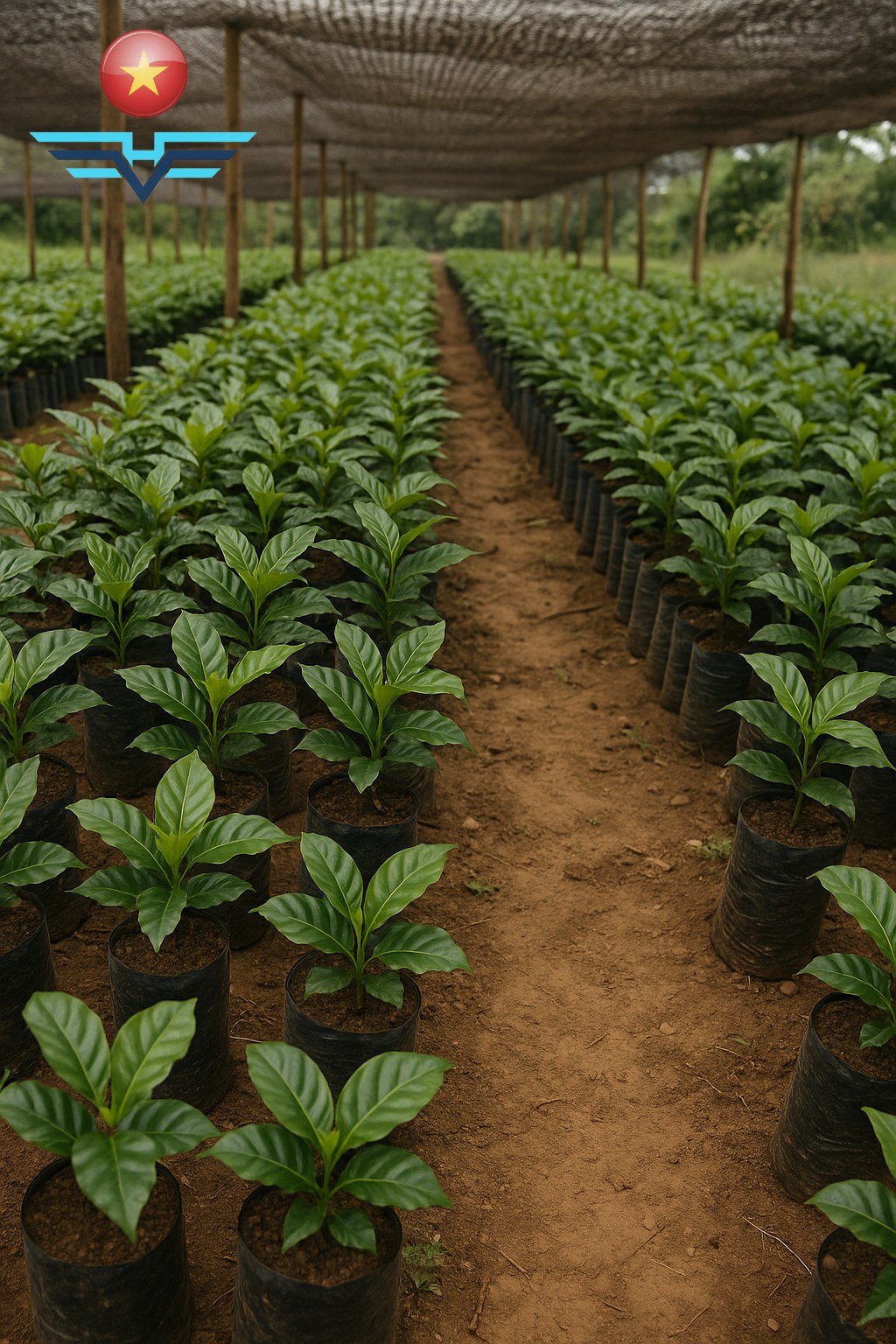
To implement the province’s coffee replanting program, over the past two years the Vietnam Coffee–Cocoa Association (VICOFA) has provided farmers in Dak Nong with free coffee seedlings to “rejuvenate” their plantations. But actual distribution has exposed many shortcomings, especially at the grassroots level, where implementation remains largely perfunctory and superficial.
The Need for Coffee Rejuvenation
According to 2012 statistics, the province had a total coffee area of 114,000 ha with an average yield of 2.2 tons/ha; more than 20% of this coffee was old and yielding less than 1.5 tons/ha. Faced with this reality, the provincial policy of “rejuvenating coffee gardens” to increase productivity and farmers’ income was both necessary and urgent. Yet so far, because local agencies have treated the program as a mere “pilot model” and farmers have largely had to cope on their own, results have been limited.
Negligence by Technical Staff?
Under the 2011–2012 commitment to support replanting, the provincial Department of Agriculture and Rural Development (DARD) received 500 kg of robusta seed to distribute to districts and towns for nursery propagation and free distribution to farmers. However, many localities subcontracted the entire nursery process to private nursery owners, from sowing to handing seedlings to farmers, without supervision from technical staff. As a result, seedlings failed to meet standards, and many died after planting.
For example, in 2012 Gia Nghia Town distributed 68,000 coffee seedlings: 58,000 were propagated by the town’s Economic Office from 50 kg of seed, while 10,000 were purchased by VICOFA from the Western Highlands Agro-Forestry Science Institute. Based on this, communes and wards allocated between 20 and 200 seedlings per household.
Because the quantities were small, most households merely used them to replace old or diseased trees. Moreover, because farmers did not follow proper replanting techniques, many young plants grew poorly. Inspection results showed survival rates in some neighborhoods below 70%, and in some places only 30%. In Tuy Duc and Chu Jut districts, inspections revealed that all the seedlings given to farmers had died, making the 2012 replanting effort a complete failure.
The provincial Plant Protection Sub-department found similarly poor results across other districts. One reason was late seedling distribution; after planting, extended hot weather stunted growth and increased mortality. In addition, because replanting was scattered and farmers lacked time to prepare soil or receive guidance on soil treatment and disease control, many new coffee plants simply could not survive. Many believe that the root cause was the negligence and poor oversight of technical staff during the seedling distribution process.
Should the Support Model Change?
Continuing the replanting program in 2013, DARD received 700 kg of coffee seed and 20,000 pre-grown seedlings. By now, districts have basically delivered these seedlings to farmers, and distribution this year has been more timely than last.
According to VICOFA, replanting under a dispersed model requires that agencies inspect, guide farmers, and supply seedlings and materials so growers can gradually replace low-quality trees (about 7–10% of trees per hectare per year). However, farmers point out that the need to replant aging coffee areas is far greater. Their biggest requirement is funding to hire mechanized equipment for removing old coffee stumps and roots, as well as a unified, effective replanting process. Not every year do farmers receive program seedlings, and often they are given seedlings passively without time to prepare the soil.
For these reasons, local authorities argue that Vietnam’s coffee sector and relevant agencies should research and adjust the replanting support model to fit the farming conditions and economic realities of each production area. Specialized agencies and localities should link the planning of specific old coffee areas needing replanting with tailored support methods. For example, instead of scattering small quantities of seedlings for piecemeal planting, the program should focus funds on helping farmers clear and treat land and supply large quantities of quality seedlings. This approach could be piloted with a few households, then expanded to entire hamlets, communes, and districts.
Though slower, such a method would avoid the current waste and inefficiency of mass, token seedling distribution. Given the financial potential of most coffee growers, this approach could quickly scale up and would make it easier to transfer technology and ensure professional technical oversight.