
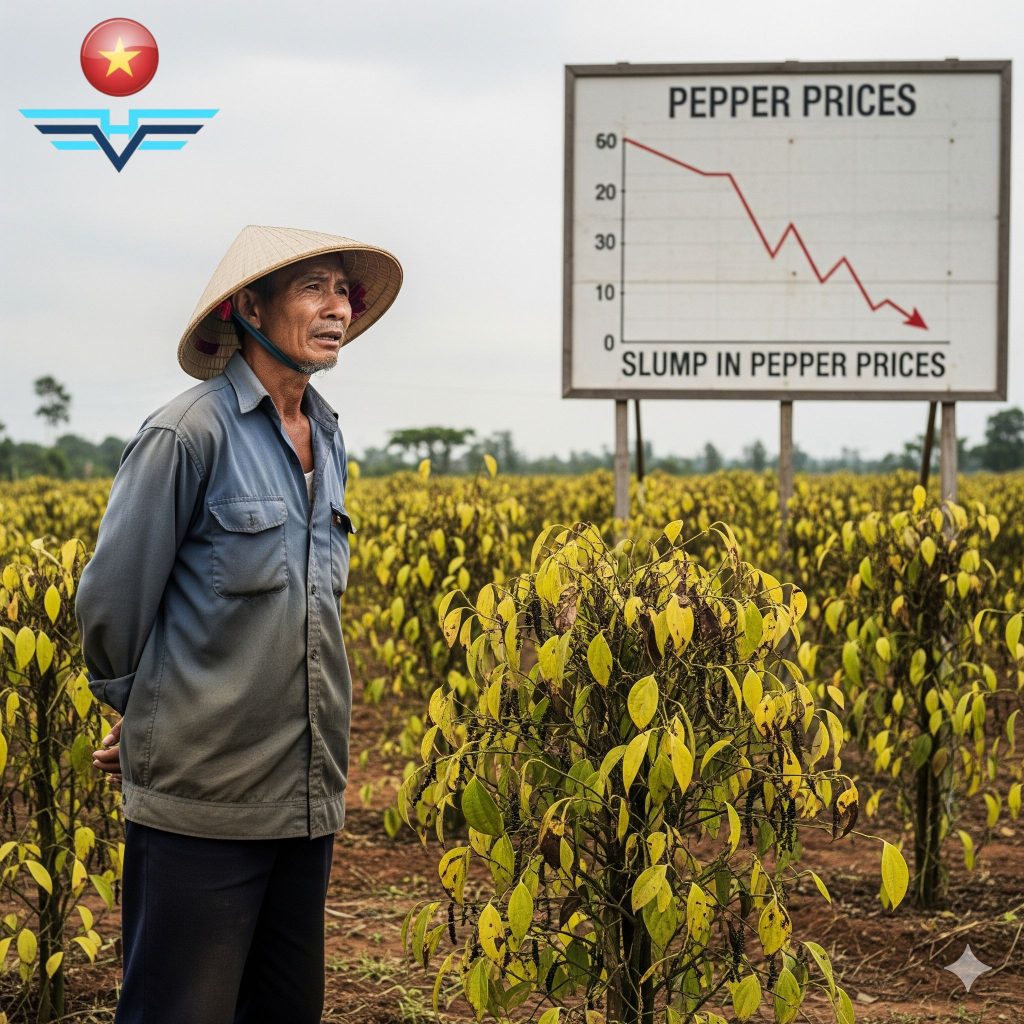

Market Crash Exposes the Risks of Speculative Expansion
Table of Contents
When black pepper prices once soared, many Dak Nong farmers rushed to expand acreage far beyond the province’s 10,000 ha target. By 2017, the area reached over 31,000 ha and production hit 37,000 tons, breaking every planning guideline.
Farmers like Tran Van Quoc in Nam N’Jang had enjoyed windfall profits—over 1.5 billion VND per crop and more than 12 billion VND saved in the bank. Convinced the boom would continue, he reinvested in land and new pepper fields across nearby communes. But when prices fell to 50,000–54,000 VND/kg, his 12 billion VND nest egg became 4 billion VND in bank debt.
Many households that borrowed heavily to plant monoculture pepper faced similar losses. At today’s prices, good-yield farms barely break even; low-yield fields cannot cover harvest labor costs, let alone loan payments.
Organic Production: A Profitable Alternative
While conventional growers struggle, members of the Dong Thuan Organic Pepper Cooperative in Nhan Co, Dak R’lap continue to sell their pepper for 100,000–130,000 VND/kg—roughly double the market rate.
Director Dao Duy Hai explains that organic methods reduce chemical inputs and keep yields steady at 3–4 tons/ha (and up to 5 tons/ha with good care). Even with lower output than intensive farming’s 8–12 tons/ha, stable premium prices guarantee higher net income.
Key Practices for Organic Success
-
Fertilization: Use only manure, composted fish waste and other organic materials; no synthetic fertilizers.
-
Plant Protection: Replace chemical pesticides with biological fungicides and disease-control agents.
-
Post-Harvest Handling: Harvest only when 95 % of berries are fully ripe. Dry and pack in clean, hygienic conditions to meet food-safety standards.
Because the cooperative strictly follows certified organic protocols and maintains third-party oversight, its products are welcomed by demanding markets in Europe and Japan.
Building a Sustainable Pepper Industry
The Dak Nong Department of Agriculture now aims to stabilize pepper acreage at around 10,000 ha and focus on:
-
Strict zoning and planning tied to high-tech and organic farming areas.
-
Deeper processing to increase value and reduce reliance on raw pepper exports.
-
Expansion of biological and organic production for premium export markets.
Takeaway for Farmers
The sharp contrast between debt-ridden conventional growers and the profitable organic model highlights a crucial lesson: long-term stability depends on quality, not quantity. Farmers who adopt organic or bio-friendly practices, diversify crops and respect production limits can withstand price volatility—and secure a resilient future for Dak Nong’s pepper industry.