
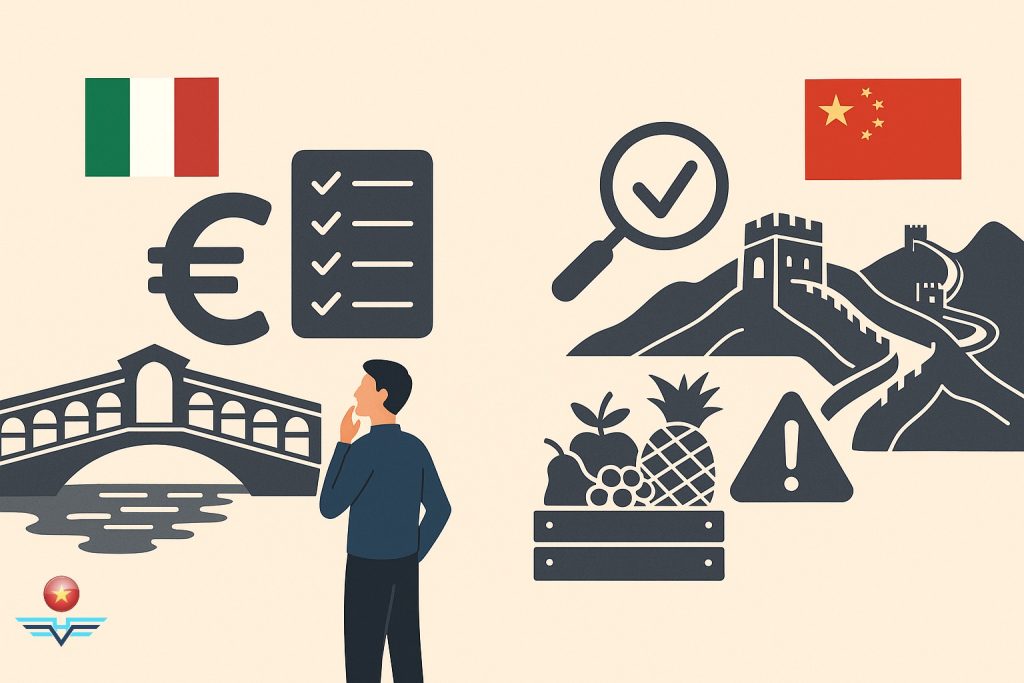
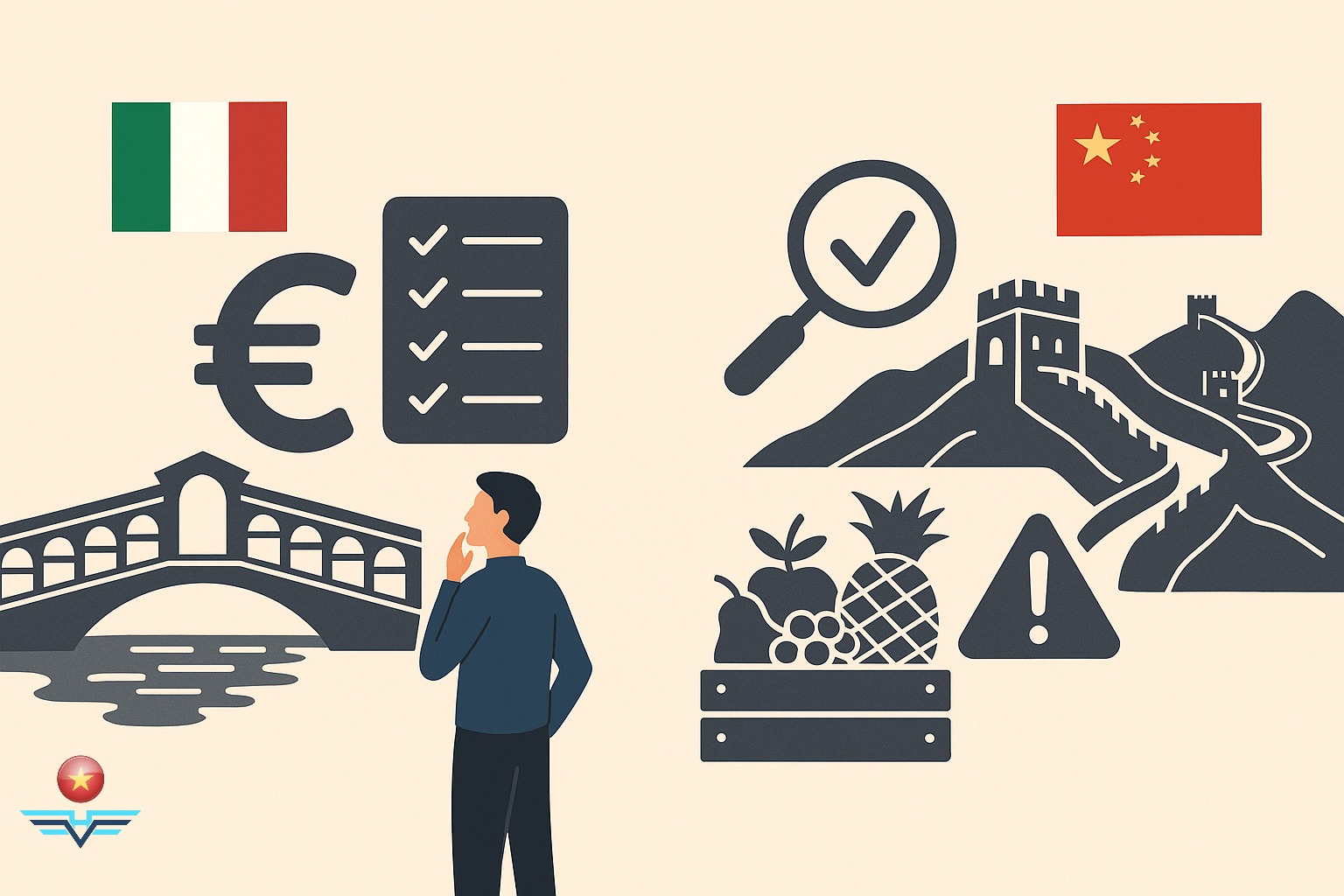
1. The Italian Market
-
The official currency in Italy is the Euro; the U.S. dollar is not widely accepted. Banks in Italy allow accounts to be opened in USD, but funds must be converted to Euros when used. All commercial banks are authorized to conduct foreign exchange transactions.
-
Italy, as a G7 country, has a large market with nearly 60 million residents and 60 million international tourists. Major Vietnamese corporations should pay greater attention to business opportunities in Italy.
-
The business habits of Vietnamese companies that often rely on Vietnamese communities in countries with large diasporas—such as Germany, the Czech Republic, or Romania—will not be effective in Italy. The country’s commercial tradition is long-established, with business networks built mainly with partners from Europe, South America, and Africa, regions that have many Italian or European-origin traders. As a result, it is difficult for new partners to gain their trust.
-
Vietnamese companies should exercise extreme caution when signing contracts, particularly with payment terms. The Vietnam Trade Office in Italy reports that it is currently handling multiple fraud cases involving Italian companies and Vietnamese exporters.
-
Many Italian company addresses are fake—when checked on-site, no such company offices exist.
-
Some Italian nationals collaborate with international scam groups, forging documents, including payment certificates, in attempts to seize original shipment documents and appropriate the goods.
-
Common fraud cases include Italian companies making a deposit, receiving goods, and then refusing to pay the remaining balance, or Vietnamese companies making advance payments but never receiving the goods.
-
-
The Vietnam Trade Office in Italy also points out that Vietnamese exporters face significant challenges in this market due to technical standards, certification regulations, packaging requirements, and a complex legal environment, which is sometimes lacking in transparency and efficiency.
Furthermore, products related to health, safety, or the environment are subject to very high technical and regulatory standards, sometimes even stricter than general EU requirements.
2. The Chinese Market
-
China now requires production area registration (growing regions must follow Good Agricultural Practices – GAP).
The Ministry of Agriculture and Rural Development of Vietnam is responsible for supervising and ensuring that no plant quarantine pests of concern to the General Administration of Customs of China (GACC) are present, while maintaining monitoring records and pest control documentation. -
Packaging facilities must establish quality management and traceability systems. After packaging, products must be stored in separate areas, not mixed with shipments intended for other markets, and must be subject to strict pest-control measures.
-
China has also issued clear warnings regarding violations:
-
Shipments without a valid phytosanitary certificate will be returned or destroyed.
-
Shipments from unregistered processing facilities, or those containing soil or live quarantine pests, will also be returned or destroyed.
-
-
To obtain a plantation code, farms must have an area of at least 10 hectares. This requirement poses a dilemma for Vietnamese businesses:
-
If they invest to obtain the code, it is financially burdensome;
-
But without the code, they cannot export.
Regarding packaging facility codes, China itself conducts inspections and issues the certifications. This creates barriers for Vietnamese enterprises, while favoring Chinese companies that are already operating in Vietnam.
Currently, most of the packaging facilities that meet the standards and hold registration codes are Chinese-owned or China-affiliated companies based in Vietnam.
-
-
In recent years, China has tightened import controls at border areas, enforcing stricter quarantine, inspection, and quality management for imported agricultural and food products.
As a result, small-scale border trade (informal trade) has become increasingly unstable and unsustainable, leaving fewer opportunities for Vietnamese agricultural and aquatic exports—especially those without traceability registration.