
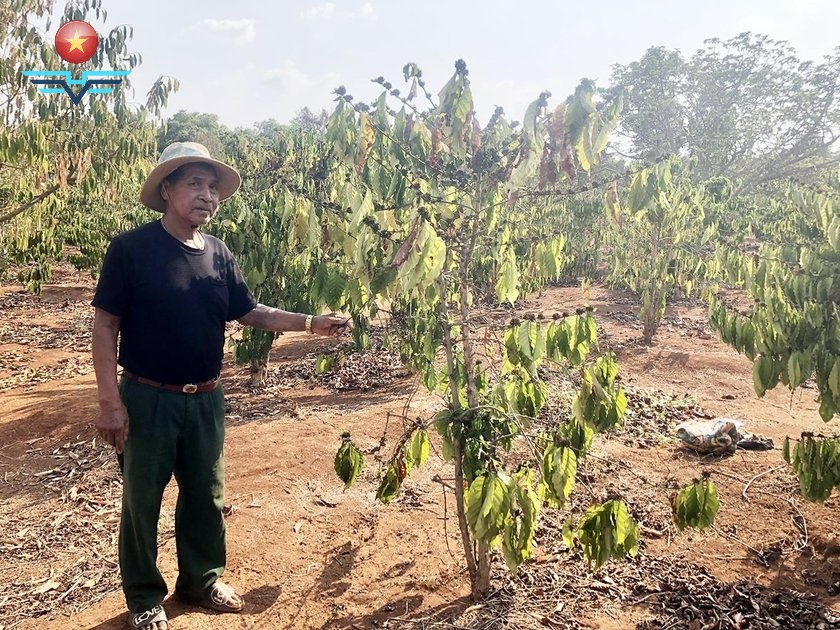
Gia Lai has received its first widespread rains of the season, bringing much-needed drought relief to thousands of hectares of crops—especially coffee and fruit trees. However, heavy showers accompanied by thunderstorms and whirlwinds have also caused damage to local communities.
“Golden” Rains Save Withering Crops
According to the Standing Office of the Provincial Steering Committee for Natural Disaster Prevention and Search & Rescue, many areas across the province have now had rain. Recorded rainfall levels include: 28 mm in the northwest (Ia Grai, Chư Păh, Đức Cơ), 75 mm in the central region (Pleiku City, Mang Yang, Đak Đoa), 72.2 mm in the southwest (Chư Prông, Chư Pưh, Chư Sê), 247 mm in the east (Đak Pơ, Kbang, Kông Chro, An Khê town), and 88 mm in the southeast (Ia Pa, Phú Thiện, Krông Pa, Ayun Pa town).
Since May 3, Ia Grai District has seen continuous widespread rainfall. For many coffee growers, these showers are “golden rains,” rescuing crops that were wilting, scorched, and losing branches.
Nguyễn Bá Tài of Tân An hamlet, Ia Sao commune, said: “My family manages more than two hectares of coffee. Water supplies were running out, and I couldn’t find a way to irrigate for the fourth round—then thankfully the rains came. These rains are like gold: they revived the coffee after months of intense heat and saved us the cost and effort of irrigation.”
Similarly, Nguyễn Hữu Nghị of Tân Lập hamlet, Ia Sao commune, explained: “Over a month ago, I could only complete the third irrigation before my pond dried up. This rain is invaluable; it saved over 700 coffee trees that were on the brink of leaf scorch.”
Rơ Mah Lel from Lung Prong village, Ia Kriêng commune (Đức Cơ District) reported that his two hectares of coffee intercropped with 200 durian trees were suffering. He had spent more than 70 million VND digging a 600 m², five-meter-deep pond to secure irrigation water. But after more than six months without rain, the pond dried up, coffee trees wilted with leaves burning from the tips, and the durian trees dropped all their young fruit. “The recent rain saved my coffee and durian from dying, but yields will still drop by 70–80% this year,” he said.
In Đak Đoa District, farmers were equally relieved. Nguyễn Kim Anh, head of the district’s Agriculture and Rural Development Office, noted that several days of heavy, widespread rain have lowered irrigation pressure and replenished water reserves for the next watering cycle should dry conditions return.
Warning of Extreme Weather
Trần Văn Đấu, deputy head of Agriculture and Rural Development in Kông Chro District, reported that between 6 and 8 p.m. on May 3, localized thunderstorms hit some areas. In An Trung commune, sudden heavy rain caused streams to rise quickly, flooding and washing away six cows and two buffalo in the Chiêu Liêu, Broch Siêu, and Brò villages. Landslides damaged roadside embankments and swept away six marker posts. Strong winds also tore roofing from the teachers’ housing at Chơ Glong Primary and Secondary School.
Likewise, Phan Đình Thắm, head of Agriculture and Rural Development in Ia Grai District, said that strong winds with the storm lifted the roofs of seven houses in Nú village (Ia Sao commune), collapsed the fence of Trần Quốc Toản Primary School (Ia Yok commune), and damaged two homes in Ia Tô commune on May 3.
The Central Highlands Meteorological and Hydrological Station forecasts that in the coming period, Gia Lai will experience average temperatures 1.5–2.5 °C above the long-term norm and total rainfall below average. Mid-to-late May could see localized heatwaves, mainly in the province’s southeast, possibly spreading to other areas. Afternoon and evening thunderstorms may trigger flash floods in small streams and landslides or ground subsidence in steep terrain.
Nguyễn Văn Huấn, head of the Forecast Division at the regional meteorological station, warned that more early-season rains will come with extreme weather such as thunderstorms, whirlwinds, lightning, and hail. Local authorities and residents are advised to monitor forecasts closely to minimize potential losses from natural disasters