
Economic Overview
Table of Contents
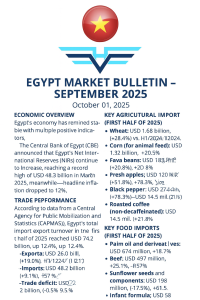
Egypt’s economy has remained stable with multiple positive indicators.
The Central Bank of Egypt (CBE) announced that Egypt’s Net International Reserves (NIRs) continued to increase, reaching a record high of USD 49.3 billion in August 2025. Meanwhile, headline inflation dropped to 12%, the lowest level since March 2022.
One of Egypt’s major sources of foreign currency — remittances — reached a record USD 36.5 billion in the 2024/2025 fiscal year, and rose sharply by 49.7% in the first seven months of 2025, reaching USD 23.2 billion, compared with the same period in 2024. This improvement was largely attributed to CBE’s flexible exchange rate policy, which contributed to stabilizing the foreign exchange market.
Trade Performance
According to data from the Central Agency for Public Mobilization and Statistics (CAPMAS), Egypt’s total import-export turnover in the first half of 2025 reached USD 74.2 billion, up 12.4% compared to the same period in 2024.
-
Exports: USD 26.0 billion (+19.0%)
-
Imports: USD 48.2 billion (+9.1%)
-
Trade deficit: USD 22.2 billion, a slight improvement (–0.6%) year-on-year.
Key Agricultural Imports (First Half of 2025)
Egypt’s major imported agricultural products included:
-
Wheat: USD 1.68 billion, –28.4% vs. H1/2024
-
Corn (for animal feed): USD 1.32 billion, +20.5%
-
Fava beans: USD 183 million, +20.8%
-
Fresh apples: USD 120 million, +51.8%
-
Black pepper: USD 27.4 million, +78.3%
-
Roasted coffee (non-decaffeinated): USD 14.5 million, +21.8%
Key Food Imports (First Half of 2025)
Some of Egypt’s major imported food products were:
-
Palm oil and derivatives: USD 674 million, +18.7%
-
Beef: USD 497 million, +25.1%
-
Sunflower seeds and components: USD 198 million, –57%
-
Condensed packaged milk: USD 95.6 million, –17.5%
-
Infant formula: USD 58 million, +61.5%