
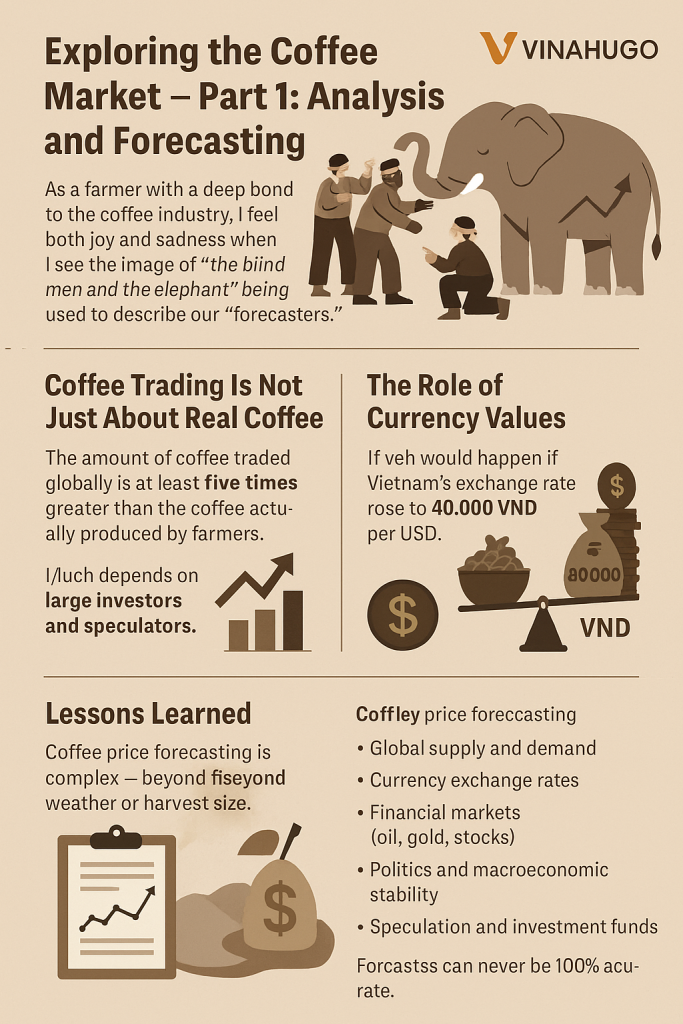
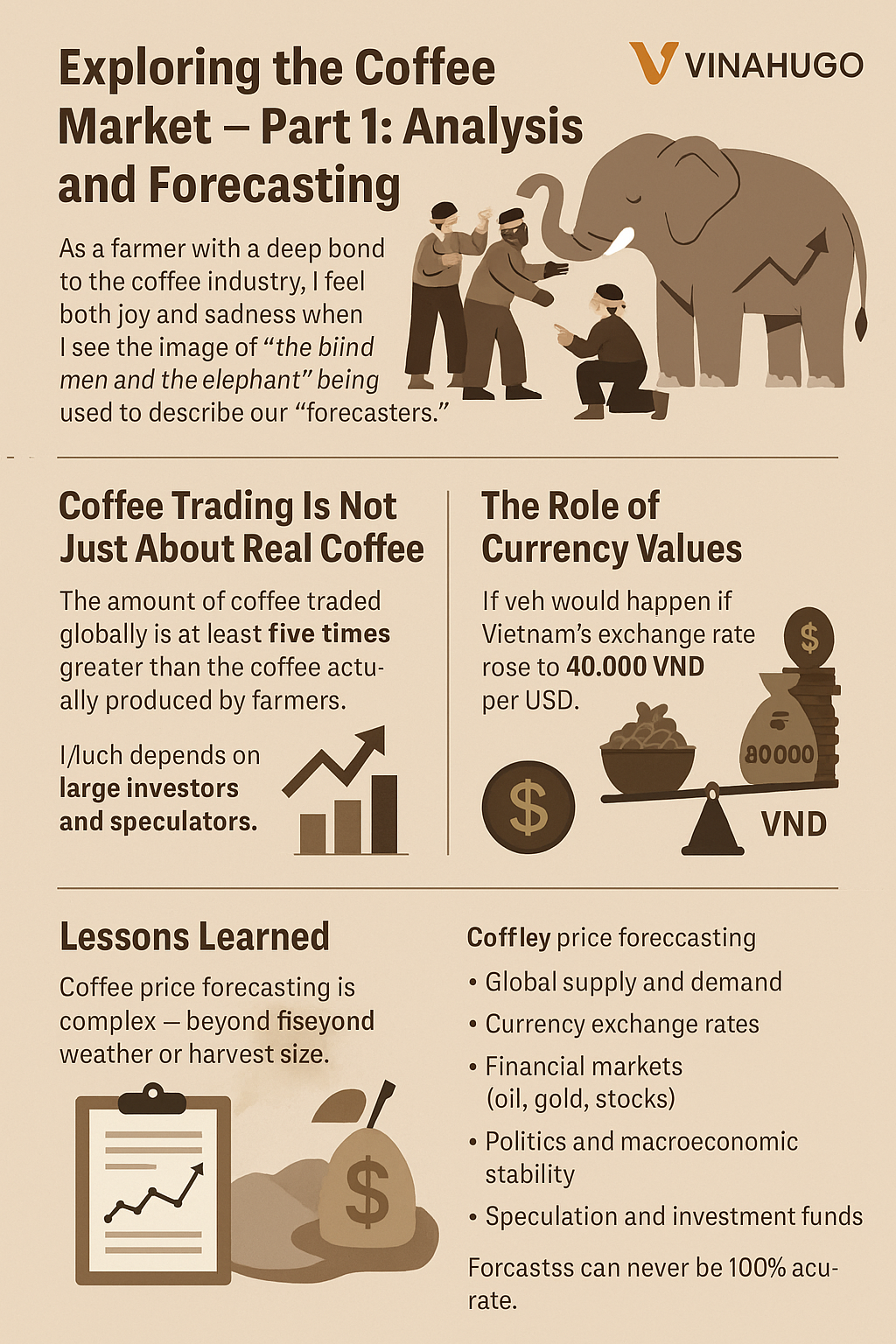
As a farmer with a deep bond to the coffee industry, I feel both joy and sadness when I see the image of the blind men and the elephant being used to describe our “forecasters.”
It is, in fact, a fitting metaphor for today’s situation. Many farmers have suffered bitter lessons because they trusted careless predictions. The author of the original article gave appropriate advice, and I fully agree that forecasting must be done with seriousness, responsibility, and careful research.
I do not intend to “defend” the forecasters on the internet, but forecasting truly requires investment in input data and a systematic approach, not simply guessing. Only with solid information can forecasts earn credibility.
Coffee Trading Is Not Just About Real Coffee
Table of Contents
The amount of coffee traded globally is at least five times greater than the coffee actually produced by farmers. For example, the 2009 world crop was about 127 million bags, yet that same bag of coffee could be traded multiple times between A, B, and C—and every transaction counted.
This means forecasting coffee prices is not only about whether Brazil suffers frost or Vietnam faces drought. Much depends on large investors and speculators. Their positions—whether they are buying, selling, or holding “paper coffee” contracts—have massive impact on prices.
Therefore, technical analysis and market news must be taken seriously. Coffee, in today’s market, is treated more like a financial instrument than an agricultural crop.
The Role of Currency Values
Currency fluctuations are one of the strongest drivers of coffee prices.
Imagine if Vietnam’s exchange rate suddenly rose to 40,000 VND per USD. Even without any change in global prices, domestic coffee would immediately double in price in local currency, prompting mass selling. This surge in supply would push international coffee prices down.
This has happened before. In 1998–2000, when Brazil’s real fell sharply to more than 3 reals per USD, farmers rushed to sell. The oversupply crisis deepened, and coffee farmers in Vietnam and elsewhere were hit brutally hard.
Another case occurred during the 2000 U.S. presidential election, when the uncertainty weakened the USD. Investors holding stronger currencies (like euros and pounds) converted to dollars and bought coffee, pushing prices upward again. Many traders, including myself, who had expected prices to keep falling, suffered heavy losses because our analysis was shallow and our forecasts wrong—like the blind man touching only the elephant’s ear and calling it a fan.
Lessons Learned
Coffee price forecasting is extremely complex. It goes beyond weather or harvest size. It is influenced by:
-
Global supply and demand
-
Currency exchange rates
-
Financial markets (oil, gold, stocks)
-
Politics and macroeconomic stability
-
Speculation and investment funds
Those who forecast must carefully analyze all these factors. And even then, forecasts can never be 100% accurate.
In the next installment, I will continue with: Updating, Compiling, Analyzing Information, and Making Assessments – Part 2. (To be continued.)
Author: Kinh Vu (Giacaphe.com)
Community Discussion & Insights
Cao Tran
A very good article. It helps readers understand that analysis and forecasting go beyond “up or down” questions. What really matters is knowing what to study to be proactive in the market.
Nguyen Van Toan
It’s always the farmers who suffer. Businesses should share more with them instead of taking all the profit.
Laba Cafe
Great explanation of how currency values impact coffee. Do you think today’s price moves are due to currency, supply–demand, or speculation?
Caphesua (Yahoo user)
Currency is important, but not everything. Coffee prices also depend on speculation, supply–demand, and policy. For example, if world prices fall sharply, farmers may still lose even with a weaker local currency. Looking forward to Part 2.
Vo Vi
Are you really a farmer? If yes, that’s impressive. Your analysis is sharp.
Hoang Hoa
Forecasting in business is top secret. Why publish it openly? Likely to mislead farmers and benefit buyers. Public forecasts are often smokescreens (“hỏa mù”). I don’t trust them.
Cao Tran (replying)
Forecasting requires analysis and effort. Even if predictions are sometimes wrong, we should still appreciate those who share insights.
Laba Cafe (replying)
The article is very good but still incomplete. Coffee prices are influenced by many factors—supply, financial markets, politics—not just currency. The hardest part is quantifying which factor dominates at which moment.
Pham Chon
If forecasts were right even 70% of the time, analysts would be rich traders, not salaried workers. One 100% correct call could already make you enough to buy a house in Saigon.
Nong Dan Ngheo (Poor Farmer)
I didn’t study much, but I enjoy these debates. Please keep them polite so farmers can still learn and not get discouraged.
Laba Cafe (further note)
Forecasting types:
-
Prediction (intuition, signs)
-
Guessing (scattered data, ~50–60% accuracy)
-
Forecasting (identified rules, 80–99% accuracy)
Most Vietnamese farmers rely on prediction; a few dealers guess; only large companies can really forecast.
Le Quang Hieu
If you don’t record and analyze, it’s just guessing. With data and analysis, it becomes forecasting.
Other voices
-
Some warned public forecasts are meant to lower prices and benefit exporters.
-
Others said the key is to improve farmers’ access to accurate, timely information.
-
Several agreed the article is highly valuable, combining theory with real-life examples.