
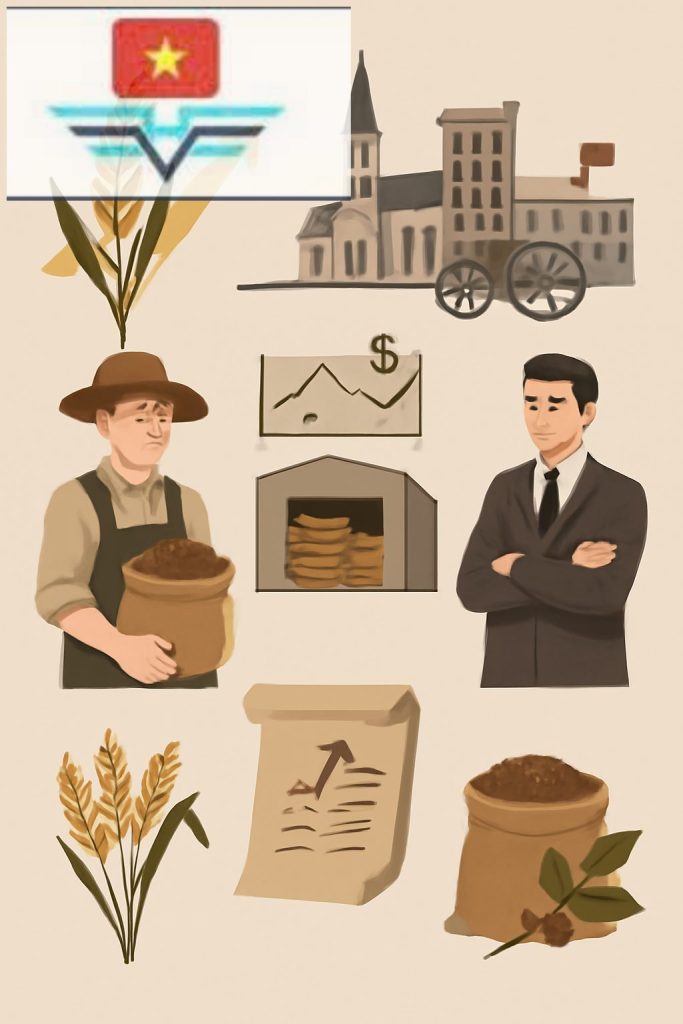

I – The Birth of the Futures Market
Table of Contents
There is still much debate about the origins of the futures market, or the futures exchange. However, many people agree on several key points, notably that the futures market began around the 17th century with Japan’s rice market.
In the 1840s, Chicago became a major trade center in the United States. During this time, McCormick’s invention of the wheat harvester greatly increased wheat production in the U.S. As a result, farmers from all over the country gathered in Chicago to sell their products. American farmers faced many challenges in production, storage, or selling their goods due to factors such as weather, transportation, etc., which influenced supply and demand. When prices went up, farmers were eager to increase production, but when prices dropped, a mass liquidation of goods occurred.
Gradually, this activity became so intense that there was almost not enough warehouse space to store the wheat. In addition, the lack of proper methods for weighing and classifying goods led farmers to be at the mercy of traders. Similarly, traders also faced significant risks in their business due to price fluctuations caused by weather, transport, etc.
The need to mitigate or limit these risks became urgent. Through pre-agreed price contracts, both buyers and sellers could hedge against future price volatility. This allowed farmers to set a guaranteed price for the goods they would produce without worrying about a glut of supply that could lead to lower prices, damaging their livelihoods. Traders acting as intermediaries between farmers and consumers no longer had to worry about adverse price fluctuations when they might have to buy at high prices and sell at low prices unexpectedly.
However, the system where buyers and sellers met to negotiate future deals regarding price and delivery dates proved inefficient. This created the demand for a market intermediary, which marked the beginning of the development of the futures market.
In 1848, 82 traders came together in Chicago to establish the Chicago Board of Trade (CBOT). There, farmers and traders could engage in spot trading, buying and selling wheat according to quantity and quality standards set by the CBOT. However, the transactions at CBOT were initially only a form of commodity exchange, where goods were exchanged for payment, and the relationship between the parties ended there. Within a few years, a new type of contract emerged: an agreement between parties to buy or sell a standardized quantity of wheat at a specific time in the future. This way, farmers knew what they would receive for their crops, and traders had an idea of their expected profits. The two parties signed a contract and paid a deposit known as the “margin.” This form of buying and selling was the precursor to the forward contract.
As time passed, this form of transaction became increasingly popular, to the point where banks allowed these contracts to be used as collateral for loans. People began to buy and sell these contracts before they were settled. If a trader did not want to buy wheat, they could sell the contract to someone else, or if a farmer did not want to deliver, they could transfer the obligation to another farmer. The price of the contract would rise or fall depending on the wheat market’s developments. If bad weather affected the crop, the seller of the contract would profit because the supply would decrease, thus driving up the price. If the harvest exceeded expectations, the contract price would drop because buyers could purchase wheat directly on the free market. Over time, the rules for these contracts became more stringent, and people gradually stopped trading forward wheat contracts and started creating futures contracts. The cost of trading the new futures contracts was much lower, and they allowed traders to hedge against price fluctuations on their goods.
From that point on, farmers could sell wheat in three ways: on the spot market (Spot/Forward), on the futures market (Forward), or through futures contracts.
The history of futures trading did not stop there. In 1874, The Chicago Produce Exchange was established and later became the Chicago Mercantile Exchange (CME), which traded a variety of other commodities and became the largest futures market in the U.S.
In 1972, CME established The International Monetary Market (IMM), the first global market to trade currency. Following this, various financial futures contracts emerged, such as interest rate futures and stock index futures.
Today, futures markets have expanded far beyond agricultural commodities and have become crucial financial instruments to hedge against price fluctuations in traditional goods, as well as one of the most effective investment tools in finance. Futures markets now operate continuously through the Globex system, connecting 12 major financial centers worldwide. The price changes in commodities occur every second, impacting not only national economies but also regional and global markets.
Futures Contract
1. Definition
Currently, in Vietnam, there are many terms used for this type of contract, such as: Futures contract, forward contract, future contract, futures contract, etc. However, regardless of the name, the nature of the futures contract remains unchanged. In this document, we will use the term FUTURES CONTRACT.
“A futures contract is an agreement created on an organized exchange to buy or sell a standardized commodity at a specific date in the future at a price determined at the current time.”
There are two types of futures contracts:
-
Futures contracts settled upon delivery: This type of contract involves actual delivery at the agreed-upon time of delivery. Essentially, this contract is similar to a forward contract.
-
Futures contracts settled before the delivery date: This type of contract does not involve actual delivery. The parties terminate their obligations with each other through a settlement process, meaning they buy back or sell the commodity in reverse to their original position. This is the more common type, which allows futures trading to exist.
2. Characteristics
-
The terms in futures contracts are standardized.
-
To ensure high-speed, large-volume transactions that are safe, futures exchanges set strict rules to standardize the contract terms as much as possible. Standardized elements in futures contracts include: the commodity name, quality, contract size, delivery dates, price terms, trading times, trading methods, margin requirements, the first notice day, and the last trading day.
-
Commodity name must be the specific commodity allowed on the exchange. It may be a standard commodity or financial instruments like stocks, bonds, interest rates, indices, etc. Each exchange only trades specific commodities.
-
Commodity quality is also standardized. Commodities are divided into various quality grades, but exchanges typically allow only a few specified grades.
-
Contract size: This is the quantity of each type of commodity in one contract. For example, a gold contract may be 100 ounces, crude oil 1,000 barrels, Japanese yen 12.5 million ¥, arabica coffee 37,500 pounds (on NYMEX), robusta coffee 5 tons (on LIFFE), etc.
-
Delivery date: This is usually the specific month in which delivery occurs. In that month, the exact delivery day is specified depending on the commodity and market.
-
Delivery location is determined by the exchange. The delivery happens when both parties wish to execute the contract.
-
Margin: To participate in futures trading, participants must comply with margin requirements. This deposit guarantees their obligations when a trade is executed.
-
First notice day and last trading day will be discussed in more detail in the next sections.
3. Common Terms
-
Ask Price: The price at which a seller offers to sell on the market.
-
Bid Price: The price at which a buyer is willing to purchase on the market.
-
Backwardation: A market situation where prices for future months are lower than those for nearby months.
-
Contango: A market situation where prices for future months are higher than those for nearby months.
-
Bear Market: A market in a downward price trend.
-
Bull Market: A market in an upward price trend.
-
Long Position: A position where the futures contract is bought (positive position).
-
Short Position: A position where the futures contract is sold (negative position).
-
Long Liquidation: Closing a long position by selling an equivalent amount.
-
Short Covering: Closing a short position by buying back an equivalent amount.
-
Margin Call: A request to add more margin to meet market requirements.
-
Settlement Price: The price (usually the closing price) used by the exchange to determine margin calls.
-
First Notice Day: The first day a position holder must settle their long position or face physical delivery.
-
Last Trading Day: The last day a short position holder must settle or face physical delivery.