
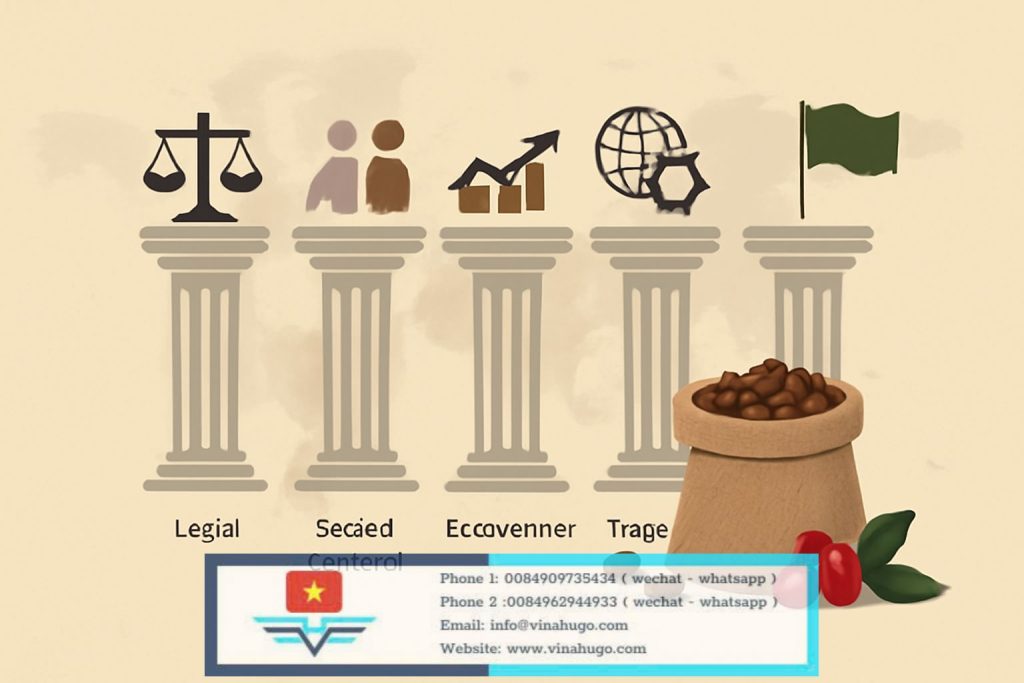
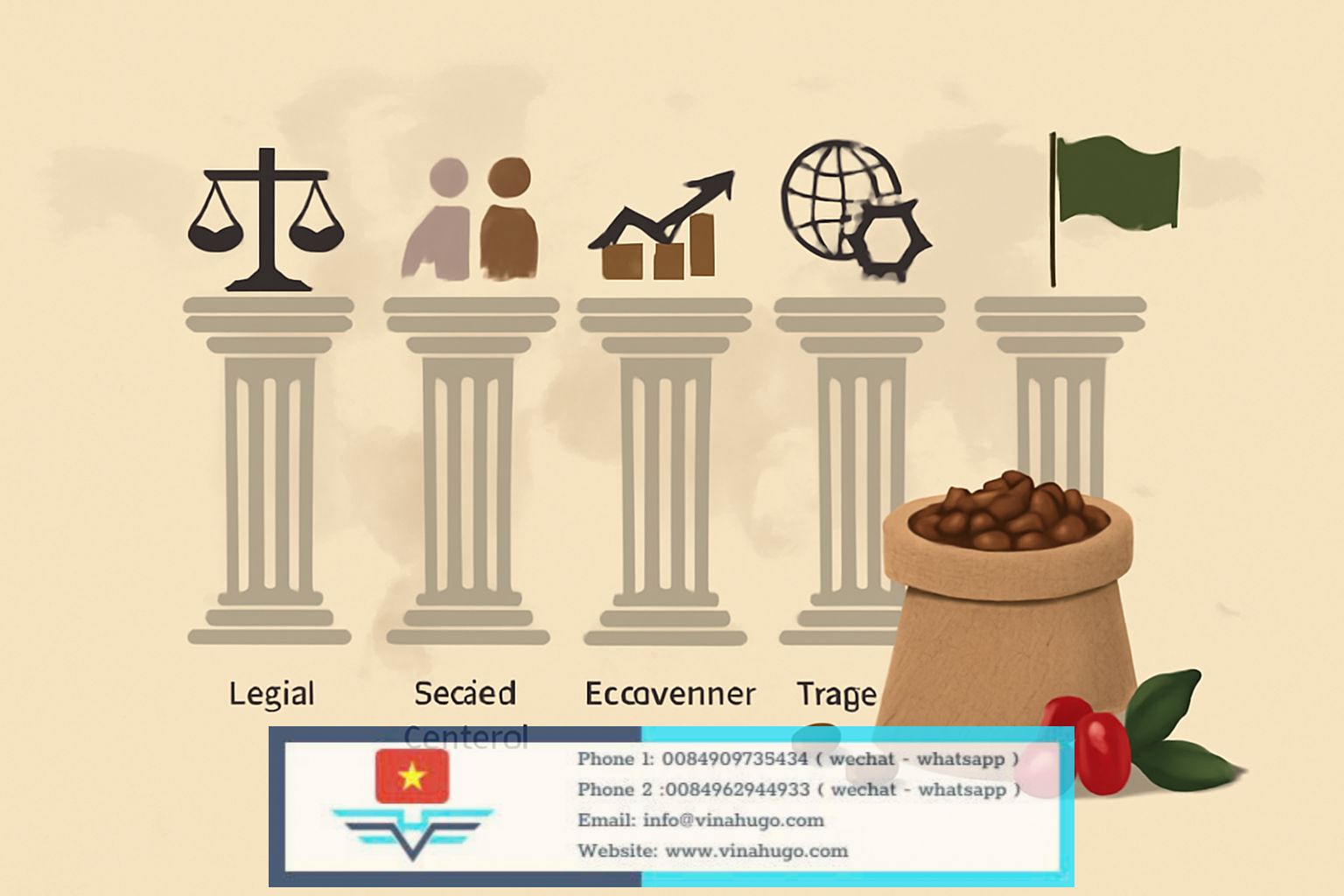
Macro-environmental Factors
Table of Contents
The macro-environment is a broad and comprehensive environment that encompasses activities within both national and international scopes. Since exporting is a complex activity that involves many different stakeholders, not only is it about the relationship between national businesses but also the relationship between countries. If not tightly controlled, it can lead to serious consequences. Therefore, it is important to analyze factors that affect the macro-environment. Each country has a different political system, culture, legal system, and economic policies. This means any international business unit must thoroughly research and understand these aspects.
Legal Factors
This includes the set of laws that affect export activities. Every country has its own legal system, thus there are different regulations regarding export activities. For coffee exports, the following factors influence the industry:
-
Tax regulations, pricing, coffee varieties, and volume of imported coffee: Currently, Vietnam doesn’t benefit from WTO privileges, so it faces high taxes. This makes it difficult to reduce costs to compete with other producers.
-
Labor regulations, wages, bonuses, and welfare benefits: The coffee industry employs a large workforce, including various groups of people. Therefore, wage policies need to be diverse, depending on the stage of coffee production. For coffee farmers, specific policies on prices and protectionism should be in place to give them more security in production. For export staff, appropriate wage policies and necessary tools to access global market information are required.
-
Regulations on export contracts: These include coffee prices, quantity, and transport methods used for coffee exports. Typically, we calculate FOB prices at the Saigon port when exporting contracts, with containers as the primary transportation method.
-
Regulations on free trade or the construction of strict tariff barriers: Vietnam does not enjoy free trade regulations because it is not a member of these organizations, and it is not yet a member of the WTO.
Thus, legal factors are important because if businesses don’t understand the regulations of the importing countries, they will face many risks.
Cultural and Social Factors
Different cultures also affect the way goods are exported and imported. The culture of a country has been formed over time and becomes a habit for its people. Exporting coffee brings Vietnamese culture to the importing countries. If we insist on keeping Vietnamese culture, it may sometimes hinder exports to EU markets. The EU highly values the origin of coffee, but in Vietnam, coffee production is scattered and often collected from small units and households. This makes it difficult for Vietnam to label the origin of its coffee.
The aim of exports is to meet the needs of the importing countries. Therefore, Vietnamese coffee must align with the needs of consumers in those countries. This requires balancing Vietnamese culture with the culture of the importing country. Cultural factors are influenced by customs and traditions of each country—whether they prefer instant coffee, black coffee, or filtered coffee. Hence, it is essential to study these preferences and create an appropriate export policy.
Economic Factors
This includes economic policies, diplomatic agreements, and exchange rates.
-
Economic policy tools of both the importing countries and Vietnam help create the most suitable business environment. Vietnam has a market-oriented economic policy with a strong focus on exports, especially coffee. The government provides many advantages for the coffee sector, making it favorable for coffee exports. Moreover, the EU’s policy shift towards investment in Asia also provides Vietnam with significant advantages in the export of goods, particularly coffee.
-
Income levels and living standards: When people’s living standards are high, the decision to buy coffee is less influenced by price fluctuations. In contrast, with lower income, price becomes a more significant factor. The EU market, with its higher income levels, does not prioritize low prices; sometimes, higher prices are used as indicators of product quality. In Vietnam, lower prices are the deciding factor in purchasing coffee. If the price drops, farmers are likely to switch to growing other crops, affecting coffee supply.
-
Natural resources and resources: This affects exporting businesses. Only when there are sufficient resources can export activities be carried out. Vietnam has a natural advantage in coffee production. The combination of favorable weather conditions, a large workforce, and long experience in coffee production creates a distinct taste, enabling Vietnam to lower export costs and boost coffee exports.
Technological Factors
Technological factors are closely related to economic activities in general and coffee exports in particular. The development of technology has made trade between partners easier. The global Internet helps constantly update market information. Businesses can advertise their products with minimal costs.
However, in the coffee production sector, Vietnam still lacks machinery and equipment, which affects the quality and consistency of the coffee supply. This becomes a challenge for coffee exports.
If the country applies technology effectively, it will be able to better integrate into the global market. But if it does not, it will lag behind other countries in terms of technical skills, affecting its competitiveness.
Political Factors
Political stability is crucial in expanding market reach and increasing the size of the coffee market. However, political instability can create significant barriers to exports. Vietnam has a relatively stable political environment, which provides a good condition for coffee production and attracts investors who rely on stable sources of supply.
The EU, which consists of politically stable countries with clear economic development strategies, helps Vietnam secure a steady market for its coffee.
International Competition
International competition is fierce and intense. For Vietnam’s coffee export to survive and thrive, it must succeed in competing in terms of price, quality, and reputation. This is a major challenge for Vietnam. Competitors like Brazil not only have economic and political power but also form large groups, creating monopolistic market strength. These large economic groups control markets, which creates a significant barrier to Vietnamese businesses. Therefore, Vietnamese businesses must build strong brands, maintain reasonable pricing, and increase the quality of coffee to successfully compete internationally.
Micro-environmental Factors
These factors directly influence the coffee exports of Vietnamese businesses. A well-coordinated combination of micro-environmental factors will make import-export activities easier and allow deeper penetration into global markets.
Key factors in the micro-environment include:
-
Finances: The Vietnam Coffee Corporation is a large state-owned enterprise with:
-
Existing infrastructure: This reflects the production capacity of the enterprise, including material resources for production, financial resources serving production, and its ability to serve future needs. The Vietnam Coffee Corporation has 53 independent operational units, including 6 specialized import-export companies, 40 agricultural units, 2 coffee processing plants, and 5 companies in other sectors.
-
Human resources: The corporation employs 26,000 people, with 23,500 in production and 2,500 in business operations. The management team is highly skilled, and their expertise helps develop export strategies for the corporation. The workforce is experienced, hardworking, and eager to apply new technologies.
In conclusion, coffee export businesses are influenced by both external factors in the international market and internal factors within the company. To succeed, businesses must study both the international market environment and the internal conditions within the company. By improving infrastructure, training skilled workers, and adapting to changing business environments, Vietnamese coffee companies can leverage their competitive advantages and capture new export opportunities.