
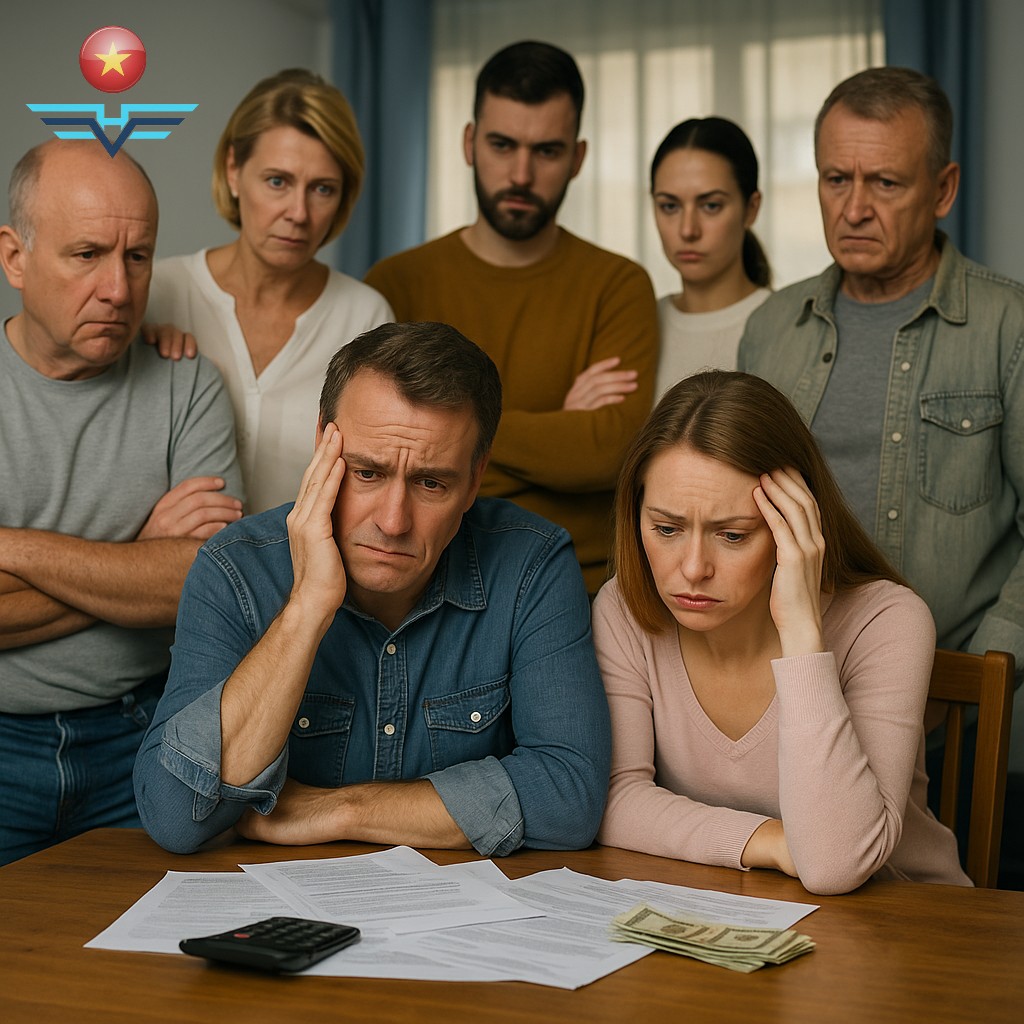
For more than a year, the lives of five village officials in Cuôr Knia Commune, Buôn Đôn District (Đắk Lắk) have been turned upside down by a “heaven-sent” debt. Acting as intermediaries to distribute fertilizer to farmers on credit, as encouraged by the commune, they were left owing over 1.3 billion VND when farmers refused to pay after discovering the fertilizer was of poor quality.
A Sudden Burden of Debt
In 2008, the Cuôr Knia People’s Committee introduced a program to help farmers buy fertilizer on credit—paying 50% upfront and the rest at the end of the year. The policy was welcomed by locals. Farmers registered through the commune and received confirmation from Le Quang Tam, then Vice Chairman of the commune.
Between March and June 2008, Mr. Tam, acting personally, received 180 tons of fertilizer from Phu My Production–Trading–Service JSC (Dong Nai) and Viet My Investment & Technology Development JSC (Binh Duong) to distribute across Ea Bar, Ea Nuôl, and Cuôr Knia communes.
Of this, 120 tons allocated to Cuôr Knia were distributed via five village officials—Cao Minh Ha, Luu Thanh Giap, Pham Van Tran, Cao Quang Nam, and Le Xuan Su.
Farmers applied the fertilizer to their coffee trees only to see no effect: yellowing leaves and premature fruit drop. When mixed with water, the fertilizer turned out to be mostly sand and clay.
Village leaders sent samples to the Tay Nguyen Institute of Agricultural and Forestry Science for analysis.
Results showed shocking deficiencies:
-
Viet My’s NPK 16.16.8.13S: only 3.5% nitrogen, 9.86% phosphorus, 1.93% potassium, 1.08% sulfur.
-
Phu My’s NPK 16.8.16.13S: 5.6% nitrogen, 3.12% phosphorus, 4% potassium, 5.15% sulfur.
Because the fertilizer was substandard, farmers refused to pay the remaining balance. The case was reported to higher authorities, seeking compensation from the companies. Buôn Đôn District Police took samples for testing but never announced the results.
Meanwhile, the fertilizer suppliers disappeared and Mr. Tam casually suggested “writing off the debt.” But in late 2011, after being dismissed and expelled from the Party for other violations, Tam suddenly sued the five village officials in the Buôn Đôn District People’s Court, demanding repayment of the outstanding amount.
In the first-instance trial on 7–8 January 2012, the court accepted Tam’s lawsuit and ordered the five officials to repay nearly 1.3 billion VND (including principal and 1.5% interest). The former intermediaries now faced debts ranging from about 70 million VND each to nearly 400 million VND, despite only acting as distributors for the commune’s program.
“I have been village head for over ten years and never took a single dong from the people,” said Pham Van Tran bitterly. “Now I owe hundreds of millions—selling my house would not cover it.”
Cao Minh Ha added angrily: “We supported the commune’s plan to help farmers, but we ended up in debt ourselves.”
Appeal and Legal Loopholes
The defendants appealed. On 10–11 July 2012, the Dak Lak Provincial People’s Court overturned the first-instance verdict (No. 02/2011/DSST), sending the case back for further investigation.
The appellate court found that the first-instance court had failed to involve the Cuôr Knia People’s Committee and the fertilizer buyers in the proceedings, even though the fertilizer-on-credit scheme originated from the commune and all farmers’ registrations were approved by Mr. Tam.
Farmers received the fertilizer and paid money; the village officials merely acted as intermediaries, collecting payments to pass on to Tam for a small commission.
Moreover, investigators waited too long to send fertilizer samples for analysis: though Buôn Đôn Police collected samples in July and October 2008 (before expiration), they only sent them to the Ministry of Public Security’s Forensic Institute on 17 September 2009, when the fertilizer had already expired.
The fertilizer companies also failed to provide crucial evidence—production processes, quality inspection reports—proving the batch supplied to Cuôr Knia met standards. Around the same time, Phu My Company sold hundreds of tons of fertilizer to farmers in Ea Hiao Commune (Ea H’leo District); when poor quality was discovered, disputes arose. At the Ea H’leo District Court, Phu My leaders admitted fault and did not collect payment from farmers there.
Legal Opinions
According to lawyer Ta Quang Tong, Vice Chairman of the Dak Lak Bar Association, under Vietnam’s commercial law, to sell packaged fertilizer under contract, Mr. Tam needed a licensed business and proper invoices, which he did not have.
“If this was counterfeit fertilizer, Mr. Tam helped distribute fake goods, causing consumer harm, and farmers have the right to claim damages. The commune should only have acted as a guarantor; the companies should have signed sales contracts directly with the farmers.”
The policy of allowing farmers to buy fertilizer on credit was sound, helping meet investment needs for the growing season. But loose implementation led to legal disputes and public outrage. Authorities and the Buôn Đôn District People’s Court must resolve the case promptly to uphold the law and protect farmers’ rights.