

Key Nutrients and Their Roles
Table of Contents
-
Nitrogen (N): Promotes vigorous growth, more shoots, abundant flowering and larger berries. Deficiency: yellow leaves, stunted growth. Excess: overly lush foliage, higher disease risk, fewer fruits.
-
Phosphorus (P): Encourages strong root development, better nutrient uptake and drought tolerance. Deficiency: poor root growth and low fruit set.
-
Potassium (K): Strengthens stems, improves resistance to pests and weather stress, enhances berry quality. Deficiency: poor nitrogen uptake, flower drop.
-
Calcium (Ca): Works as both a secondary nutrient and a natural disease suppressant. Apply 0.5–1 kg lime per plant every two years (more for plants on concrete posts).
-
Magnesium (Mg): Vital for chlorophyll formation. Supply with 1 % magnesium sulfate solution (1–2 liters per plant) or foliar micro-nutrient sprays.
-
Organic matter: Organic manures naturally contain macro-, secondary- and micro-nutrients. If unavailable, supplement with bio-organic or microbial fertilizers at about 2 tons/ha/year.
Tip: Foliar nutrient sprays every 2–3 months help maintain balanced micronutrient levels.
Annual Fertilizer Program for Mature Black Pepper
Recommended for 2,000 plants per hectare:
| Fertilizer | Total Rate (kg/ha/year) |
|---|---|
| Urea (N) | 400 kg |
| Superphosphate (P) | 300 kg |
| Potassium chloride (KCl) | 250 kg |
Divide into four applications:
-
After harvest (April)
-
All organic manure
-
1/3 N + 1/4 P + 1/4 K
-
→ ~130 kg urea + 100 kg superphosphate + 60 kg KCl
-
-
Early rainy season (June)
-
1/3 N + 1/4 P + 1/4 K
-
→ ~130 kg urea + 100 kg superphosphate + 60 kg KCl
-
-
Mid rainy season (August)
-
1/3 N + 1/4 P + 1/4 K
-
→ ~140 kg urea + 100 kg superphosphate + 60 kg KCl
-
-
Late rainy season (October)
-
1/4 P + 1/4 K
-
→ ~100 kg superphosphate + 70 kg KCl
-
Application Technique
-
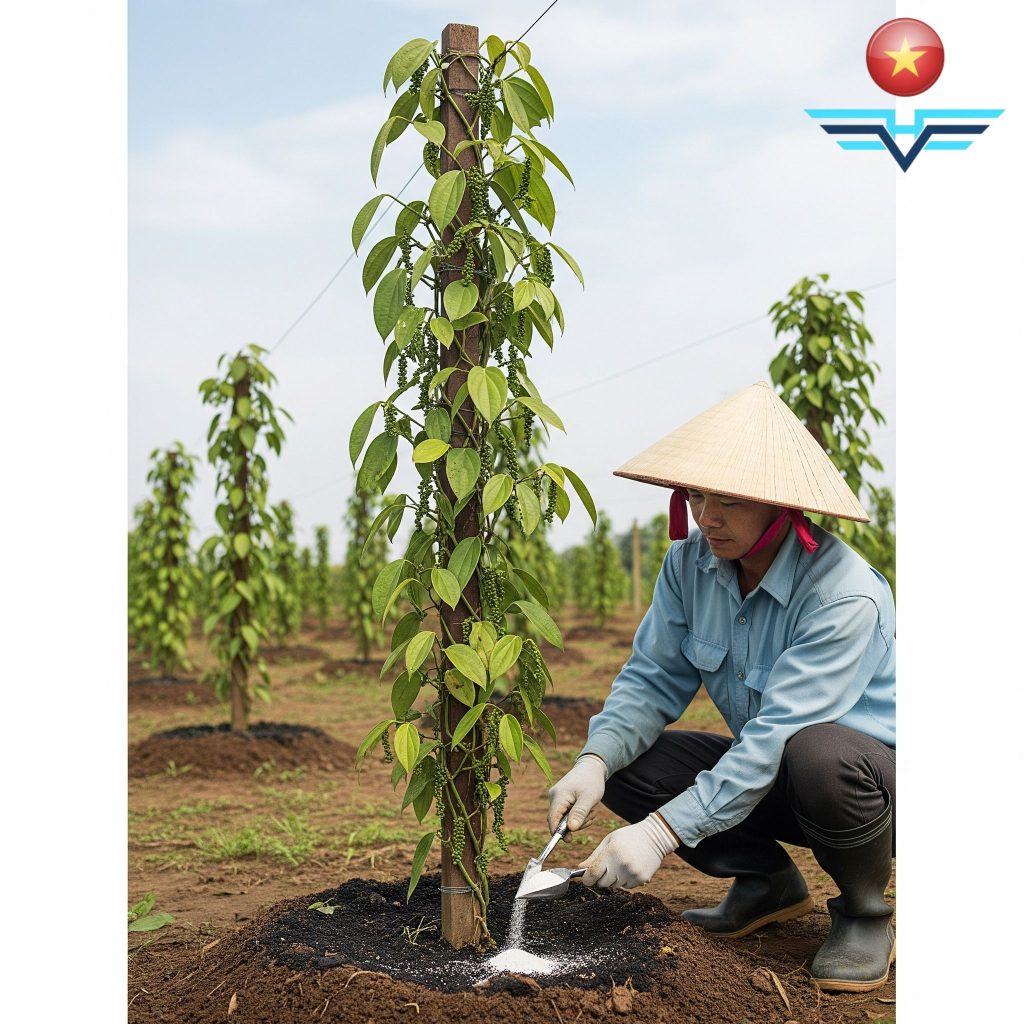
Lightly till a shallow trench 5–10 cm deep, 40–60 cm away from the base.
-
Spread fertilizer evenly, then cover with soil immediately.
-
Adjust rates to local soil fertility and plant vigor.
-
Where needed, add bio-stimulants, vitamins, amino acids or NPK+TE formulations suited to each growth stage.
Takeaway
Balanced, staged fertilization—combining organic manure, key macro nutrients (N-P-K) and timely micronutrient supplements—supports strong pepper vines, high yields and long-term soil health.